
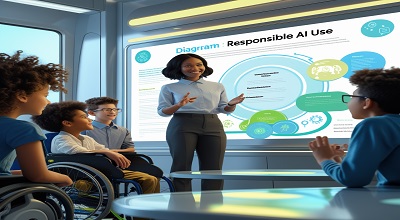
Responsible AI Use in Teaching
Responsible AI Use in Teaching: Artificial Intelligence (AI) is transforming education by providing personalized learning experiences, automating administrative tasks, and enhancing student engagement. However, with great power comes great responsibility. Responsible AI use in teaching ensures that AI tools are ethical, fair, transparent, and beneficial for all stakeholders—students, teachers, and institutions.
In this blog post, we will explore the latest examples of AI in education, discuss ethical concerns, and provide best practices for responsible AI adoption in classrooms.
Why Responsible AI Matters in Teaching?
AI can revolutionize education, but misuse can lead to:
- Bias and discrimination (if AI models are trained on biased data)
- Privacy concerns (student data misuse)
- Over-reliance on automation (reducing human interaction)
Responsible AI ensures:
✅ Fairness – AI should not favor any group.
✅ Transparency – Teachers and students should understand how AI decisions are made.
✅ Accountability – Institutions must monitor AI tools for ethical compliance.
Key Principles of Responsible AI in Education
To use AI responsibly, educators should follow these principles:
A. Fairness and Inclusivity
AI should support all students, including those with disabilities or from diverse backgrounds.
B. Transparency and Explainability
AI decisions (e.g., grading, recommendations) should be explainable to teachers and students.
C. Data Privacy and Security
Student data must be protected under regulations like GDPR and FERPA.
D. Human-in-the-Loop (HITL)
AI should assist, not replace, teachers. Educators must oversee AI-driven decisions.
Examples of AI in Teaching (Latest Applications)
A. Personalized Learning with AI
- Example: Knewton Alta adapts lessons based on student performance.
- Duolingo uses AI to customize language learning paths.
B. Automated Grading & Feedback
- Example: Gradescope helps teachers grade assignments faster using AI.
- Turnitin’s AI detector identifies AI-generated essays.
C. AI-Powered Tutoring Systems
- Example: Squirrel AI (China) provides one-on-one AI tutoring.
- Carnegie Learning’s MATHia offers real-time math assistance.
D. AI Chatbots for Student Support
- Example: Georgia State’s “Pounce” chatbot reduces dropout rates by answering student queries 24/7.
E. AI in Special Education
- Example: Microsoft’s Immersive Reader helps dyslexic students with text-to-speech.
Ethical Considerations When Using AI in Classrooms
- Bias in AI: If an AI tool is trained on non-diverse data, it may disadvantage minority students.
- Surveillance Concerns: AI-powered proctoring tools (like Proctorio) may invade student privacy.
- Dependence on AI: Overuse may reduce critical thinking skills.
Solution: Regular audits, diverse training data, and teacher oversight.
Challenges and Risks of AI in Education
| Challenge | Risk | Solution |
|---|---|---|
| Data Privacy | Student data leaks | Use encrypted AI tools |
| Algorithmic Bias | Unfair grading | Test AI models for bias |
| Job Displacement | Teachers fear replacement | Use AI as an assistant, not a replacement |
Best Practices for Implementing AI Responsibly
✔ Train teachers on AI tools before deployment.
✔ Use explainable AI (avoid “black box” systems).
✔ Obtain consent before collecting student data.
✔ Regularly audit AI systems for fairness and accuracy.
Future of AI in Education: Trends and Predictions
- AI-generated lesson plans (e.g., MagicSchool AI)
- Virtual reality (VR) + AI classrooms
- Predictive analytics to identify at-risk students early
Conclusion
AI has immense potential in education, but responsible use is crucial. By following ethical guidelines, ensuring transparency, and keeping human oversight, educators can harness AI’s power without compromising student welfare.
Free Download: Cake Vs Demons APK