
NYC Boosts Teacher Pay to Attract New Educators
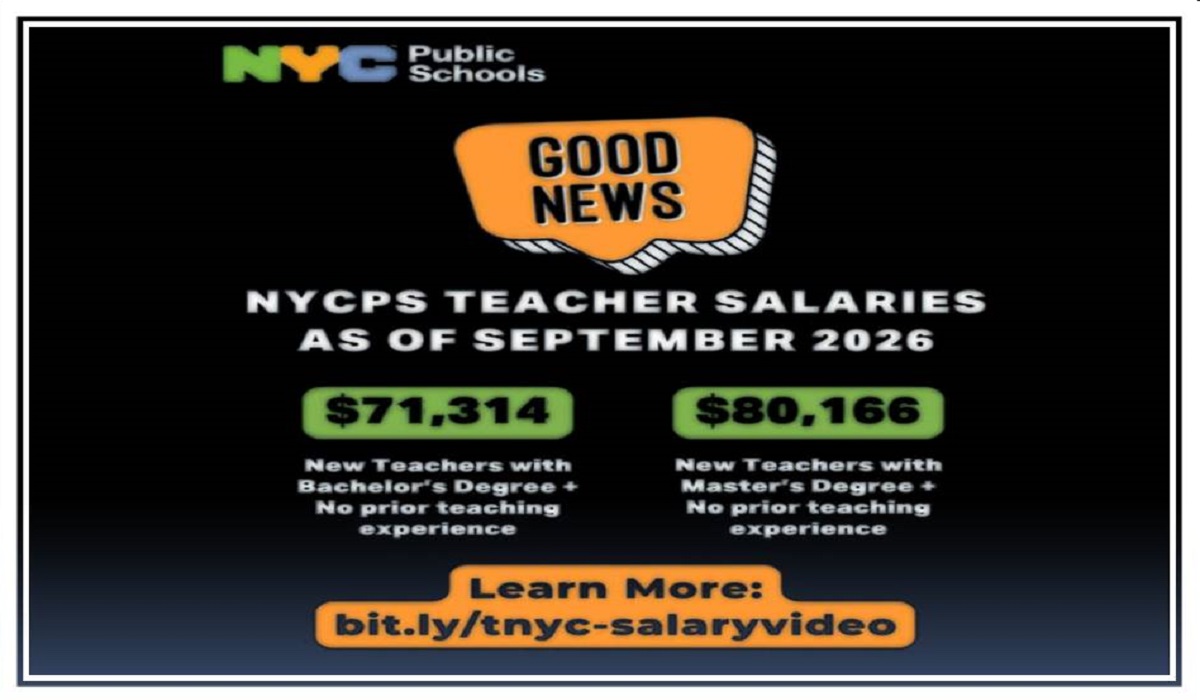
NYC Boosts Teacher Pay to Attract New Educators: The New York City Public School system has announced a significant increase in entry-level teacher pay, effective at the beginning of the 2026-2027 school year. The changes are designed to make teaching in the city more competitive and rewarding for new graduates.
Key Salary Figures
Under the new pay structure, starting annual salaries for educators new to the system will be:
- $71,314 for individuals holding a bachelor’s degree.
- $80,166 for individuals holding a master’s degree.
Both figures apply to candidates without prior full-time teaching experience.
Opportunities for Additional Earnings
Beyond these base salaries, the Department of Education confirms. That teachers can further increase their income through supplemental roles. Additional compensation is provided for leading after-school or summer school programs. As well as for teaching in specialized or high-need school environments.
Navigating Your Pay Scale: A Resource Guide
For current and prospective teachers seeking a deeper understanding of the full compensation system, the NYCPS provides detailed guidance. The complete salary schedule is built on a model of “steps” and “differentials.”
- Salary Steps: Represent annual increases in pay tied to years of service within the school system. Each year of completed experience typically moves a teacher to the next “step” on the pay scale, resulting in a higher base salary.
- Salary Differentials: These are permanent pay increases awarded for advanced education (beyond a master’s degree), specific professional certifications, or specialized skills.
Educational resource videos are available to help educators learn how to advance on the step schedule and apply for eligible differentials with the proper documentation.
Full Guide About NYC Teachers’ Pay
For educators joining the nation’s largest school district, understanding the pay structure is crucial. In New York City public schools, your annual salary isn’t a matter of individual negotiation; it’s determined by a clear, grid-based system built on two pillars: professional experience and academic achievement.
The Salary Framework: Steps and Differentials
Think of your salary as a coordinate on a map. Your vertical position is set by Salary Steps, which reward your years of teaching experience. Your horizontal position is set by Salary Differentials, which reward your educational credentials beyond a bachelor’s degree.
Together, these coordinates pinpoint your exact salary on the union-negotiated salary schedule. Every teacher’s financial progression follows this public roadmap.
Part 1: Climbing the Ladder – Salary Steps
Salary steps represent your journey in the classroom. They are incremental pay increases awarded for qualifying professional experience.
- Automatic Progression: Once hired, you will typically advance two steps per full year of uninterrupted teaching in NYC—one in September and one in March—resulting in a consistent increase in your earnings.
- The Starting Gate (Step 1A/1B): All new hires begin at the base salary (e.g., $68,926 as of the September 2025 schedule). Your first day is Step 1A, moving to 1B the following March.
- Credit for Past Experience: If you taught before joining NYC, you can apply to have that experience evaluated for a higher starting step. However, there is a cap: newly appointed teachers cannot start beyond Step 8B, regardless of prior years.
- The Verification Process: Be prepared—evaluating prior experience takes approximately 20 weeks. The Division of Human Resources will contact your former employers directly. Unverifiable experience will not be counted.
What Counts as Qualifying Experience?
The district recognizes three main categories for step credit:
- NYC Substitute Teaching: Must total at least 85 days within a single school year (not necessarily consecutive). Each 85-day block earns one salary step.
- Out-of-City/State Teaching: Must have been a paid, full-time. Regular appointment (not per-diem) for at least one full term. With satisfactory ratings, in an accredited K-12 day school.
- Non-Teaching Professional Experience: Applicable mainly in specialized license areas (e.g., sciences, special education). Or for Career & Technical Education (CTE) teachers. Requires at least one full calendar year of paid. Full-time work directly related to the teaching license area.
Important Note: Paraprofessional, teacher’s aide, or co-teaching experience does not qualify for salary step credit.
Part 2: Earning Your Stripes – Salary Differentials
While steps are about time, differentials are about academia. These are pay increases for graduate-level credits and degrees. But they are not automatic—you must apply.
- Payment Cycles: Differentials are paid three times a year (Feb. 1, July 1, Sept. 1) for coursework completed in the preceding semester.
- The Differential Ladder:
- C1: Base salary (Bachelor’s degree only).
- C2: +30 credits beyond a bachelor’s.
- C2+ID (Intermediate Differential): +60 credits beyond a bachelor’s.
- C2+PD (Promotional Differential): A master’s degree, or a bachelor’s + 30 credits with a specialization.
- C6+PD (Second Differential): A master’s degree + 30 additional credits plus completion of specific advanced professional development.
Accelerating Your Credits: The ASPDP Advantage
A key pathway for earning differential credits is the After-School Professional Development Program (ASPDP). This citywide initiative offers flexible, affordable courses. That counts toward both salary advancement and state recertification.
- Equity-Focused Learning: Many courses are designed to help educators build inclusive, equitable classrooms.
- “A+” or “P” Credits: To qualify for a differential, ensure you take courses designated for A+ or P credit. Requirements vary based on your hire date.
- Broad Catalog: Choose from over 200 courses per term offered by vetted universities and cultural institutions.
Key Perks and Processes
- Longevity Bonuses: Beyond the grid, teachers receive bonus payments at milestone years of NYCPS service (5, 10, 13, 15, 18, 20, and 22 years). These are listed at the bottom of the salary schedule and only accrue from your start date as a teacher.
- The Application Imperative: All new teachers start at the base salary. To claim your rightful step and differential, you must submit a formal online application through the Office of Salary Services (OSS) after you are on payroll.
- Set Your “Equated Date”: This critical date, established during your initial application. Becomes the benchmark for all future step increases and longevity bonuses.
- Use Available Tools: The United Federation of Teachers (UFT) provides a salary calculator and detailed step-by-step guides to help you estimate your pay and navigate the application process.
Your Takeaway: Your NYC teaching salary is a structured, transparent system. Advance vertically by gaining classroom experience. And horizontally by pursuing further education. Success requires understanding the rules, meticulously documenting your qualifications, and proactively submitting applications to claim what you’ve earned.
Frequently Asked Questions (FAQs)
Q: When do the new starting salaries officially begin?
A: The updated starting salaries of $71,314 and $80,166 take effect on September 14, 2026.
Q: What is a “salary differential” and how do I get one?
A: A differential is a permanent salary increase for additional qualifications. You can earn differentials for completing relevant graduate-level coursework, earning national board certification, or gaining certification in high-need subjects. Approval requires submitting official documentation, like transcripts or certificates, to the DOE.
Q: How does my salary increase after I start teaching?
A: Your salary will typically increase each year through “step” increments based on your years of service. You can receive further raises by earning salary differentials for advanced education or certifications. Moving you to a higher pay column on the salary schedule.