
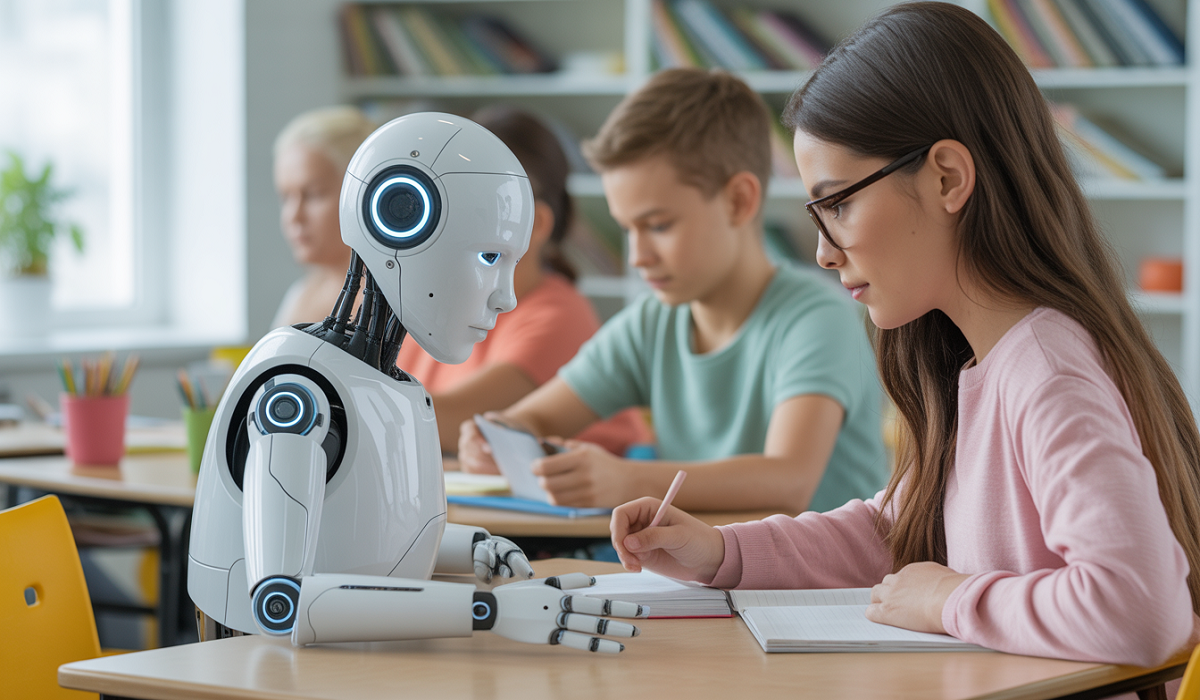
Reshaping Middle School Literacy Recovery in 2026
Reshaping Middle School Literacy Recovery in 2026: The classroom hums with a different kind of energy than it did just a few years ago. In a middle school in the Bronx, a small group of 7th graders huddle around a Chromebook, deeply engaged in a debate about a character’s motivation in a short story.
They toss ideas back and forth, then one of them types their collective thought into a chat interface. Almost instantly, the “handout talks back,” posing a probing question that directs them back to a specific paragraph to find text-based evidence .
This isn’t a scene from a sci-fi movie; it’s the reality of literacy recovery in 2026. As educators grapple with the stark reality that the students who were in early elementary school during the pandemic are now navigating the complex reading demands of middle school. A powerful new ally has emerged: AI agentic tutors.
Unlike the rigid, drill-based software of the past, today’s agentic tutors are adaptive. Conversational, and designed to foster deep thinking rather than just correct answers. They act as a digital guide—a “copilot” for the student and a real-time data analyst for the teacher.
As we move through 2026, these tools are moving from pilot programs to essential components of a robust literacy recovery strategy. This article explores the state of AI agentic tutors. The hard data proving their worth, and how they are being integrated into classrooms to rebuild confident readers.
The 2026 Literacy Crisis: Why Middle School Is the New Frontier
To understand why AI tutors are gaining traction so rapidly. We have to look at the data shaping this school year. For a long time, education policy focused intensely on early literacy—the “learning to read” phase by 3rd grade. But what happens when a child hits 6th, 7th, or 8th grade and still struggles?
According to NWEA experts, the students who were in K-3 during the initial shock of the COVID-19 pandemic are now in middle school. And the recovery simply hasn’t fully materialized for many of them. Nationally, only 30% of eighth graders are reading proficiently, and no state has shown significant gains in this area since 2022 . This is the “engagement cliff.”
Middle school literacy isn’t just about decoding words anymore; it’s about “reading to learn.” It requires stamina, background knowledge, and the ability to parse complex informational texts and nuanced literature.
Traditional interventions often feel infantilizing to a 13-year-old, focusing on skills remediation in a way that disengages them further. This is where AI agentic tutors offer a paradigm shift. They provide personalized, age-appropriate support that meets students where they are without publicly stigmatizing them .
What Are AI Agentic Tutors? Defining the “Teacher-in-the-Loop”
Before we dive into the success stories, it’s critical to define what makes a tutor “agentic.” In 2026, the market is flooded with AI tools, but not all are created equal. The gold standard emerging from research—including a new February 2026 study from arXiv—is the concept of the “teacher-in-the-loop” .
An AI agentic tutor is not meant to replace the educator. Instead, it functions as an intelligent agent that works on behalf of the teacher’s pedagogy. Here’s how they differ from old ed-tech models:
- Contextual Personalization: Early AI simply made content easier or harder. Today’s tutors, like those studied in the arXiv paper, create tasks that correspond to students’ interests. If a student loves soccer or a specific video game. The AI can frame a reading comprehension exercise around that interest, provided the teacher prompts it to do so .
- Real-Time Feedback Loops: Instead of just marking an answer wrong, agentic tutors guide students through their thought process. The “LitAI” project being developed in Zurich uses eye-tracking technology combined with verbal responses to identify why a student is misreading a passage, offering adaptive support in real time .
- Human-in-the-Loop Systems: The arXiv study involving 7 middle school teachers and 521 7th-grade students highlights a crucial finding for 2026: while AI can generate personalized content, the teacher is essential for refining it. Teachers were found to be critical for adjusting pop culture references and ensuring the “depth or realism” of the problems generated. The AI didn’t save time initially, but it improved the quality of personalization, allowing teachers to iterate their approaches based on student data .
Case Study 2026: The New York City Pilot & The Doubling of Growth
The most compelling evidence for AI agentic tutors in literacy recovery comes from the front lines of New York City public schools. In a powerful first-person account published by superintendents in the Bronx and Brooklyn. We see the tangible impact of these tools .
Facing stagnant reading scores, these districts didn’t just buy software; they co-designed a pedagogical approach. They targeted core English Language Arts classes rather than adding another intervention layer. The goal was to embed support so effectively into the school day that fewer students would need extra help later.
The Methodology:
- Students work in small groups on Chromebooks, discussing questions collaboratively before engaging with the AI.
- The AI provides immediate, targeted feedback, directing students back to the text to find evidence.
- Teachers monitor a live dashboard, seeing which students grasp inferences and which are stuck on literal comprehension.
- After 15 minutes, the AI synthesizes the two biggest misconceptions in the class and suggests discussion questions for the teacher to address with the whole group .
The Results (2025 Test Data):
The data from this initiative is the headline story of 2026. Students in classrooms using these AI tools at least twice a week doubled their rate of growth on the 2025 New York State reading assessments compared to their peers in the same district who did not use the tools.
In the Bronx’s District 11, participating schools saw growth of 14 to 16 percentage points over the previous year. Compared to a district-wide average improvement of only seven points . This isn’t just incremental improvement; it’s a potential game-changer for how we approach learning loss.
Beyond the Screen: Fostering Collaboration and Confidence
One of the biggest fears surrounding AI in education is that it will turn students into isolated zombies. Staring blankly at screens while human connection withers. The 2026 model actively fights this paradigm. The NYC pilot emphasized that most early AI products follow an “old paradigm”—headsets on, silent, working alone .
In contrast, effective agentic tutors are designed to be social catalysts.
- Peer Discussion First: Students must talk over each question with their partners before typing an answer. This ensures that the technology supports, rather than replaces, collaborative thinking.
- Confidence Building: Teachers report that after receiving validation from both peers and the AI. Students are far more willing to share their thoughts during the full-class discussion that follows the digital activity . They’ve had a chance to test their ideas in a low-stakes environment first.
The New Toolkit: Blending High-Tech with High-Touch
While AI gets the headlines, smart districts are pairing it with structural changes. The Institute of Education Sciences (IES) is set to release the PRISMS (Providing Reading Interventions for Students in Middle School) Toolkit in Winter 2026. This resource provides evidence-based recommendations for interventions in grades 6-8 . The implication is clear: Technology is a tool, but it must be wielded within a framework of proven instructional strategies.
Furthermore, initiatives like the UK’s Reading Reboot programme. Funded by a £500,000 grant, remind us that high-tech and high-touch aren’t mutually exclusive. This programme focuses on creating social book clubs in school libraries. Dedicated time and space for reading engagement—to combat the decline in reading for pleasure . AI can help a student learn to read, but initiatives like Reading Reboot help them want to read.
Challenges: The “Grain Size” Problem and Teacher Workload
Despite the optimism, 2026 is also a year of清醒反思. The integration of AI isn’t seamless. The arXiv study highlighted what researchers call the “grain size” problem .
Teachers, when using AI to create personalized tasks, tend to operate at a broad grain size (e.g., “relate this to sports”). Students, however, prefer a much smaller, more specific grain size (e.g., “relate this to that specific player on that specific team“).
Students want the deep cuts, the niche popular culture references that show the AI (and the teacher) truly “gets” them. Bridging this gap requires teachers to spend a lot of effort adjusting the AI’s output. Which can negate the promised time-saving benefits .
This leads to a critical point echoed by the OECD Digital Education Outlook 2026: pedagogy must lead, not the technology. The OECD warns against uses of GenAI that “displace cognitive effort or undermine deep learning.” The goal isn’t to give students a shortcut to the answer. But to create a “hybrid human–AI approach” that preserves learner agency .
Looking Ahead: The Future of Literacy Recovery
As we look at the rest of 2026, several trends are converging. With ESSER (pandemic relief) funding sunsetting, districts are looking for sustainable, scalable solutions. AI agentic tutors, which can be deployed on existing devices like Chromebooks, offer a cost-effective way to provide personalized tutoring that was previously only available to those who could afford private tutors.
However, the mandate from researchers and superintendents is clear: success hinges on clear goals. As the NYC leaders stated, “The North Star of any improvement effort must be student outcomes.” Districts must rigorously evaluate the impact of these tools, ensuring that contracts with AI vendors are tied to clear measures of student growth .
The future of learning is not AI-centric; it is human-centric, AI-enhanced.
Conclusion
The story of AI agentic tutors in 2026 is one of cautious optimism. We are moving past the hype and into an era of evidence-based implementation. The data from New York shows that when AI is used to amplify great teaching—fostering collaboration, providing instant feedback, and freeing teachers to address misconceptions in real-time—it can reverse the alarming trends in middle school literacy.
We are not handing our children over to machines. We are giving them tools that make the “handout talk back,” giving teachers dashboards that reveal the hidden struggles of their students, and rebuilding the confidence of a generation of readers.
Frequently Asked Questions (FAQs)
1. What exactly is an “agentic tutor” and how is it different from old educational software?
Unlike traditional software that follows a linear “right or wrong” script, an agentic tutor uses generative AI to adapt in real-time.
It acts as an agent that can probe a student’s misunderstanding, redirect them to the text, and personalize examples based on their interests (like sports or pop culture). It’s designed to mimic the back-and-forth of a human tutor rather than just a digital worksheet .
2. Does the use of AI tutors mean teachers are being replaced?
Absolutely not. The most successful models in 2026, such as those in New York City and endorsed by the OECD, rely on a “teacher-in-the-loop” approach. The AI handles real-time feedback and data synthesis, which frees the teacher to facilitate small-group collaboration and lead targeted whole-class discussions based on the insights the AI provides. The teacher’s role evolves from lecturer to learning architect .
3. Is there real proof that these tools improve reading scores?
Yes. The most compelling data comes from the 2025 New York State reading assessments. Middle school students in Bronx districts who used AI teaching assistants at least twice a week showed growth of 14-16 percentage points, nearly double the rate of their peers who did not use the tools .
4. Won’t this just make students more addicted to screens and less social?
It can, if implemented poorly. However, effective 2026 models use the technology specifically to enhance social interaction. Programs require students to discuss questions with peers before interacting with the AI.
Teachers report that this process actually boosts student confidence and increases participation in classroom discussions because students have already processed the material in a low-stakes environment .
5. How can my school start implementing AI tutors without breaking the bank?
Start by auditing the hardware you already have (most programs run on standard Chromebooks or tablets). Focus on high-quality instructional materials (HQIM) and look for AI tools that integrate with your existing curriculum rather than requiring a costly overhaul.
Most importantly, follow the lead of districts like NYC: start with a small pilot program, provide training for teachers on the “pedagogical” decisions, and rigorously evaluate the student outcome data before scaling up