
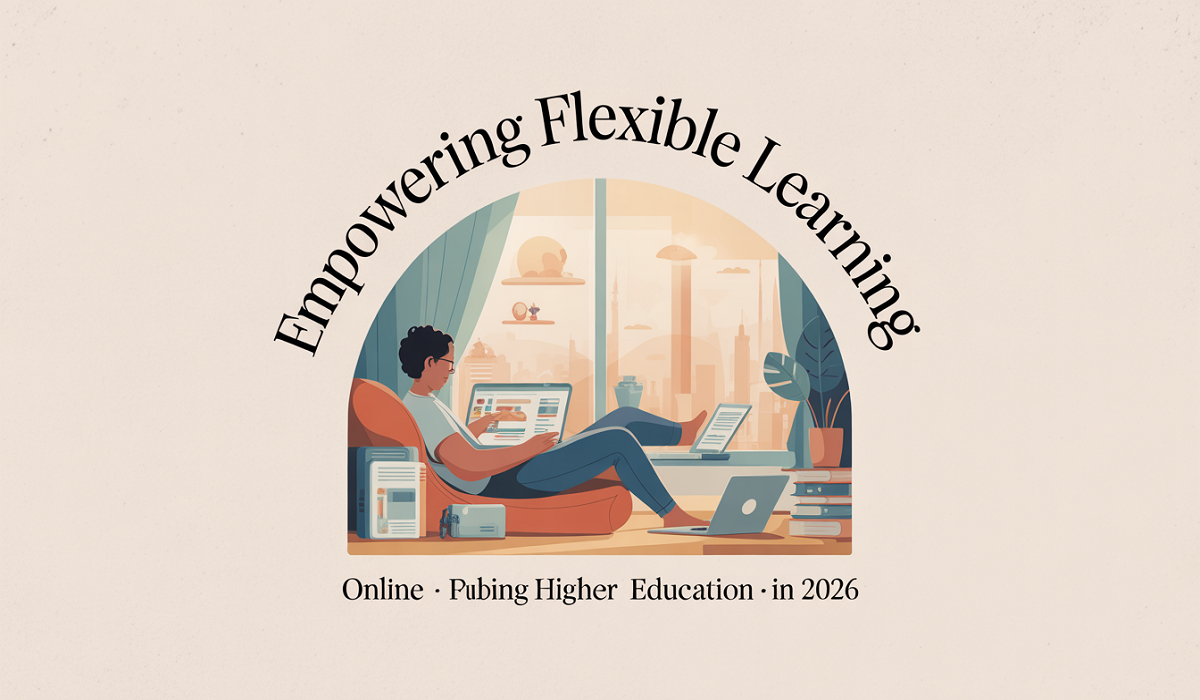
Flexible pacing online higher ed 2026
Flexible pacing online higher ed 2026: Life doesn’t follow a nine-to-five schedule. It’s messy. It’s unpredictable. You might be a single parent waiting for the kids to go to bed, a night shift worker grabbing coffee at 3 a.m., or a busy professional with a tiny window for lunch.
For a long time, going to college meant forcing your messy, unpredictable life into the rigid mold of a semester system. You had to show up at a specific time, on a specific day, and keep up with a class pace set in stone.
Welcome to higher education in 2026. The biggest game-changer isn’t just artificial intelligence or virtual reality headsets—it’s control. It’s the power to hit the gas pedal or tap the brakes on your own learning. This is the era of flexible pacing online higher ed 2026, and it is completely rewriting the rules of who gets a degree and how they get it.
If you’ve ever felt that traditional school moves too fast or, honestly, too slow for you, this new model is your invitation back to the table.
The Death of the One-Size-Fits-All Semester
Think about a typical college classroom. Twenty, thirty, or a hundred students all read the same chapter at the same time, listen to the same lecture on the same Tuesday, and take the same test on the same Friday. It works for some. But for many, it’s a disaster.
What if you already understand the first three chapters? Too bad—you have to sit through them again. What if you’re struggling with a key concept? Too bad—the class is moving on to Chapter 4 on Monday whether you like it or not. This “lockstep” method doesn’t account for the fact that human brains don’t all work at the same speed.
Flexible pacing online higher ed 2026 smashes that model to pieces. It’s an approach that puts the student in the driver’s seat. Instead of the semester dictating the speed, your understanding dictates the speed.
In a flexibly paced program, the structure is there—the videos, the readings, the assignments—but the timeline is fluid. If you’re a whiz at math, you can blast through the calculus module in a weekend and immediately take the final exam. If you’ve always struggled with writing, you can spend three weeks on that English composition unit, watching videos over and over until the lightbulb goes off.
This isn’t just about convenience; it’s about mastery. You don’t move on until you actually get it. And in 2026, technology is finally making this dream a reality at scale.
Why 2026 is the Tipping Point?
We’ve talked about flexible learning for years, so why is it finally taking over now? A few major shifts have come together to make flexible pacing online higher ed 2026 not just possible, but expected.
1. AI is the Ultimate Personal Tutor
Artificial intelligence has evolved from a fancy chatbot into a true learning companion . Imagine reading a complex paragraph about macroeconomic theory. If you don’t get it, you no longer have to email a professor and wait two days for a response. An AI study assistant, like the ones being integrated by institutions such as the University of London, can instantly rephrase the concept, give you a different example, or quiz you on the spot to make sure it sticks . This allows you to keep moving forward on your own schedule without getting stuck in the mud.
2. The Rise of “Micro” Learning
We’ve realized that degrees don’t have to be these massive, four-year commitments. Universities are now breaking down education into smaller, stackable pieces called microcredentials . Think of them like Lego blocks. You can take a short, self-paced course on data visualization, earn a badge or credit for it, and then later, stack it with other blocks to build a full master’s degree.
The University of London, for example, is launching microcredentials where you can “start anytime, self-paced study, assessment when ready” . This means you can step into education, step away when work gets crazy, and step back in without losing your progress. It’s education that bends to the reality of a modern career.
3. Content is Everywhere (Literally)
Gone are the days when “online school” meant staring at a forum board. In 2026, your classroom is wherever you are. At the Integrated Systems Europe (ISE) 2026 conference, experts coined the term “Learning Everywhere” . Technology has advanced so that a lecture isn’t just a video; it’s a transcript you can skim, a podcast you can listen to on your commute, and a summary you can read in five minutes .
Flexible pacing online higher ed 2026 means you can consume content in the format that fits your moment. If you have 40 minutes, you watch the lecture. If you have 10 minutes, you read the AI-generated summary. You’re always learning, regardless of how much time you have.
The New Classroom: High-Tech and Simple
You might be picturing a lonely student staring at a laptop in a dark room. But flexible pacing doesn’t mean you’re alone. Colleges are investing heavily in “Connected Classrooms” . These are physical rooms packed with cameras, microphones, and interactive screens that bring remote students right into the heart of the action.
But here’s the cool part: they’re making the tech simple. At the big education tech shows in 2026, the hottest new feature wasn’t some complex AI—it was a “preset button” on a camera . Professors can press Button 1 to point the camera at the whiteboard, Button 2 to point at themselves, and Button 3 to show a demo. It’s reliable.
This simplicity is key. It allows students learning at their own pace to drop into live sessions when they can, without the professor needing to be a tech wizard to include them.
The Big Challenge We Have to Solve
Of course, any revolution has its rebels. The biggest threat to flexible pacing online higher ed 2026 is a problem called “Agentic AI” .
Since late 2025, AI has become so advanced that it can actually do the coursework for you. Imagine an AI browser that can log into your school account, read the material, answer the quiz questions, and write the discussion post—all without you lifting a finger. Researchers at MEF University tested this and found an AI completed a course designed for up to 60 hours of study in about 25 minutes .
If you can set an AI loose to do all your self-paced work, what’s the point of the degree? This is the headache keeping university presidents up at night. It means that in 2026, flexible programs have to be smart about assessment. Instead of just multiple-choice quizzes that a bot can take, we’re seeing a shift toward “authentic assessment.”
This means project-based work, video presentations, live discussions, and real-world problem-solving that requires a human touch. The goal is to make sure that when you earn that degree, it’s because you did the work, not a robot.
How to Make Flexible Pacing Work for You?
So, you’re ready to dive into a program that offers this flexibility. But having freedom requires a bit more self-discipline. Here’s how to succeed in this new world.
- Build Your Own Structure: Just because the school doesn’t impose a structure doesn’t mean you shouldn’t have one. Block out time in your calendar for “school time” just like you would for a meeting.
- Use the Tools: Don’t ignore the AI study assistant. Use it to quiz yourself. If you’re confused, ask it for help before you get frustrated .
- Find Your People: Flexible pacing doesn’t mean you can’t connect. Join study groups, even if they’re online. Having people to talk to about the material keeps you engaged and accountable .
- Focus on the Skills: In 2026, employers care more about what you can do than the grade on your transcript . As you move through your self-paced course, build a portfolio of your projects. That’s your real-world proof.
What’s Next? The Future of You
Looking ahead, the line between “school” and “work” will continue to blur. Learning won’t be something you do for four years in your twenties; it will be something you do your whole life . Flexible pacing online higher ed 2026 is the infrastructure for that lifelong journey.
Whether you are an honors student at Ohio University looking for a challenge that fits your schedule, or a professional in Mexico City upskilling to stay relevant, the power is shifting to you .
The future of education isn’t about sitting in a room for a fixed number of hours. It’s about proving you have the skills. And thanks to flexible pacing, you can prove it on your own time.
Frequently Asked Questions (FAQs)
1. What exactly is “flexible pacing” in online college?
Flexible pacing means you control how fast or slow you move through a course. Unlike a traditional class where everyone takes the same test on the same day, you can speed through topics you find easy and slow down to master difficult ones. You generally have deadlines, but they are wider windows (like finishing a course in 8 weeks vs. 16 weeks) rather than specific due dates every Tuesday .
2. If I have a flexible schedule, does that mean I have no interaction with professors or other students?
Not at all! Most programs using flexible pacing online higher ed 2026 are designed to keep you connected. You might join live (synchronous) video discussions when you can, or you might participate in discussion boards asynchronously. Many classes use tools like “Connected Classrooms” to let remote students interact with in-person classes in real-time .
3. How do I know an online degree with flexible pacing is legitimate?
Check for accreditation. Reputable schools like the University of London, Capella University, and Ohio University are leading the way in this space . Their programs are accredited and recognized by employers. Be wary of “diploma mills” that make it too easy—real flexible learning still requires hard work and mastery of the subject.
4. Won’t employers think it’s easier than a traditional degree?
Employers in 2026 are increasingly looking for skills over traditional grades . If you take a flexibly paced course, you can often build a portfolio of work that proves your abilities. The key is demonstrating that you have the discipline to manage your time and master the material, which is actually a huge selling point for employers.
5. Can I use financial aid for self-paced or microcredential programs?
It depends on the program and the country. In many cases, yes. However, government financial aid is often tied to credit-hour requirements. For shorter “microcredentials,” you may need to check if they qualify for federal aid or if the university offers payment plans. The move toward lifelong learning is pushing governments to update these rules to make funding more flexible .
Summary
Flexible pacing online higher ed 2026 is more than just a trend; it is a fundamental shift in the philosophy of education. By leveraging AI, microcredentials, and immersive tech, universities are finally handing the reins over to the students. While challenges like AI cheating require smart solutions, the core promise remains: anyone, anywhere, can now earn a high-quality degree at a speed that matches their life and learning style. It’s an exciting time to hit the books—on your own terms.