
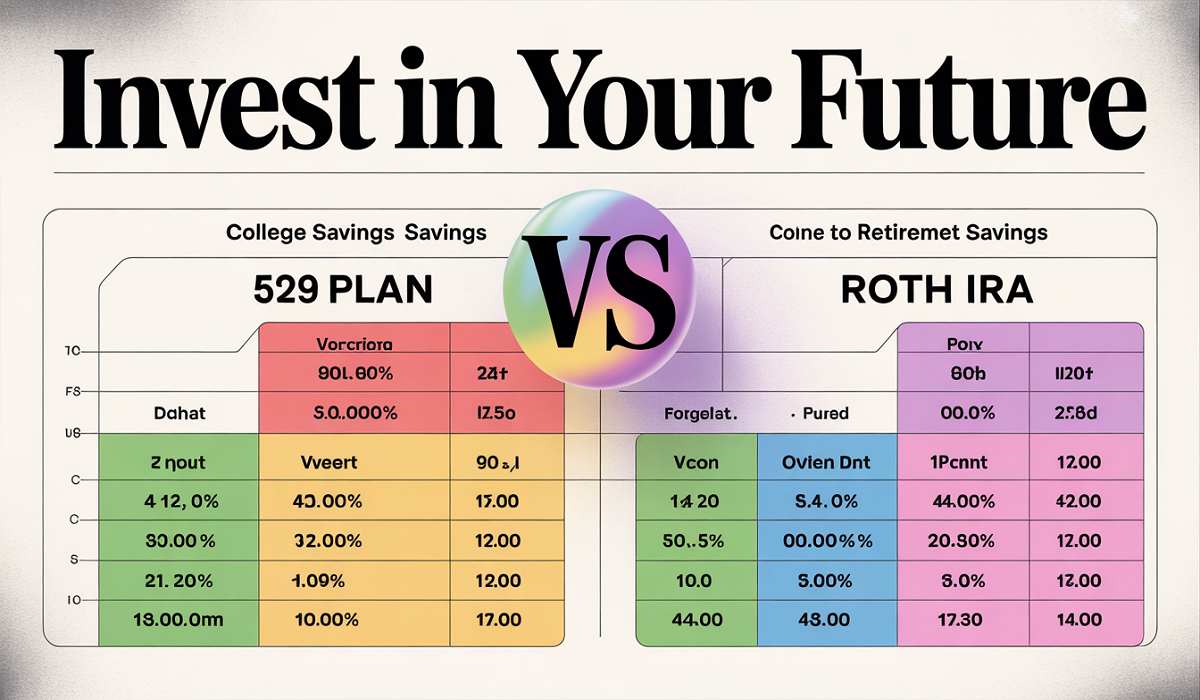
529 Plan vs Roth IRA
529 Plan vs Roth IRA: Saving money for big goals like college or retirement can feel confusing. You want to do the right thing for your kids and yourself, but where do you start? Two popular choices keep popping up: the 529 plan and the Roth IRA.
In this 529 plan vs Roth IRA comparison, we will explain everything step by step using easy words. Think of it like picking the best backpack for school – one is made just for books, the other is super flexible for anything.
By the end, you will know the differences, the good and bad points, and which one (or both) fits your family. We will cover rules for 2026, simple examples, and tips that anyone in 8th grade can understand. Let’s dive in and make saving feel exciting instead of scary!
What Is a 529 Plan?
A 529 plan is like a special savings jar made just for school stuff. States run these plans, and you can open one for your child, grandchild, or even yourself. The cool part? The money grows without paying taxes, and you do not pay taxes when you take it out for things like college tuition, books, a laptop, or even some K-12 private school costs.
Imagine your family putting coins into this jar every month. Over time, it gets bigger because the investments inside (like stocks and bonds) grow. In 2026, you can use up to $20,000 a year for private school or tutoring – that is double what it used to be! You can also pay for apprenticeships and even some student loans now.
Anyone can open a 529 plan. No matter how much money you make, you are welcome. Grandparents, aunts, uncles, and friends can all chip in too. That makes it great for big family gifts. Most states let you put in hundreds of thousands of dollars over time, way more than other savings accounts.
The best thing about a 529 plan is the tax break. In many states, you even get a break on your state taxes when you add money. Plus, the growth stays tax-free as long as you use it for school. If your kid decides not to go to college, you can change the beneficiary to another family member, like a sibling or cousin. That keeps the money in the family.
But remember, it is mainly for education. If you take money out for something else, you pay taxes plus a 10% penalty on the growth part. Still, with the new rules in 2026, you have more ways to use it without waste.
What Is a Roth IRA?
Now let’s talk about the Roth IRA. This one is like a magic wallet for your future grown-up life. Roth stands for “after-tax,” meaning you put in money you already paid taxes on. But here is the awesome part: the money grows tax-free, and when you take it out after age 59½ (and the account is at least five years old), you pay zero taxes on everything!
Roth IRAs were made for retirement, but they are flexible. You can use the money you put in (not the growth) anytime without penalty. That means if your kid needs college money before you are 59½, you can pull out what you contributed without extra costs. The growth part might have taxes and penalties if used early, but for retirement, it is perfect.
In 2026, most people under 50 can add up to $7,500 a year. If you are 50 or older, you can add $8,600. But there is a catch: if you make too much money, you cannot add anything. For a single person, full contributions stop around $153,000 income. For married couples, it is higher – around $242,000.
You open a Roth IRA yourself at a bank or investment company. It is in your name, not your kid’s. Investments inside can be stocks, bonds, or funds – lots of choices. The best part is flexibility. Use it for retirement beach trips, or help with college if needed. No state tax deductions usually, but the tax-free growth is still powerful.
Many families like the Roth IRA because it doubles as a backup plan. If college plans change, the money stays safe for your golden years.
Key Differences Between 529 Plan and Roth IRA
Let’s put the 529 plan vs Roth IRA side by side so it is crystal clear.
- First, purpose: 529 is built for education only. Roth IRA is for retirement but can help with school too.
- Contribution limits: 529 has no real annual limit – you can superfund $95,000 at once in 2026 as a gift without tax problems. Roth IRA caps at $7,500 or $8,600.
- Who can use it: Anyone for 529, no income limit. Roth IRA has income rules.
- Taxes: Both grow tax-free. 529 withdrawals are tax-free for school. Roth withdrawals are tax-free for retirement.
- Flexibility: 529 money must mostly stay for education or face penalties (but you can rollover some now). Roth gives you more choices.
- Investment options: 529 usually has a list of funds picked by the state. Roth IRA lets you choose almost anything.
- Financial aid: 529 counts more against college aid. Roth IRA is seen as retirement money and hurts aid less.
In the 529 plan vs Roth IRA battle, the 529 wins for pure college saving. The Roth IRA wins for “what if college doesn’t happen” safety.
Pros and Cons of 529 Plans
Pros of 529 plans:
- Super high contribution room – perfect for grandparents helping out.
- Tax-free for school costs, including the new $20,000 K-12 limit in 2026.
- State tax deductions in many places.
- Anyone can contribute.
- Change beneficiary easily.
- New rollover to Roth IRA up to $35,000 lifetime.
Cons:
- Must use for education mostly or pay penalty.
- Affects financial aid more.
- Fewer investment choices than a regular account.
- State rules can change.
Overall, if college is almost sure, 529 plans feel like a winning ticket.
Pros and Cons of Roth IRA
Pros of Roth IRA:
- Total flexibility – use for school contributions or full retirement.
- Tax-free forever for retirement.
- Pull out your own contributions anytime without penalty.
- Lots of investment options.
- Great backup plan.
Cons:
- Low annual limit.
- Income limits block some families.
- Earnings used for college before 59½ can have taxes and penalties.
- No state tax breaks usually.
- Only you (or spouse) own it.
The Roth IRA shines when life has surprises.
When to Choose a 529 Plan?
Pick a 529 plan if:
- Your child is set on college or private school.
- You want family and friends to pitch in big amounts.
- You like the extra state tax help.
- College costs are your top worry right now.
Many parents start a 529 plan the day their baby is born. It grows for 18 years tax-free. In the 529 plan vs Roth IRA choice, this one feels made for school dreams.
When a Roth IRA Might Be Better
Go with Roth IRA if:
- You are not 100% sure about college.
- You already maxed your retirement savings.
- Your income is low enough to qualify.
- You want one account that works for two goals.
Some families use Roth IRA for college contributions only. Later, the rest becomes retirement money. Smart, right?
Can You Use Both? The 529RothDualSaver Approach
Yes! Many smart families do both in a 529RothDualSaver way. Put most college money in the 529 plan for tax perks and high limits. Use the Roth IRA for extra flexibility and your own retirement.
This hybrid fixes the weaknesses of each. The 529 handles big school bills. The Roth IRA keeps options open. In the 529 plan vs Roth IRA world, combining them is often the real winner.
Recent Changes: 529 to Roth Rollover in 2026
Big news! Thanks to new rules, you can move up to $35,000 lifetime from a 529 plan to a Roth IRA for the same person. The 529 account must be open 15 years, and recent five years’ money stays out. The rollover counts toward the annual Roth limit ($7,500 in 2026).
This change makes 529 plans less scary. No more “use it or lose it” fear. In 2026, the 529 plan vs Roth IRA choice got even better because unused school money can become retirement savings tax-free. Families love this safety net.
Contribution Limits and Rules for 2026
For 529 plans: No federal yearly cap. Gift up to $19,000 per person ($38,000 married) without extra paperwork. Superfund five years at once. Total lifetime per state around $300,000 or more.
For Roth IRA: $7,500 under 50, $8,600 age 50+. Income limits apply strictly.
These numbers help you plan exactly how much to save each year.
Tax Implications Explained Simply
Both accounts use after-tax money. But the magic is in the growth. With 529, school withdrawals = zero tax. With Roth, retirement withdrawals = zero tax.
Example: You put $5,000 in each. It grows to $10,000. For 529 used for college: keep all $10,000 tax-free. For Roth used in retirement: keep all $10,000 tax-free. If you misuse, taxes hit. Simple rule: use them for what they were made for and win big.
How They Affect College Financial Aid?
Colleges look at your savings when giving aid. 529 plans count as a parent asset – up to 5.64% can affect aid. Roth IRAs in your name count less or not at all in many formulas. So in the 529 plan vs Roth IRA decision, Roth might help more with aid forms. Talk to a counselor for your exact situation.
Real-Life Examples and Stories
Meet the Garcia family. They opened a 529 plan for little Sofia. Grandparents added $50,000 at once. Now Sofia is 17, and the account covers most of her state college. No stress!
The Lee family chose Roth IRA. Dad maxes it every year. When their son needed books and fees, they pulled contributions penalty-free. Later, the rest will fund Mom and Dad’s retirement beach house.
Many families mix both. They call it the 529RothDualSaver method and sleep better at night.
Investment Choices in Each
529 plans offer age-based funds that get safer as college nears – like training wheels. Roth IRAs let you pick any stocks, ETFs, or bonds you want. Both grow your money, but Roth gives more control.
Withdrawal Rules and Penalties
529: Tax-free for school. Non-qualified = taxes + 10% penalty on earnings. Roth: Contributions anytime free. Earnings after 59½ tax-free. Early school use of earnings = taxes + penalty.
Know the rules and stay safe.
FAQs About 529 Plan vs Roth IRA
1. Which is better in 529 plan vs Roth IRA for most families?
It depends! If college is definite, choose 529. If you want flexibility, pick Roth IRA. Many use both for the best of everything.
2. Can I rollover my 529 to Roth IRA?
Yes, up to $35,000 lifetime in 2026 if the account is 15 years old and rules are followed. It is a game-changer!
3. Does income limit stop me from a 529 plan?
No! Anyone can open a 529 plan no matter how much they earn.
4. Will my 529 plan hurt college financial aid?
It can a little more than a Roth IRA, but the tax savings usually make it worth it.
5. Can kids open their own Roth IRA?
Yes, if they have earned income like a summer job. Great way to start early!
Summary
The 529 plan vs Roth IRA choice comes down to your family’s dreams. 529 plans shine for dedicated college saving with high limits and tax perks. Roth IRAs give flexibility and retirement power. In 2026, new rollover rules make both even stronger together.
Start small today. Open one, add what you can, and watch it grow. Whether you pick 529, Roth IRA, or the 529RothDualSaver mix, you are giving your family a brighter future. Talk to a trusted advisor if needed, but remember – any saving is smart saving.
You got this! Your future self and your kids will thank you.