
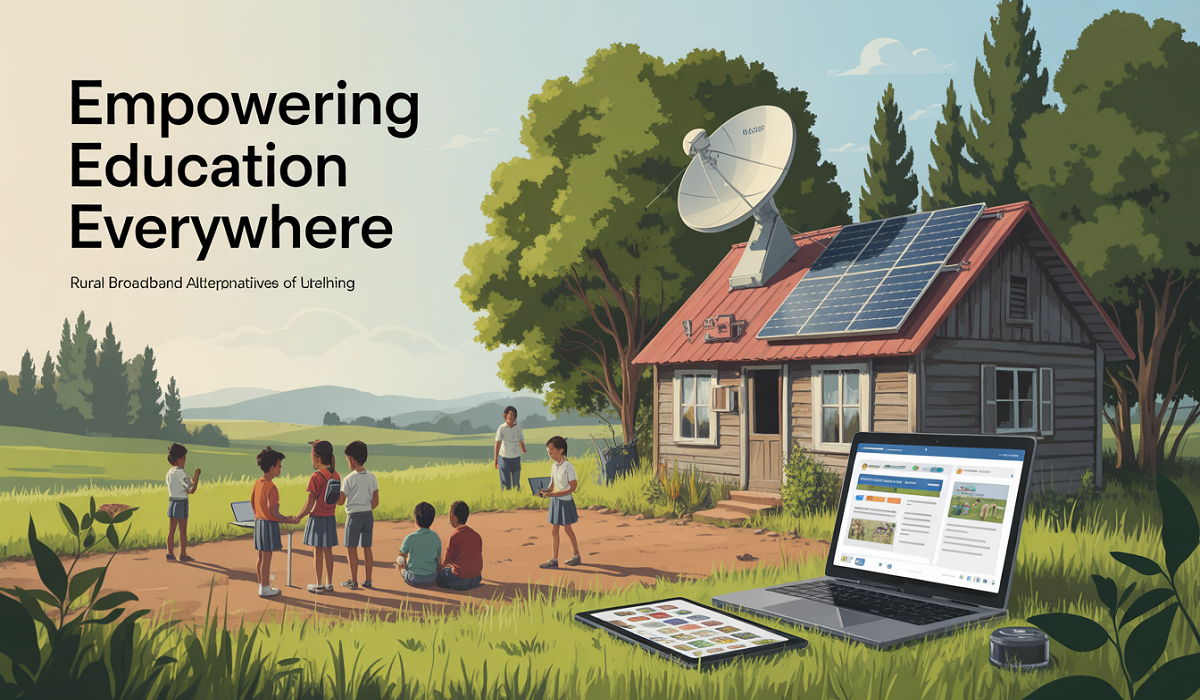
Rural Broadband Alternatives for Offline Learning
Rural Broadband Alternatives for Offline Learning: Imagine you have a science project due tomorrow. You need to watch a short video about volcanoes. But at your home, the Wi-Fi signal is a circle with a line through it. You live seven miles from the nearest town. The cellular data drops after one bar. This is not a rare problem in 2026.
Millions of students in rural America, Canada, Australia, and other countries still struggle with slow or no internet. Schools hand out laptops, but those laptops are useless without a connection. Teachers assign online quizzes. Parents feel frustrated.
But here is the good news: you don’t need fiber-optic cable or 5G to learn. In fact, rural broadband alternatives offline learning 2026 is not just a phrase—it is a growing movement. Communities are building their own solutions. Libraries are lending out offline hotspots. Even old radio towers are becoming digital classrooms.
This article will show you exactly how to keep learning alive, even when the internet is dead.
What Does “Offline Learning” Actually Mean?
Before we dive into tools, let’s get clear on one thing. Offline learning does not mean no technology. It means learning without a live, always-on connection to the global internet.
Think of it like this:
- Online learning = watching a YouTube live class.
- Offline learning = watching a downloaded video, reading a saved webpage, or using an app that works without Wi-Fi.
In 2026, offline learning is smarter than ever. Many apps and devices now sync when you do get a signal, then let you work for days without reconnecting.
For rural families, offline learning is not a backup plan. For many, it is the plan.
The Main Problem – Why Rural Broadband Is Still Spotty
You might wonder: hasn’t the government fixed rural internet by 2026? The answer is partly yes, partly no.
In some places, satellite internet like Starlink works well. In others, trees or mountains block the signal. Fixed wireless is better, but not everywhere. And fiber optic cables are expensive to bury across long distances.
Many rural areas have:
- DSL (slow, old phone lines) – 3 to 10 Mbps
- Mobile hotspots – expensive data caps
- No cable or fiber at all
When a family has four kids all trying to do Zoom school at the same time, the connection crashes. That is why rural broadband alternatives offline learning 2026 has become a lifeline.
Offline Option #1 – TV White Space (Super Wi-Fi)
Let’s start with a technology you may not have heard of: TV white space.
Between TV channels, there are empty frequencies called “white spaces.” These can carry internet signals for miles—through trees, hills, and even rain. In 2026, TV white space is being used in rural school districts from Virginia to New Mexico.
How it helps offline learning:
A school puts an antenna on its roof. It beams the internet to a receiver at a student’s home. That home then has a local Wi-Fi network. It works offline? No—it works like normal internet. But it works where nothing else does. And it allows students to download assignments overnight, then study offline during the day.
Cost: Schools pay a setup fee (around $2,000 per tower). Families pay nothing or a small monthly fee ($10–20).
Offline Option #2 – The Return of Radio School
Radio? For learning in 2026? Yes. But not your grandparent’s radio.
In places like Alaska, Kentucky, and rural India, educational radio is making a huge comeback. But now it is hybrid radio: students listen to a lesson, then use a simple offline device to answer questions.
Example: A nonprofit called OfflineEd broadcasts math and reading shows at 9 AM and 2 PM. Kids tune in using any FM or AM radio. After the show, the host says: “Open your offline tablet. Question one: What is 12 x 8?” Students tap the answer. The tablet saves their responses. When a parent goes to town with a phone signal, the tablet uploads the answers.
This is one of the purest forms of rural broadband alternatives offline learning 2026 because it requires zero home internet.
Cost: Radio is free. Offline tablets cost $50–100 one time.
Offline Option #3 – Library Hotspots That Work Offline First
Many rural libraries now lend out “offline-first hotspots.” These are small devices that do not provide live internet. Instead, they come pre-loaded with:
- Khan Academy videos (hundreds of them)
- Wikipedia for schools (no inappropriate content)
- E-books and audiobooks
- Educational games
A student checks out the device for two weeks. They watch videos, read, and take quizzes—all without any signal. When they return the device, the library syncs the progress.
In 2026, over 4,000 rural libraries in the U.S. offer this. It works beautifully for families who can drive to town once a week.
Real story: In eastern Oregon, a mom named Clara said, “My son finished his entire 7th-grade science using only a library hotspot. We have no internet at home. Not even cell service. But he learned.”
Offline Option #4 – LoRaWAN and Community Mesh Networks
This one sounds technical, but it’s actually simple.
LoRaWAN (Long Range Wide Area Network) is a low-power way to send small amounts of data over miles. It cannot stream Netflix. But it can send text messages, quizzes, and assignments.
A teacher can send a multiple-choice question to 30 students. Each student answers on a cheap device. The teacher sees results instantly—even without normal internet.
Communities are also building “mesh networks.” Imagine ten houses in a valley. One house has a satellite dish. That house shares the signal wirelessly with the other nine. They bounce the signal from roof to roof. If one house loses power, the signal jumps around it.
These mesh networks work offline inside the community. Only the “gateway” house needs the real internet.
By 2026, rural co-ops in 15 states have built these. Cost: $300–500 per household one time.
Offline Option #5 – SD Cards and SneakerNet
You might laugh, but “SneakerNet” (walking data from place to place on foot) is still alive.
Here is how it works in 2026: A school prints small SD cards or USB drives with a week’s worth of lessons. A bus driver drops them off at mailboxes. Students plug the card into a $40 offline player (looks like an old MP3 player with a screen). They learn, they answer questions. They put the card back in the mailbox. The driver picks it up.
It sounds old-fashioned. But in parts of West Virginia and the Australian Outback, this is faster than waiting for fiber optic cable.
One company called PacketSneaker delivers educational SD cards by drone in very remote areas. The drone drops a small package. The family loads the content. The drone returns a week later to pick up the answer cards.
This is offline learning at its most creative.
Cost: $20–30 per month for the drone service. Free for low-income families.
Offline Learning Software You Need in 2026
Hardware is only half the battle. You also need software that works without the web.
Here are the top offline-friendly apps in 2026:
- Kiwix – Carries the entire Wikipedia, Khan Academy, and thousands of books on one small device. Search works offline.
- Kolibri – A learning platform made for offline use. Teachers can load lessons, videos, and quizzes. Students log in on any device connected to the same local Wi-Fi.
- RACHEL (Remote Area Community Hotspot for Education and Learning) – A plug-and-play device that creates a local offline server. Up to 50 students can connect and learn at once.
- Endless OS – A full operating system for cheap laptops that comes with 100+ educational apps pre-installed. No internet needed after setup.
All of these work perfectly with rural broadband alternatives offline learning 2026 strategies.
How Teachers Can Design Offline Lessons
Switching to offline teaching is not hard, but it is different. Here are five tips for teachers in 2026:
Tip 1: Stop assuming everyone has live video. Record short 5–10 minute video lessons. Put them on SD cards or offline hotspots.
Tip 2: Use “flipped classroom” offline style. Students watch a video and read at home. Then, when they come to school (or meet at a community center once a week), they do group work.
Tip 3: Print key materials. Yes, paper still works. A printed worksheet does not buffer.
Tip 4: Use text-based quizzes. They take less data and work on any device.
Tip 5: Build a local offline library. Work with the public library to share resources across families.
One teacher in rural Montana told me, “I used to cry over my lesson plans because half the kids couldn’t load them. Now I design offline first. The internet is just a bonus.”
What Parents Can Do Right Now? (Even with No Tech Skills)
If you are a parent reading this, do not panic. You do not need to be a computer expert.
Here is your step-by-step action plan for 2026:
Step 1: Talk to your school. Ask: “Do you have offline hotspots or SD cards we can borrow?” Many schools have them but forget to tell parents.
Step 2: Visit your nearest public library. Ask for an offline learning kit. Many libraries now have them.
Step 3: Check your smartphone. Can you download YouTube videos at a friend’s house or at a cafe? Download entire playlists of educational content. Watch later at home with no signal.
Step 4: Find your local community center or church. Ask if they have a “download night.” Once a week, families bring devices and download a week’s worth of lessons using shared satellite internet.
Step 5: Buy a cheap USB drive or SD card. Ask the teacher to load it once a month.
You can do this. Thousands of rural parents already are.
Real Case Study – How One Town Solved It?
Let’s visit Marrowbone, Kentucky (population 412). In 2024, only 18% of homes had reliable broadband. By 2026, they now have 94% learning coverage—without digging a single fiber optic cable.
How?
- They built a TV white space network from the school to three local towers.
- The library bought 50 RACHEL offline servers.
- A local radio station agreed to broadcast daily math and reading lessons from 3–4 PM.
- Parents formed a mesh network across five valleys.
The total cost? $48,000. That is less than one mile of fiber trenching.
Today, a 6th grader named Maya says, “I used to do homework in the library parking lot to get Wi-Fi. Now I sit on my porch. My dog sleeps next to me. I watch videos that are saved on my tablet. I turned in my last essay using a library hotspot. It felt normal.”
That is the goal. Not fancy. Just normal.
The Future – What’s Coming After 2026?
We are only at the beginning. Here is what experts predict for offline learning in rural areas:
- Low-orbit satellite constellations will get cheaper. By 2028, many rural homes may have $20/month satellite internet.
- AI on the edge means small devices will have powerful AI that works offline. Imagine a tablet that can answer science questions without the cloud.
- Offline credentialing – Students will earn badges and certificates without ever connecting to the internet.
- Solar-powered offline hubs – These are already being tested in Africa and rural Australia. A small solar panel powers a local server for an entire village.
But until then, rural broadband alternatives offline learning 2026 is not a temporary fix. It is a new way of thinking: learning should not depend on a corporate fiber line.
Common Myths About Offline Learning (Busted)
Myth 1: “Offline learning means low quality.”
False. Many offline resources are the same videos and articles used in rich schools. They are just downloaded.
Myth 2: “Kids need live teachers on Zoom.”
Not really. Research shows that well-designed offline lessons with weekly check-ins work just as well for most subjects.
Myth 3: “It’s too hard to set up.”
Actually, once you learn the first tool (like Kolibri or Kiwix), everything becomes easier.
Myth 4: “Only poor people use offline learning.”
Nope. Many wealthy rural families choose offline learning to reduce screen time and escape bad internet.
Costs Compared – What Works on a Tight Budget
Let’s break down real 2026 prices:
| Solution | One-time cost | Monthly cost | Best for |
|---|---|---|---|
| Library hotspot | $0 (borrow) | $0 | Any family |
| SD card + player | $40–$60 | $0 | Very remote |
| Radio lessons | $0–$10 (radio) | $0 | All ages |
| TV white space | $0 (school pays) | $10–$20 | Moderate use |
| Mesh network | $300–$500 per home | $0–$10 | Clusters of homes |
| Satellite internet | $300–$500 equipment | $50–$120 | Higher budget |
For most families, starting with library hotspots and radio is the smartest move.
A Simple Weekly Offline Learning Schedule
You do not need to reinvent your whole day. Here is a sample schedule that real rural families use in 2026:
Monday:
- Morning: Listen to radio math lesson (20 min)
- Afternoon: Do printed worksheet + offline tablet quiz
- Evening: Watch one downloaded science video
Tuesday:
- Morning: Read from offline Wikipedia (Kiwix)
- Afternoon: Write a short summary in a notebook
- Evening: Offline educational game (20 min)
Wednesday:
- Morning: Review flashcards (pre-loaded)
- Afternoon: Group call via community mesh network (voice only)
- Evening: Work on a long-term project (saved offline)
Thursday:
- Morning: Watch a recorded teacher video (on SD card)
- Afternoon: Answer questions in Kolibri
- Evening: Free reading from offline library
Friday:
- Morning: Catch up day
- Afternoon: Drive to town for library sync (upload progress)
- Evening: Download new materials for next week
This works. It is calm. It does not require a stressed parent to be a teacher.
Conclusion: You Are Not Alone
If you live in a rural area with bad internet, you might feel left behind. You see cities getting gigabit speeds. You see schools posting assignments online, you wonder if your child will fall behind.
But here is the truth: rural broadband alternatives offline learning 2026 are better than ever. You have options, you have communities building real solutions. You have libraries, radios, SD cards, and mesh networks.
Learning does not need a fiber optic cable. It needs creativity, persistence, and the right tools. And now you have them.
Start small. Borrow a library hotspot. Download one Wikipedia for Schools. Tune into an educational radio show. You will be surprised how much your child can learn without a single Wi-Fi bar.
The web is wonderful. But offline? Offline works too.
FAQs
1. Can my child really learn without any internet at all?
Yes. With pre-loaded videos, offline Wikipedia, and educational apps like Kolibri, students can learn math, science, reading, and history completely offline. They only need occasional internet (like once a week) to upload progress or download new materials.
2. What is the cheapest rural broadband alternative for offline learning?
The cheapest is educational radio (free) combined with a library hotspot (free to borrow). Second cheapest is using an SD card loaded by a teacher or librarian.
3. Do I need a special device for offline learning?
No. Any laptop, tablet, or even old smartphone works. You just need to load content onto it while you have internet somewhere else (library, school, friend’s house).
4. How do teachers track progress if there’s no internet?
Apps like Kolibri save student answers locally. When the device gets internet again (even for 2 minutes), it automatically uploads all progress. Some teachers also use paper checklists.
5. Is offline learning only for poor or rural areas?
Not at all. Many families choose offline learning to reduce distractions, save money on home internet, or take learning on camping trips. It is a flexible choice for anyone.
Summary
Learning without the internet is not a dream. In 2026, families in rural areas have more offline tools than ever before. From TV white space and educational radio to library hotspots and SD card deliveries, there is a solution for almost every budget and location. The best part? You do not need to be a tech expert.
Start with one small step—borrow an offline hotspot from your library, or tune into a local educational radio show. Then build from there. Remember, millions of students learn successfully offline every day. Your family can too. The future of rural education is not waiting for faster internet. It is using what works right now.