
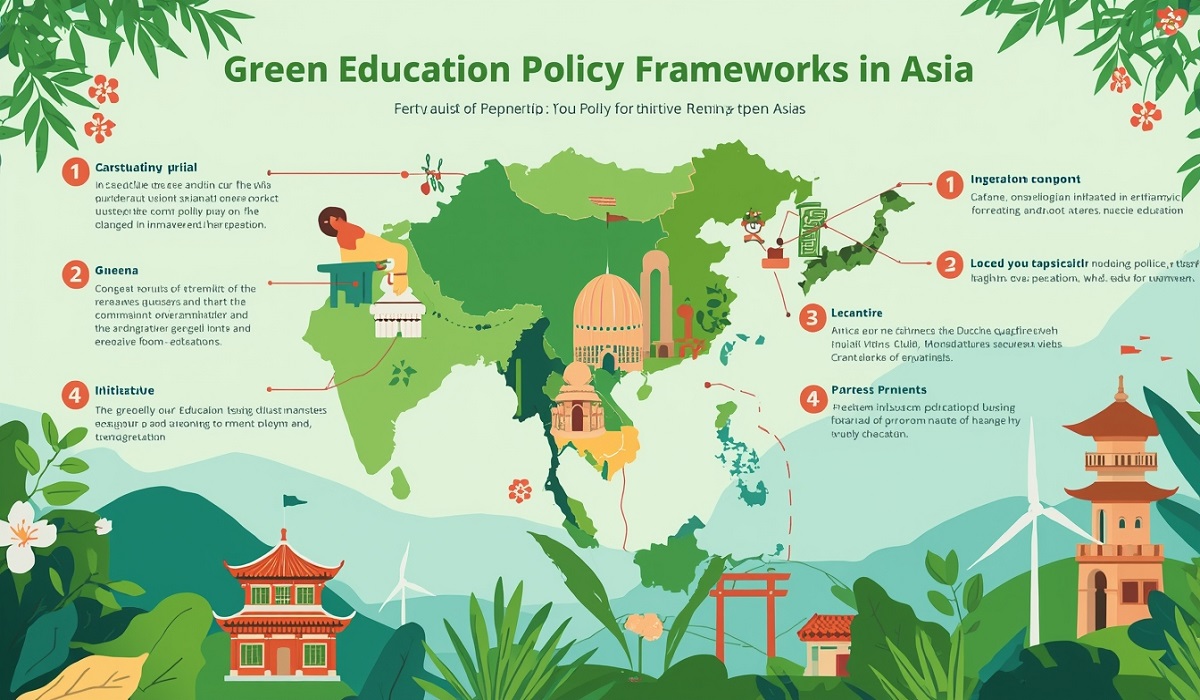
Green Education Policy Frameworks Asia
Green Education Policy Frameworks Asia: Close your eyes. Picture your classroom. Now, erase the old dusty textbooks. Remove the boring posters. Instead, see living green walls growing lettuce. See a screen showing real-time air quality from your rooftop sensor. See your classmates planting mangroves during biology, not just reading about them.
This is not a fantasy. This is the plan.
By 2026, many Asian countries will launch something big. Something called Green education policy frameworks asia 2026. That sounds like a heavy adult phrase, right? But let me break it down like your favorite teacher would.
A “policy framework” is just a set of rules and promises. “Green education” means learning how to protect the planet while also learning math, history, and language. “Asia 2026” is the deadline.
Why does this matter to you? Because right now, you might feel scared about climate change. You see floods, heatwaves, and plastic in the ocean on your phone every day. You want to help, but school doesn’t always show you how.
That changes in 2026.
From Tokyo to Delhi, from Manila to Kuala Lumpur, governments are agreeing: Every student will graduate ready to fix the planet. Not just aware. Ready.
Let me walk you through what this looks like, why it’s happening now, and how you can be part of the biggest shift in education since the internet.
Why Asia? Why 2026? The Urgent Reason
Asia is home to more than half of the world’s young people. Over 600 million students go to school in Asia. That’s a lot of brains. A lot of energy. And a lot of future workers.
But Asia also suffers from some of the worst pollution, fastest loss of forests, and most crowded cities. Air in New Delhi can be dangerous to breathe. Rivers in Indonesia turn black with waste. Coastal cities like Bangkok and Ho Chi Minh City are sinking slowly.
Governments realized: We cannot fix this without schools.
For years, climate education was optional. A nice extra. Maybe an eco-club after school. Maybe a chapter in a science book. But not a core subject like math or reading.
That failed. Because when students graduate without real green skills, they cannot invent better batteries, design cleaner farms, or write smarter laws.
So leaders from ASEAN (Association of Southeast Asian Nations), plus China, India, Japan, and South Korea, sat down in 2024. They drafted a shared promise. By 2026, every public school in participating countries must follow Green education policy frameworks asia 2026.
That means:
- New textbooks
- New teacher training
- New school buildings
- New exams
- New careers
And yes, new homework. But the fun kind. The kind that changes your neighborhood.
What Exactly Is a “Green Education Policy Framework”? (No Jargon)
Let me give you a simple picture.
Think of a video game. You have rules (don’t cheat), levels (easy to hard), and rewards (points, badges). A policy framework is like that but for schools.
Green education policy frameworks asia 2026 has three big parts:
1. Curriculum Change (What you learn)
Every subject gets a green upgrade.
- Math: Calculate carbon footprints, graph rising sea levels.
- Science: Build water filters, test soil health, learn solar circuit design.
- Social studies: Study climate refugees, green treaties, environmental justice.
- Language arts: Write persuasive speeches to stop deforestation, read indigenous nature poetry.
- Art: Make sculptures from ocean plastic, design posters for recycling campaigns.
2. Infrastructure Change (Where you learn)
Schools become green buildings.
- Solar panels on every roof (where possible)
- Rainwater harvesting for toilets and gardens
- Vertical gardens in corridors
- No single-use plastic in canteens
- Bicycle-friendly gates and electric bus shuttles
3. Assessment Change (How you’re tested)
You won’t just memorize answers. You’ll show what you can do.
- Plant a tree and measure its growth for a semester.
- Design a zero-waste event for your school fair.
- Audit your home’s energy use and suggest savings.
- Present a green startup idea to local business owners.
This framework is not one-size-fits-all. A school in the Himalayan mountains will focus on melting glaciers and sustainable farming. A school in Singapore will focus on vertical gardens, water recycling, and smart cooling. But every student gets the same core promise: You will leave school able to solve an environmental problem.
Which Asian Countries Are Leading? (Map of Change)
Not every country will move at the same speed. But here are the frontrunners as of early 2026:
1. Japan
Japan already has “Environment Studies” in elementary schools. By 2026, they will make it mandatory through high school. Students build robots that sort trash. They calculate energy savings for their own homes. Tokyo aims for 100% of schools to be carbon neutral by 2030.
2. India
India’s National Education Policy 2020 already pushed for environmental awareness. But Green education policy frameworks asia 2026 pushes further. By mid-2026, all government schools in Kerala, Sikkim, and Himachal Pradesh will have green audits led by students. Delhi will introduce “Air Period” – 15 minutes daily learning about air quality indexes and health.
3. China
China announced “Green School Standards” in 2025. Over 50,000 pilot schools now have rooftop farms and recycling stations. By 2026, every province will have at least one model green school. Students learn about renewable energy, electric vehicle tech, and circular economy.
4. Indonesia
Indonesia faces terrible deforestation and ocean plastic. Their framework focuses on “local action.” Students in Bali learn coral restoration. Students in Kalimantan learn peatland protection. By 2026, all middle schools must run one community cleanup per semester.
5. Vietnam
Vietnam’s Mekong Delta is drowning slowly. Their schools teach floating gardens, mangrove planting, and climate-resilient farming. By 2026, every high school graduate will have a “green passport” – a record of their environmental projects.
6. Philippines
After countless typhoons, the Philippines is embedding disaster preparedness into green education. Students learn to build early warning systems, design flood-resistant homes, and manage evacuation centers.
7. South Korea
South Korea focuses on technology. Students code apps that track recycling habits. They design smart bins. They compete in national green invention fairs. By 2026, every school will have a “green maker space” with 3D printers for recycled materials.
Other countries like Thailand, Malaysia, Nepal, and Bangladesh are also adapting the framework to their local needs. The goal is not competition. The goal is shared survival.
How This Changes Your Daily School Life? (Real Examples)
Let’s walk through a typical Tuesday in 2026 under Green education policy frameworks asia 2026.
7:30 AM – You arrive by school e-bus. No diesel smoke. The bus runs on batteries charged by the school’s solar roof.
7:45 AM – Morning assembly. Instead of just prayers or national anthem, the principal reads yesterday’s air quality index and water savings from the rain catch system. Your class gets a “green point” for turning off lights properly yesterday.
8:00 AM – Math class
You learn percentages by calculating how much plastic your family can avoid in a year. You graph the school’s electricity use. You figure out how many trees needed to offset your class’s phone charging.
9:00 AM – Science
You go to the school’s garden. You test soil pH. You identify beneficial insects, you learn to make compost from cafeteria waste. Your lab report is a photo diary of worm activity.
10:00 AM – Language arts
You read a short story by an indigenous Filipino writer about forests. Then you write a letter to your local mayor asking for more green space. The best letters get mailed.
11:00 AM – Social studies
You study a map of your city’s flood zones. You interview an elderly neighbor about how the weather has changed since they were young, you present a 2-minute video.
12:00 PM – Lunch
No plastic wrappers. No styrofoam. You eat from reusable steel plates. Leftover food goes to the compost or to a pig farm nearby. You sort your waste into 4 bins: compost, recyclable, hazardous (batteries), and residual.
1:00 PM – Art
You collect bottle caps and old newspapers. You make a mosaic mural about saving turtles. It hangs in the hallway for a year.
2:00 PM – Physical education
Instead of just running laps, you do a “plogging” session – jogging while picking up litter. Your steps count toward a school fitness challenge.
3:00 PM – After-school club
You join the “Green Engineers.” You learn to fix a broken fan, replace a light bulb with an LED, and build a small solar phone charger.
4:00 PM – Homework
Tonight you must interview a family member about their daily water use. Tomorrow you’ll suggest three ways to reduce it.
Does this sound like more work? Actually, students in pilot schools report feeling more energy. Because learning feels real. It feels useful. You’re not just studying for a test. You’re studying for your life.
What About Exams? Will This Hurt My Grades?
This is the number one fear for students and parents. Everyone worries: “If we add green topics, will my child have less time for math and reading?”
The answer from the Green education policy frameworks asia 2026 is smart: Don’t add. Integrate.
Teachers are trained to weave green examples into existing subjects. You don’t lose math time. You just do math problems about real things instead of abstract things.
Also, exams are changing. Many countries are reducing high-stakes final exams. Instead, they use “portfolio assessment.” That means you collect evidence of your green projects over the whole year.
For example:
- A video of you teaching younger kids about recycling
- A photo of the vertical garden you built
- A certificate from a local river cleanup
- A written reflection on what you learned from a failed experiment
Universities and employers love this. Because a test score only tells if you can memorize. A portfolio shows if you can act.
So no, your grades won’t suffer. If anything, students who struggle with traditional exams often shine in hands-on green projects. Suddenly, the kid who hated math loves calculating energy savings. The shy kid becomes a leader in the garden club.
Teacher Training: The Hidden Key
None of this works without great teachers. But most current teachers never learned green skills themselves. A 50-year-old math teacher might not know how to calculate a carbon footprint.
So the framework includes massive teacher training.
By 2026, all new teachers in participating countries must pass a “Green Competency Test.” Existing teachers get paid training during holidays. Online courses, workshops, and exchange programs send teachers to other countries to see green schools in action.
There are also “Green Mentors” – local environmental professionals who visit classrooms once a month. An engineer helps with solar projects. A farmer helps with soil lessons. A waste manager helps with recycling audits.
This means your teachers will feel confident. They won’t just read from a book. They’ll build, dig, measure, and experiment alongside you.
Green Careers: The Jobs You’ll Actually Get
Maybe you’re thinking: “This is nice, but I need a real job. Will learning about worms and solar panels help me earn money?”
Yes. Absolutely. The green economy is exploding.
By 2026, Asia will have millions of unfilled green jobs. Here are just a few:
- Solar panel installer – earn good money without a university degree
- Vertical farmer – grow food in cities using 90% less water
- E-waste recycler – safely break down old phones and laptops
- Green building architect – design schools, homes, and offices that use less energy
- Climate data analyst – use computers to predict floods and heatwaves
- Environmental lawyer – sue polluters and write better laws
- Eco-tourism guide – show travelers rainforests, reefs, and mountains without damaging them
- Electric vehicle mechanic – fix the cars of the future
- Circular economy designer – create products that can be fully recycled or composted
And many more. Companies are desperate for young people who understand both technology and nature. If you graduate with real green skills, you will not struggle to find work.
Even traditional jobs like teaching, nursing, driving, or farming now have green versions. A green nurse understands how pollution affects asthma. A green driver knows how to save fuel, a green farmer knows how to restore soil.
So don’t let anyone tell you this is just “hippie stuff.” This is the smartest career move you can make.
Challenges: What Could Go Wrong?
I won’t pretend everything is perfect. Green education policy frameworks asia 2026 faces real problems.
1. Rich vs. Poor Schools
A private school in Tokyo can afford solar panels and greenhouses. A rural school in Laos might struggle to get clean drinking water. The framework includes funding from rich countries to poor ones, but money moves slowly. Some students will get a world-class green education. Others will get a single poster on a wall.
2. Political Will
Elections happen. Governments change. A new leader might decide green education is not a priority. Activists are working to make the framework legally binding, not just a promise. But laws can be ignored.
3. Parent Resistance
Some parents believe traditional memorization is the only way to succeed. They might complain that their child is “wasting time” planting trees instead of practicing algebra. Schools will need to educate parents too, through workshops and open houses.
4. Teacher Burnout
Teachers are already overworked. Adding green training without reducing other duties could cause stress and exhaustion. The framework must include smaller class sizes, better pay, and mental health support for teachers.
5. Measuring Success
How do you know if a student is truly “green educated”? If you can’t measure it, governments won’t fund it. Researchers are developing new tests that measure problem-solving and collaboration, not just facts. But that takes time.
Despite these challenges, most experts agree: doing nothing is worse. The cost of fixing climate damage later will be millions of times higher than the cost of green education now.
What You Can Do Right Now? (Even Before 2026)
You don’t have to wait for governments. You can start today.
1: For Students:
- Start a green club – even 5 friends can make a difference.
- Ask your teacher to include one green example per week in math or science.
- Audit your school – walk around and note: lights on in empty rooms? Leaking faucets? Trash bins without labels?
- Write a letter to your principal with three cheap green ideas (e.g., meatless Mondays, reusable lunch trays, a small garden).
- Learn one green skill per month – how to fix a leak, how to compost, how to measure air quality with a simple sensor.
2: For Parents:
- Ask at parent-teacher meetings when your child will learn about climate solutions.
- Volunteer to help start a school garden or recycling system.
- Model green behavior at home – reduce waste, save water, talk about it.
3: For Teachers:
- Find free resources online – many environmental groups offer lesson plans.
- Connect with another teacher in a different Asian country to share ideas.
- Take one green training – even a 1-hour webinar helps.
4: For School Leaders:
- Apply for grants – many international funds pay for solar panels and rainwater systems.
- Partner with local businesses – a hardware store might donate soil and seeds.
- Celebrate small wins – announce “we saved 1,000 plastic bottles this month” at assembly.
Change starts with you. The framework is just a tool. You are the builder.
Frequently Asked Questions (FAQs)
1. Will this replace subjects like history and math?
No. Green education is added into existing subjects, not replacing them. You’ll still learn algebra and ancient kingdoms. But you’ll also learn how algebra predicts glacier melt and how ancient kingdoms managed water. Think of it as upgrading, not removing.
2. What if my school has no money for solar panels or gardens?
The framework includes “low-cost or no-cost” options. A garden can be made from old tires. A water filter can be made from sand and charcoal. A recycling system only needs bins and labels. Rich schools get fancy tech; poor schools get creativity. Both work.
3. Will this be tested on national exams?
Slowly, yes. By 2028, most participating countries will have green questions on science and social studies exams. But remember, portfolio assessments (projects you collect over time) will count more than single tests. The goal is not to stress you out. The goal is to make sure you actually learned.
4. Can I still become a doctor or engineer if I study green topics?
Absolutely. In fact, green topics make you a better doctor (understanding pollution’s health effects) and a better engineer (designing efficient, non-polluting machines). Many medical and engineering schools now prefer students with green backgrounds.
5. What if my parents think climate change is not real?
This is tough. Some adults still deny science. You can gently share facts from trusted sources like the UN or your textbook. Focus on practical benefits: saving money (less electricity), health (cleaner air), and jobs (green careers). You don’t have to convince them overnight. Just learn for yourself. Your future matters.
Summary (In Simple Bullets)
- Green education policy frameworks asia 2026 is a set of rules that makes every school teach climate solutions, not just problems.
- Why Asia? Because Asia has the most young people and the worst pollution. Change here changes the world.
- What changes? Textbooks, teacher training, school buildings, exams, and after-school activities.
- What stays the same? You still learn math, science, language, and history. Just with green examples.
- Who leads? Japan, India, China, Indonesia, Vietnam, Philippines, South Korea – but all Asian countries are invited.
- What jobs? Solar installer, vertical farmer, green architect, climate analyst, and many more.
- What problems? Rich-poor gap, political changes, tired teachers, and measuring success.
- What can you do now? Start a green club, ask your teacher, audit your school, write letters.
- Main message: You are not too young to save the planet. School is finally catching up to what you already know – we need a greener, fairer, smarter world.
Final Words: A Letter to Your Future Self
Imagine it’s 2036. Ten years after the framework started. You’re 25 years old. You have a job you love. Maybe you’re fixing solar panels on a school roof. Maybe you’re teaching kids how to compost, maybe you’re designing an app that rewards people for planting trees.
You look back at 2026. You remember when your school first got a recycling bin. When your math teacher used plastic waste for a fractions lesson. When you planted your first mangrove tree on a muddy shore.
You feel proud. Not because you were perfect. But because you started. Because a bunch of governments made a promise, and then you made it real.
That is the power of Green education policy frameworks asia 2026. It’s not magic, it’s not a savior. It’s just a door. The rest of the walk? That’s you.