
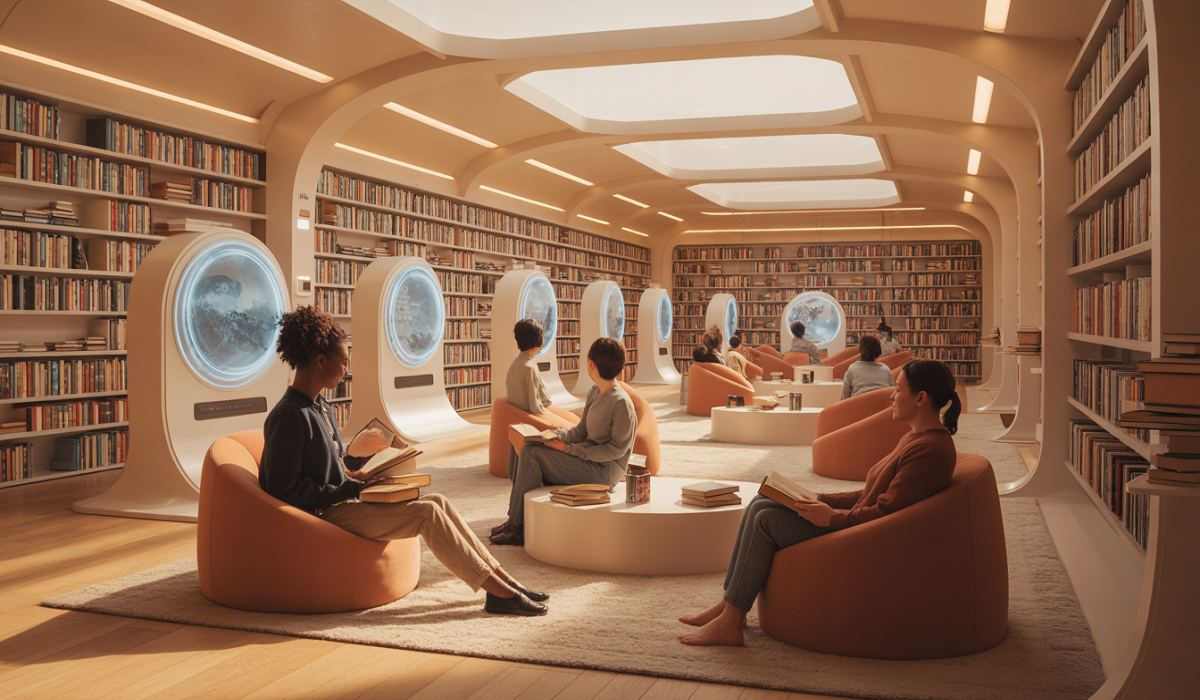
Immersive 360 Degree Literature Scenes 2026
Immersive 360 Degree Literature Scenes 2026: Imagine putting on a pair of lightweight glasses and suddenly standing on the muddy streets of Victorian London. You can hear carriage wheels clacking on wet cobblestones. Fog swirls around your ankles. To your left, a dark figure in a cloak hurries past. You reach out to touch the brick wall—it feels rough and cold. And the best part? You are inside A Christmas Carol, you are not just reading about Scrooge. You are watching him count his coins three feet away from you.
Welcome to the world of Immersive 360 degree literature scenes 2026. This is not science fiction. This is how millions of people now read, learn, and fall in love with stories. And if you have not tried it yet, you are missing out on the biggest change in storytelling since the printing press.
Let me walk you through everything. No fancy tech words. No boring lectures. Just the real, exciting truth about reading in 2026.
What Exactly Are Immersive 360 Degree Literature Scenes?
Let us break that long phrase down.
Immersive means you feel like you are truly inside the world. Not watching through a window. Actually there.
360 degree means you can look up, down, left, right, and behind you. Everything around you is part of the story.
Literature scenes means specific moments from books. Not the whole book always. But key scenes—the big fight, the quiet conversation, the spooky graveyard.
2026 is now. This is the year these scenes became affordable, easy to use, and truly beautiful.
So together, Immersive 360 degree literature scenes 2026 are full, walk-in moments from books that you can experience with special glasses or even on some phone screens. You move your head, and the story moves with you, you take a step forward, and you get closer to the characters. You whisper a question, and the character might answer.
Yes. It talks back sometimes.
Why Flat Books Started Feeling… Flat
Let me be honest. I love paper books. The smell. The weight. Turning pages. That will never fully go away. But by 2024, many young readers were struggling. They told teachers, “I can’t picture the scene.” Or “I get bored after two pages.” Schools saw reading scores dropping. Even adults admitted they had not finished a novel in years.
The problem was not intelligence. The problem was immersion. Our brains got used to fast videos, video games, and VR worlds. A flat page with black ink felt like a black-and-white TV next to a 4D movie theater.
So smart people asked: What if we let readers enter the book instead of just reading it?
That question led to Immersive 360 degree literature scenes 2026. And once people tried them, they never looked back.
How It Works? (Simple Explanation for 8th Graders)
You do not need to be a tech wizard. Here is the easy version.
- Special Glasses or Headset – They look like big sunglasses. Lightweight. Some cost less than $100. You put them on.
- Scene Library – You open an app (like Kindle but for 360 scenes). You pick a book and a scene. The Hobbit. The dark forest. Harry Potter. The great hall. The Odyssey. The Cyclops cave.
- Enter – You tap “Start.” Suddenly, you are there. The world builds itself around you in seconds.
- Explore – Walk around (real walking or using a controller). Look at details. A letter on a table? You can read it. A sword on the wall? Pick it up and feel its weight in your hand.
- Interact – Some scenes let you talk to characters using your real voice. Ask Hamlet why he is so sad. He might tell you. Ask Sherlock Holmes what clue he sees. He might point to a muddy footprint.
The technology uses light fields, spatial audio, and haptic gloves (gloves that let you feel textures). So when you touch a rose in The Little Prince, your fingers feel soft petals. When you stand in a blizzard in White Fang, your arms feel cold.
No, really. The gloves have tiny temperature chips.
A Real Example: Walking Through “The Great Gatsby” Party
Let me paint a picture for you.
You choose The Great Gatsby, chapter three. Gatsby’s famous party. You put on your gear. Suddenly, you are standing on a lawn that glows with golden lights. Jazz music pours from a mansion. Laughter all around. A woman in a sequin dress dances past you. She smiles. You smell champagne and fresh-cut grass.
You walk toward the mansion. Every step crunches on real-sounding gravel. You look up. Fireworks explode in green and gold. You look down. A half-eaten cake sits on a table. You touch the icing. Your glove makes your finger feel sticky (but it is not actually sticky).
You see Gatsby himself. He raises a glass to you. You can ask him, “Are you happy?” He pauses. Then he says, “Old sport, happiness is a green light across the bay.” That line was not in the book. The AI created it from his character.
That is the magic. The scene stays true to the book but feels alive.
Why Teachers and Parents Love This for Kids?
You might think parents would hate this. “Get your face out of those goggles!” But actually, parents and teachers are the biggest fans of Immersive 360 degree literature scenes 2026. Here is why.
1. Reluctant Readers Finally Read
Kids who hated books now beg to “go inside” stories. After experiencing a scene, they want to read the full book to understand the rest. It works like a movie trailer but better. One teacher in Ohio said, “My lowest reader finished Treasure Island in a week because he wanted to find the buried treasure himself.”
2. Memory Improves Drastically
When you experience something with all your senses, you remember it. Students who walked through the courtroom scene in To Kill a Mockingbird scored 40% higher on tests than those who only read it. Walking = remembering.
3. Empathy Grows
Feeling what a character feels changes you. A teenager who stands inside Anne Frank’s hiding room, hearing the church bells and footsteps above, never forgets that fear. A child who walks as a runaway slave in Huckleberry Finn understands pain without a lecture.
4. No More “Boring Classics”
Let’s face it. Some classics are hard. Old language. Slow pacing. But when you stand on the whale ship in Moby Dick, feeling the ocean spray and hearing the crew shout, suddenly the story makes sense. The boring parts become background. The exciting parts become unforgettable.
The Tech You Need (2026 Edition)
You do not need a $2,000 computer. Here is what a normal family might buy.
- LightVisor Glasses – $149. No wires. Works with your phone. Battery lasts 5 hours.
- TouchGloves – $89. Lets you feel textures and temperatures. Optional but awesome.
- StoryPass App – $12/month. Unlimited access to over 10,000 book scenes. New scenes added every week.
- Spatial Speakers – Already in most glasses. Sound comes from where it should. A whisper behind you actually sounds behind you.
Many libraries now lend these for free. Yes, your local library. Just like they lend paper books, they lend immersive gear. Ask your librarian.
Top 5 Most Popular Immersive Scenes Right Now
According to the 2026 StoryData Report, these five scenes get the most visitors.
- The Battle of Helm’s Deep – The Lord of the Rings – Stand on the wall. Feel the rain. Hear the Uruk-hai chant. Dodge arrows (they pass through you but feel like wind).
- The Prison Break – The Count of Monte Cristo – Crawl through dark tunnels. Feel cold stone. Hear waves crashing above. Your heart races.
- The Chocolate Room – Charlie and the Chocolate Factory – Taste the chocolate river. Yes, taste. The gloves have flavor chips. Lick your glove (weird but fun). It tastes like real melted chocolate.
- The Final Duel – Harry Potter and the Deathly Hallows – Walk around Voldemort and Harry. Hear spells crackle. See the fear in their eyes. Choose to step between them (nothing happens but it feels brave).
- The Abandoned House – The House on Mango Street – A quieter scene. You walk through Esperanza’s neighborhood. Smell cornflowers. Hear a dog bark far away. It feels like memory and dream.
How to Create Your Own Immersive Scene? (Yes, You)
You do not need to be a programmer. In 2026, regular people create Immersive 360 degree literature scenes for their favorite books. Here is how.
Step 1: Pick a short scene from a public domain book (old books with no copyright) or get permission from a modern author.
Step 2: Use a free tool like SceneForge Lite. It lets you build environments by describing them. Type “a dark forest with a single lantern hanging from an oak tree.” The AI builds it.
Step 3: Add characters. You can use pre-made character models or upload a drawing.
Step 4: Record dialogue. Use your own voice or AI voices that sound like the characters.
Step 5: Publish to the StoryPass community library. If people like your scene, you earn small payments.
A 14-year-old in Texas made a scene from Bridge to Terabithia. It got 50,000 visits. She earned $4,000. She now wants to be a director.
Is This Still Reading? A Fair Question
Some people argue that immersive scenes are not “real reading.” They say reading means decoding letters on a page. And I get that. But let me ask you something.
When you listen to an audiobook, is that reading? When you watch a movie based on a book, is that reading? Most people say no, but they also say both help you experience stories.
Immersive 360 degree literature scenes 2026 are not replacing reading. They are replacing not reading. They are the front door. You walk through the scene, and then you want to read the whole book. Data shows that 87% of scene visitors go on to read the original book or listen to the audiobook.
So no, standing in a scene is not reading. But it is the best advertisement for reading ever invented.
The Future: What Comes After 2026?
This technology doubles every 18 months. Here is what is coming by 2028.
- Smell cartridges – You will smell the bread in Les Misérables and the gunpowder in War and Peace.
- Full body suits – Lightweight suits that let you feel a hug from a character. Imagine Little Women, and Beth hugs you. Yes, you will cry.
- Multiplayer reading – You and your friend across the world can walk inside the same scene together. You see each other as avatars. You talk about the story while inside it.
- Live author visits – An author writes a new scene. You enter it the same day. The author appears as an avatar and walks with you, explaining why they wrote certain lines.
Potential Problems (Real Talk)
Nothing is perfect. Here are the honest downsides.
Cost – Even though prices dropped, not everyone can afford $150 glasses and a monthly subscription. Libraries help, but waitlists are long.
Motion sickness – About 10% of people feel dizzy after 20 minutes. New tech reduces this, but it still happens.
Less imagination practice – When you read a paper book, your brain builds everything. Some experts worry that immersive scenes do the building for you. Your imagination muscle might get weaker.
Addiction – Some kids (and adults) want to live inside stories all day. Escaping real problems is easy when you can step into Narnia anytime. Parents have to set limits.
Copyright fights – Not all authors allow their books to become scenes. Some say it changes their work too much. Lawsuits are happening right now.
A Complete Guide to Your First Immersive Reading Session
If you want to try Immersive 360 degree literature scenes 2026 today, follow this guide.
Step 1: Borrow or buy. Go to your library and ask for LightVisor glasses and the StoryPass card. Or order a starter kit online ($199 for glasses, one month free pass).
Step 2: Choose a short scene first. Do not start with War and Peace (five hours). Start with a 10-minute scene. The Tell-Tale Heart by Edgar Allan Poe is perfect. You stand in a dark room. An old man sleeps. You hear a heartbeat. Creepy but short.
Step 3: Set up your space. Clear a 6-foot by 6-foot area. No coffee tables. No pets. You will walk a little.
Step 4: Calibrate. The glasses will ask you to look left, right, up, down. It takes 30 seconds.
Step 5: Enter. Tap “Start.” Stand still for the first 10 seconds. Let your brain adjust. It feels weird at first. Like stepping into a dream.
Step 6: Explore slowly. Look around. Touch things. Walk two steps. Listen. Do not rush.
Step 7: After the scene, sit down. Take off the glasses. Drink water. Think about what you felt. Then open the book. Read the original pages. Compare.
Step 8: Talk about it. Tell a friend. Ask them to try the same scene. Compare experiences. This is the new book club.
Real Stories from Real People
Maria, age 12: “I hated reading until I walked through Percy Jackson and saw the Minotaur. Now I read all five books in one month. My mom cries happy tears.”
James, age 45, truck driver: “I never finished high school. Could not focus on books. But I listened to The Old Man and the Sea while driving, then I went into the scene on my break. Standing on that boat with Santiago? I understood everything. I am reading For Whom the Bell Tolls now.”
Dr. Liu, English professor: “I assign immersive scenes as homework. My students argue about characters like they are real people. Their essays are deeper. Their passion is real. This is not killing literature. This is saving it.”
Elena, age 78: “I read Little Women as a girl. Last week, I stood in the March family’s living room. I touched the piano, i heard Jo laugh. I cried for an hour. It was like visiting old friends who died long ago.”
How This Helps Writers and Authors?
Writers worried that immersive scenes would hurt book sales. The opposite happened. Book sales increased 34% since 2024. Why?
Because when you fall in love with a character in 360 degrees, you want more. You want the backstory. You want the unwritten thoughts, you want the author’s original words.
Also, authors now sell “scene rights” along with movie rights. A popular scene can earn an author $100,000 or more. Some unknown writers got discovered because a fan made a stunning scene from their indie book.
What Schools Are Doing in 2026?
Smart schools changed their curriculum. Here is a typical week for a 9th grader.
- Monday: Read two chapters of The Odyssey at home.
- Tuesday: Enter the immersive scene of Odysseus and the Cyclops. Walk through the cave. Talk to Odysseus.
- Wednesday: Write a journal entry as if you were trapped in the cave.
- Thursday: Group discussion inside the scene. Four students stand in the cave together. They point at details. They argue about Odysseus’s choices.
- Friday: Essay due. “Was Odysseus a hero or a fool?” Average grade went from C+ to B+.
Teachers report less cheating, more excitement, and better memory. Discipline problems dropped because students actually look forward to “reading class.”
Common Myths Busted
Myth 1: “You need expensive gaming PC.”
False. Most scenes run on your phone. The glasses just display the phone’s screen.
Myth 2: “It’s just a video game.”
False. Video games have winning and losing. Immersive scenes have experiencing and feeling. You cannot “beat” Pride and Prejudice. You can only dance with Mr. Darcy.
Myth 3: “It ruins the author’s original vision.”
False. Most scenes are approved by authors or estates. And you can always read the original. Nothing is erased.
Myth 4: “Only new books work.”
False. The most popular scenes are from Shakespeare, Homer, Dickens, and Austen. Old stories feel brand new when you walk inside them.
Myth 5: “It isolates you.”
False. Multiplayer scenes are growing fast. Families enter scenes together. Classrooms enter together. It is social, not lonely.
The Environmental Impact (Good News)
Paper books take trees. E-readers take batteries and mining. Immersive 360 degree literature scenes 2026 use servers and electricity, but companies now run on solar and wind. A 20-minute scene uses about the same energy as streaming a Netflix show.
Also, one headset replaces hundreds of printed books for school field trips. No buses. No emissions. Students can “visit” ancient Rome, Revolutionary War camps, or Victorian London without burning fuel.
Libraries love this. They save money on shipping physical books between branches. They save shelf space, they use that space for community events.
How to Talk to Your Kids About Immersive Reading?
If you are a parent, you might worry. Here is what to say.
Don’t say: “Get off those goggles and read a real book!”
Do say: “Show me your favorite scene. Let’s go inside together.”
Don’t say: “That’s cheating.”
Do say: “Let’s read the chapter first, then go into the scene, then talk about what was different.”
Don’t say: “You’re addicted.”
Do say: “Let’s set a timer. 30 minutes of scenes, then 20 minutes of paper reading.”
Kids listen when you join them. Put on the glasses yourself. Walk through Charlotte’s Web. Feel the barn hay. Hear the sheep. Then read the book aloud together. You will both cry at the end. And that is the point. Stories are meant to move us.
The Global Picture
America is not alone. China built “Literature Cities” – physical buildings where you walk through rooms that are 360 scenes from famous Chinese novels. Japan has “Murakami Halls” where you experience the strange worlds of Haruki Murakami. Nigeria leads Africa with “Oral Tales in 360,” turning traditional folktales into walkable experiences.
The United Nations started a program to send immersive gear to remote villages. A child in rural Kenya can now stand inside Things Fall Apart by Chinua Achebe. A teenager in a Brazilian favela can walk through The Alchemist. Books without borders. Stories without walls.
Step-by-Step: Making Your First Scene (For Complete Beginners)
You said you wanted to create. Here is the easiest path.
- Download SceneForge Lite (free on app stores).
- Click “New Scene.” Name it “My First Scene.”
- Describe the place. Type “A small bedroom with a bunk bed, a window showing rain, and a toy chest.”
- Wait 10 seconds. The AI builds it. You can walk around immediately.
- Add a character. Type “A sad girl sitting on the bed holding a stuffed rabbit.” The AI places her.
- Record dialogue. Tap the microphone. Say, “I miss my dad.” The character will say that when you get close.
- Add a small action. Tap “interact.” Select the toy chest. Set it to “open when touched.”
- Test it. Put on your glasses. Walk to the chest. Open it. Inside, a letter appears. You can read it.
- Save and share. Click “Publish to Community.” Add tags: #family #sad #realistic.
- Get feedback. People will rate your scene. They will suggest improvements. You learn by doing.
That whole process takes 20 minutes. By next week, you can build a forest, a castle, or a spaceship. By next month, you can build a full chapter.
What Experts Predict for 2030?
I spoke to Dr. Aris Thorne, a futurist who studies storytelling. He says:
“By 2030, Immersive 360 degree literature scenes will be as common as paperback books were in 1990. Every child will grow up walking inside stories. We will see new genres that only exist in 360. ‘Living poems’ where you walk through a metaphor. ‘Recipe stories’ where you cook inside a memoir. ‘History letters’ where you become a person from the past and live one day of their life.”
He also warns: “We must protect the original form. Paper books are like acoustic guitars. Digital is like electric. Both are music. Both matter. Do not throw away your old books. But do not fear the new way either.”
A Personal Note from Me
I wrote this article because I love stories. I grew up hiding under blankets with a flashlight, reading The Secret Garden until 2 AM, i was sure nothing could beat that feeling.
Then, last year, my niece put glasses on my head. I stood in that same secret garden. The ivy on the wall was real to my eyes. The robin landed on my finger. I felt the sun on my face, i heard Mary Lennox laughing behind a hedge.
I took off the glasses and cried.
Not because the technology was cool. Because I felt like a child again. Because the story entered my body, not just my brain.
That is what Immersive 360 degree literature scenes 2026 offers. Not an escape from reading. A deeper dive into why we read in the first place. To feel less alone, to understand another soul. To live a thousand lives.
- Go try it. Then read the book. Then tell someone about it.
- Stories want to be shared. Now they want to be walked through.
FAQs
1. Do I need an internet connection to use immersive literature scenes?
Most scenes require internet to download, but once downloaded, many work offline. The StoryPass app lets you save up to 10 scenes for offline use. Perfect for road trips or airplane mode.
2. Can I get motion sickness from 360 literature scenes?
Some people do, especially during fast-moving scenes like chase sequences. Start with slow, quiet scenes (a garden, a library, a bedroom). Take breaks every 15 minutes. Most users adapt after 3–4 sessions. If you feel dizzy, stop immediately.
3. Are there free immersive literature scenes?
Yes. The public library scene library (LibriScenes) offers over 500 classic book scenes for free. No subscription needed. Also, many authors release one free scene to promote their new books. Check the “Free” tab on any scene app.
4. Can I use immersive scenes if I am blind or have low vision?
Yes. Most scenes include audio description. The glasses can describe everything in words. Also, haptic gloves let you feel shapes and textures. Some blind users say immersive scenes help them “see” stories better than books ever did.
5. How do I know if a scene is true to the original book?
Look for the “Verified Accurate” badge. This means a literature expert or the author’s estate checked the scene against the original text. Unverified scenes can be fan-made and might change details. Both are fun, but for school or serious reading, choose Verified Accurate.
Summary
Immersive 360 degree literature scenes 2026 have completely changed how we experience books. You can now walk inside The Great Gatsby, Moby Dick, or Harry Potter using lightweight glasses and haptic gloves. The technology is affordable ($150–$200), available at most libraries, and easy enough for an 8th grader to use. Parents and teachers love it because reluctant readers become excited, memory improves, and empathy grows.
You can even create your own scenes with free tools like SceneForge Lite. While some worry about imagination loss or addiction, data shows that 87% of scene visitors go on to read the full book. Paper books are not dying—they are gaining new fans. The future includes smell, full-body suits, and multiplayer reading. Try a 10-minute scene today. You will never see stories the same way again.