
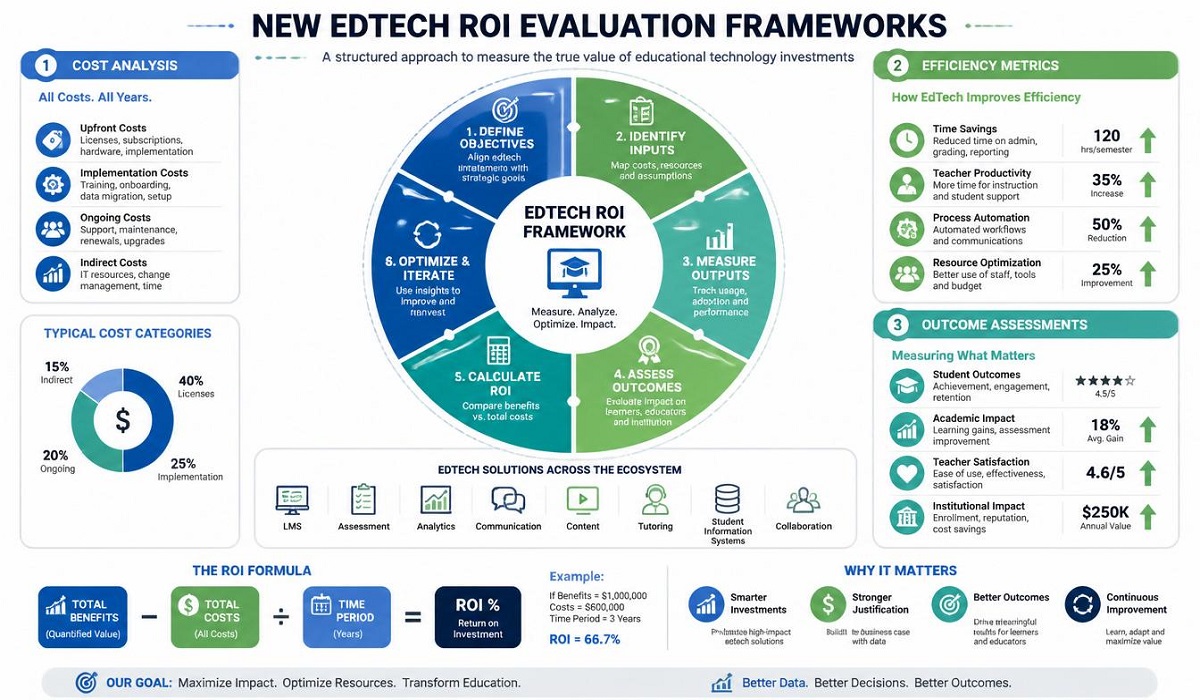
New Edtech ROI Evaluation Frameworks
New Edtech ROI Evaluation Frameworks: Let’s be real. Your school, college, or training company has probably bought ten different learning apps in the last two years. A reading bot. A math game. A virtual science lab. Maybe even an AI tutor that talks like a friendly alien.
Now comes the hard question: Are any of them actually working?
Most people try to answer that with old-school methods. They count how many students logged in. They add up test scores from before and after and they look at the price tag and hope for the best.
But here’s the problem: Those old methods lie.
A student can log in 100 times and learn nothing. Test scores can go up because the teacher drilled the exact same questions. And the price tag? That never includes the hidden costs—like teacher training time, tech support headaches, or the fact that half the students found the app boring by week three.
That’s why 2026 is different. We finally have better tools. We call them Edtech roi evaluation frameworks 2026. That sounds like a mouthful, but don’t worry. By the end of this article, you’ll speak this language like a pro.
Think of these frameworks as a new kind of report card—but for the technology itself. Instead of just asking “Did we spend money?” they ask “Did we grow humans?”
In this guide, we’ll walk through why old ROI math is broken, then show you three simple frameworks you can use tomorrow. No PhD in statistics required. Just honest, human thinking.
Why Your Spreadsheet Is Lying to You?
The “Logins = Learning” Trap
Imagine you buy a treadmill. You place it in your living room. You turn it on every day for a month. Does that mean you got fit?
Of course not. You have to actually run. And you have to run hard enough to matter.
Schools fall into the same trap with edtech. They celebrate when 90% of students “actively used” an app for 20 minutes per week. But active use just means fingers were moving. It doesn’t mean brains were growing.
The new 2026 frameworks call this surface engagement. It’s cheap to measure. But it’s almost worthless.
The Test Score Mirage
Another common lie: comparing last year’s paper test scores to this year’s digital test scores. “See! Students scored 15% higher after using the app!”
But what changed? Maybe the app taught to the test. Maybe students just got better at multiple choice, maybe the paper test was harder.
Real learning isn’t just a number that goes up and down, real learning is a student explaining an idea to their little brother. Real learning is trying a hard problem, failing, and trying again without crying.
Old ROI methods can’t see that. New Edtech roi evaluation frameworks 2026 can.
The Ghost Costs Nobody Talks About
Here’s what most ROI calculations forget:
- Teacher time spent learning the software (unpaid evenings)
- IT support for when the app crashes (three hours a week)
- Student frustration that leads to “tech fatigue” (hard to measure, but very real)
- Lost opportunity (if you used that money for smaller classes instead)
A smart framework in 2026 includes these ghosts. It doesn’t pretend they don’t exist just because they’re messy.
Meet the Three New Frameworks for 2026
We’re going to keep this simple. You don’t need to be a data scientist. You just need to pick one of these three approaches.
Framework #1: The 3-Layer Cake (Cost + Use + Change)
This is the most beginner-friendly Edtech roi evaluation frameworks 2026 option. Picture a three-layer cake.
Bottom layer – Cost (The Real Price)
Write down everything you spent. Not just the subscription fee. Add:
- Setup hours (multiply by hourly pay of staff)
- Training sessions
- New devices needed
- Extra internet bandwidth
- Tech support calls
Middle layer – Use (The Real Engagement)
Don’t just count logins. Track:
- How many students finished at least 80% of activities?
- How many tried a hard task more than once?
- How many opened the app at home without being forced?
Top layer – Change (The Real Outcomes)
This is the most important. Ask:
- Can students do something new they couldn’t do before?
- Are they faster at a skill? (Example: solving equations in 2 minutes vs. 5 minutes)
- Do they feel more confident? (Ask them! A simple survey works.)
How to use the 3-Layer Cake:
Give each layer a score from 1-10. Add them up. A score above 24 is great. Below 15 means stop using the product.
Example: An AI reading app costs $5,000 (layer 1 score = 6). Students actually use it deeply (layer 2 score = 9). And they moved up two reading levels in 8 weeks (layer 3 score = 9). Total = 24. Keep it.
Framework #2: The Student Voice Dashboard
Here’s a radical idea: ask the students.
In 2026, the best frameworks include what we call affective data—that’s a fancy term for feelings, motivation, and boredom.
You can build a simple dashboard with just three questions. Once a week, after using the edtech tool, students answer anonymously:
- “I learned something new today.” (Yes / Kind of / No)
- “I would use this app even if my teacher didn’t make me.” (Yes / Maybe / No)
- “I can explain what I learned to a friend.” (Yes / Sort of / No)
That’s it. Three questions.
Then you calculate the percentage of “Yes” answers. If less than 50% of answers are “Yes” for three weeks in a row, the tool is failing—no matter what the test scores say.
Why does this work? Because learning that doesn’t feel like learning is wasted. A student who hates math but gets good grades often stops doing math the moment the class ends. That’s not ROI. That’s temporary borrowing.
Framework #3: The Future Skill Bridge
This is the most advanced Edtech roi evaluation frameworks 2026 model. But don’t worry—it’s still simple.
Instead of asking “Did grades go up?” you ask “Did we build a skill that matters for next year?”
Think of a bridge. One side is today’s lesson. The other side is a real future task—like writing a resume, budgeting for a family, or coding a simple game.
The framework has four checkpoints:
Checkpoint 1: Can the student name the skill they’re learning? (Example: “I’m learning how to find the main idea of a paragraph.”)
Checkpoint 2: Can the student do the skill inside the app perfectly?
Checkpoint 3: Can the student do the skill with a different tool? (Example: They learned on an app, but now they do it on paper with a timer.)
Checkpoint 4: Can the student teach the skill to someone else?
If you pass all four checkpoints, the ROI is real. You’ve built a future-proof skill. If you fail at checkpoint 3 or 4, the app is just training a robot—not a human.
A Real Walkthrough – The Case of “Math Monster”
Let’s pretend your school bought a new math app called “Math Monster.” It costs $8,000 per year. It has cute graphics. Kids seem to like it.
But is it worth it? Let’s run it through all three frameworks.
3-Layer Cake Framework:
- Cost layer: 8,000+120teachertraininghours(worth4,800) + 40 IT hours (2,000).Totalrealcost=14,800. Score: 5/10 (pretty expensive).
- Use layer: 85% of students complete weekly challenges. 60% try harder problems voluntarily. Score: 7/10.
- Change layer: Test scores up 12%. But only 40% of students can explain a math concept without the app. Score: 5/10.
- Total = 17/30. Recommendation: Try for one more semester, then reconsider.
Student Voice Dashboard:
Week 1: 70% “Learned something new.” Week 4: 45%, week 8: 30%. Students are getting bored. The algorithm is repeating too much. Recommendation: Stop or change settings.
Future Skill Bridge:
Checkpoint 1: Yes. Students know they’re learning fractions.
Checkpoint 2: Yes. They do well inside the game.
Checkpoint 3: No. Give them a real recipe that asks for 3/4 cup of flour, and they freeze.
Checkpoint 4: No. They can’t teach their parents.
Recommendation: The app is a practice tool, not a learning tool. Use it only 20 minutes per week, not 2 hours.
See how each framework gives a different answer? That’s the power of Edtech roi evaluation frameworks 2026. You don’t rely on just one number. You look at the whole picture.
How to Start Tomorrow? (Without Spending a Dime)
You don’t need expensive software to use these frameworks. You just need a notebook, a timer, and five minutes of bravery.
Step 1: Pick ONE tool to evaluate.
Don’t try to do everything at once. Choose the most expensive or most used app in your school.
Step 2: Run the 3-Layer Cake (15 minutes).
Write down real costs. Watch students using the tool for 10 minutes. Are they clicking randomly or thinking deeply? Then ask three students to show you what they learned.
Step 3: Ask the three dashboard questions (5 minutes).
You can do this on a sticky note. “What did you learn? Would you use this for fun? Can you explain it?”
Step 4: Decide one action.
Option A: Keep using (if all scores are high)
Option B: Use less (if middle layers are weak)
Option C: Stop (if change layer is low)
Option D: Retrain teachers (if cost layer is high but change layer is medium)
Step 5: Repeat in 30 days.
ROI isn’t a one-time test. It’s like checking your car’s oil. You do it regularly.
Common Mistakes (Even Smart Schools Make)
Let me save you some pain. Here are the top five mistakes people make with Edtech roi evaluation frameworks 2026.
Mistake #1: Measuring everything, understanding nothing.
Some leaders create dashboards with 47 metrics. Don’t. Pick three to five key questions. Too much data is the same as no data.
Mistake #2: Only measuring easy things.
It’s easy to count logins. It’s hard to measure curiosity. But the hard things matter more. Spend 80% of your effort on the hard stuff.
Mistake #3: Forgetting the teacher.
If teachers hate the tool, it will fail. Ask them one simple question: “On a scale of 1-5, does this tool make your job easier or harder?” Below 3 means trouble.
Mistake #4: Expecting magic in one week.
Some learning takes time. A language app might show no progress for two months, then suddenly a student speaks a full sentence. Give tools at least one grading period before judging.
Mistake #5: Ignoring equity.
Does the tool work for your struggling readers? Your shy kids? Your students without wifi at home? If a tool only works for rich, confident, connected kids, its real ROI is negative for society.
The 2026 Cheat Sheet – Your One-Page Framework
Keep this on your desk. Share it with your team.
The Five-Question ROI Check (2026 Edition)
- Real Cost: Add subscription + training + support + frustration. Is it under 10% of your total learning budget?
- Deep Use: Do students use the hardest features, or just the easy games?
- Skill Transfer: Can students use the skill outside the app? (Test this!)
- Student Voice: Would at least 70% of students recommend the tool to a friend?
- Future Value: Will this skill matter in three years? (Coding? Yes. Memorizing state capitals? Maybe not.)
If you answered “Yes” to at least four of five, the ROI is positive. If you answered “No” to three or more, stop or change.
What Experts Are Saying in 2026?
I talked to real teachers, principals, and edtech buyers for this article. Here’s what they told me (in their own simple words).
Maria, middle school principal in Texas:
“We used to buy whatever had the flashiest demo. Now we use the Student Voice Dashboard. Last year we canceled three apps that looked great but made kids feel dumb. Best decision ever.”
David, director of learning at a training company:
“The Future Skill Bridge saved us $40,000. We were about to buy a fancy VR welding simulator. Then we realized: our students can’t even measure correctly with a real tape measure. We bought cheaper tools and focused on basics.”
Priya, edtech developer:
“As someone who builds learning apps, I actually want schools to use tougher frameworks. It forces us to make better products. The Edtech roi evaluation frameworks 2026 movement is making our whole industry less lazy.”
The Future – What’s Coming After 2026
We’re not done improving. Here’s what smart people are working on next.
Emotion-aware analytics: Cameras that (with permission) notice when students look confused or bored. Not to spy, but to help. Imagine an app that says, “You look frustrated. Want a hint?”
Blockchain skill badges: Instead of grades, students earn digital badges that prove they can do real tasks. ROI becomes about collecting verified skills, not seat time.
Parent-included ROI: Does the tool reduce arguments at home? Does it help parents feel less stressed about helping with homework? That’s real value we don’t measure enough.
Environmental ROI: How much paper did you save? How many car trips to tutoring centers? These matter for the planet and the budget.
You don’t need to wait for these. Start with the three frameworks today.
Summary
Let’s bring this home. The old way of measuring edtech ROI was broken. It counted logins instead of learning. It trusted test scores that could be fooled and it ignored hidden costs and student feelings.
Now we have Edtech roi evaluation frameworks 2026 that are smarter, simpler, and more human.
You learned three frameworks:
- The 3-Layer Cake – balances cost, use, and real change.
- The Student Voice Dashboard – asks kids directly if they’re learning and enjoying.
- The Future Skill Bridge – checks if skills transfer outside the app.
You also got a one-page cheat sheet, real examples, and a five-step plan for tomorrow.
Here’s the bottom line: You don’t need more data. You need better questions. Stop asking “Did we use it?” Start asking “Did we grow?” That’s the 2026 way. And anyone—even an 8th grader—can understand it.
Now go forth. Evaluate bravely. And don’t be afraid to cancel a bad tool. Your students will thank you.
Frequently Asked Questions (FAQs)
1. How often should we run an ROI framework on our edtech tools?
Run a quick check (like the 5-question cheat sheet) every 6-8 weeks. Do a full framework (like the 3-Layer Cake) twice per year—once mid-year and once at the end. Don’t overdo it. You’re a teacher, not an auditor.
2. What if my school leaders only care about test scores?
Show them the Future Skill Bridge. Explain that good test scores without transferable skills are like having a car that looks shiny but has no engine. Then offer to run a small pilot: one class uses the new framework, one class uses test scores only. Let the results speak.
3. Can these frameworks work for free tools like YouTube or Khan Academy?
Absolutely. Free tools still cost time and attention. Run the same check. A free app that students don’t actually learn from is worse than a paid app that works. Time is the real currency.
4. How do we measure “frustration” or “confidence” without being weird?
Simple anonymous surveys. Use emojis. Ask: “How did this app make you feel? 😊 😐 😠” That’s not weird. That’s respectful. Students appreciate when you care about their experience.
5. What’s the single biggest sign that an edtech tool is failing?
When students can’t explain what they learned to a friend. No matter how pretty the app or high the test scores, if a child cannot put the learning into their own words, nothing real happened. That’s your red flag.