
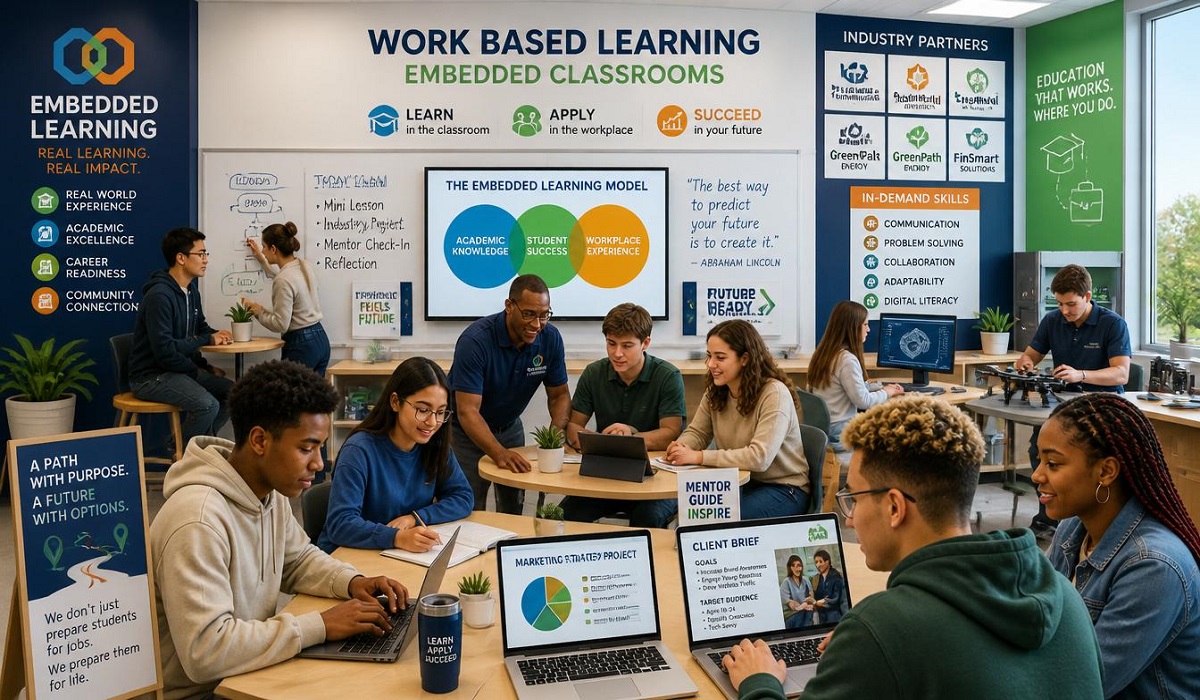
Work Based Learning Embedded Classrooms
Work Based Learning Embedded Classrooms: Imagine walking into a high school classroom. Instead of rows of desks with students quietly filling out worksheets, you see small teams designing a real marketing campaign for a local bakery. Across the hall, another group is testing soil samples for a city park project. In the back, three students are fixing a small engine while their teacher—and a local mechanic—watch and guide them.
This is not a dream. This is the reality of work based learning embedded classrooms 2026. And it is changing everything we thought we knew about school.
For decades, students sat through classes hoping that one day, after twelve or sixteen years, they would use what they learned. But in 2026, that wait is over. The line between “learning” and “working” has become fuzzy. And that is a very good thing.
Let’s walk through what this new classroom looks like, why it works, and how it prepares young people for real life—without boring them to death first.
What Does “Work Based Learning Embedded Classrooms” Actually Mean?
Big phrases can be scary. Let’s break it down.
Work based learning means you learn by doing real jobs. Not pretend jobs. Not “imagine you are a manager.” Real tasks that a real business or organization needs done.
Embedded classrooms means these work tasks are not after-school programs or summer internships. They are inside the regular school day. During history class. During science, during math.
So work based learning embedded classrooms 2026 means: your normal classroom has become a mini workplace. You still learn fractions, grammar, and chemical reactions. But you learn them while building something useful for the real world.
Think of it like a cooking show. The chef does not just tell you how to chop an onion. You chop the onion while she explains it. And at the end, you eat the soup. In these classrooms, the “soup” is a real project that helps someone.
Why 2026? The Perfect Storm for Change?
You might ask: why is this happening now in 2026? Good question.
Three big things came together:
- Employers got tired of training new hires. Companies realized that diplomas did not guarantee basic skills like showing up on time, solving problems, or talking to customers. They begged schools to change.
- Students got bored. By 2024, nearly half of high school students said school felt useless. They wanted to see the point. When you ask a teenager to sit still for six hours doing abstract math problems with no real use, they check out.
- Technology made it easy. In 2026, every classroom has fast internet, project management apps, and video calls. A teacher in a small town can connect students with a business three states away. The world became the classroom.
So schools finally said: “Let’s stop preparing students for life. Let’s let them live while they learn.”
And that is exactly what work based learning embedded classrooms 2026 does.
The Old Way vs. The New Way: A Side-by-Side Look
Let me show you the difference. It will help you see why this is not a small change. It is a whole new world.
The Old Classroom (before 2026)
- Teacher talks. Students listen.
- Homework is worksheets or essays.
- You learn a skill in September. You maybe use it in a test in December. You never use it again.
- Grades come from tests and quizzes.
- Work experience starts after graduation.
- Students ask: “When will I ever use this?”
The Work Based Learning Embedded Classroom (2026)
- Teacher explains a concept briefly. Then students do it.
- Homework is real tasks: “Finish the social media post for the animal shelter by Thursday.”
- You learn a skill and use it the same week—sometimes the same hour.
- Grades come from project quality, teamwork, and problem-solving.
- Work experience starts in 9th grade.
- Students say: “This actually matters.”
See the difference? One is a museum of facts. The other is a workshop.
What Does a Typical Day Look Like? Let’s Visit One.
Walk with me into a real work based learning embedded classrooms 2026. Let’s pick a 10th grade class called “Applied Math and Local Business.”
8:30 AM – The teacher (Ms. Chen) spends 15 minutes explaining profit margins. Short lesson. Straight to the point.
8:45 AM – Students log into a secure portal. They see three real requests from local businesses:
- Bakery needs help calculating costs for a new cupcake flavor.
- Landscaping company wants a bid for a driveway job.
- Nonprofit needs a budget for a fundraising event.
8:50 AM – Students form teams. Each team picks one request. They are not pretending. The business will actually use their work.
9:00 AM to 10:30 AM – The room buzzes. One team calls the bakery owner on a classroom tablet. Another team measures a sample driveway drawn on the floor. Another team uses spreadsheets to track donation income.
10:30 AM – Teams stop. They share one “win” and one “problem” from the morning. Ms. Chen gives quick feedback.
11:00 AM – Students switch to a different subject. But even in English class, they write a proposal for their math project. In history, they research how small businesses started in their town.
See how subjects blend? The school day is not chopped into isolated boxes. Everything connects around real work.
By Friday, each team delivers something useful. The bakery gets a pricing guide. The landscaper gets a bid. The nonprofit gets a budget.
That is work based learning embedded classrooms 2026 in action.
Why Students Love It? (And Why You Will Too)
Let’s be honest. Most students do not wake up excited for school. But in these classrooms, something shifts.
Here is what students say:
- “I know why I’m learning this.” – When you need fractions to mix concrete for a real garden project, fractions stop being boring. They become tools.
- “I made something that matters.” – There is a deep human need to be useful. These classrooms give that feeling every week.
- “Mistakes are not failures. They are edits.” – In real work, you mess up, you fix it, you move on. That is normal. Students lose their fear of being wrong.
- “Adults listen to me.” – When you present a real budget to a real business owner, that owner thanks you. That respect changes how students see themselves.
One student told me: “Last year, school was a prison. This year, school is my job. And I actually like my job.”
That is powerful.
Teachers Are Not Replaced. They Are Upgraded.
Some people worry: “Does this mean teachers become useless?” Not at all. But their job changes.
In work based learning embedded classrooms 2026, a teacher is not a “sage on the stage.” They are a “guide on the side.”
Here is what teachers do now:
- They find real projects from local businesses.
- They teach short, focused lessons on exactly what students need for that project.
- They coach teamwork and communication.
- They help students reflect: “What worked? What would you do differently?”
- They grade process, not just final answers.
It is harder than standing at a whiteboard. But most teachers say it is more fun. They get to see students light up. They get to do creative work themselves.
And schools help by giving teachers planning time and business partners. No teacher does this alone.
What About Tests? What About College?
I hear you. Parents and principals ask this all the time.
Do students still learn reading, writing, and math? Yes. But they learn it deeper. When you write a proposal for a real client, your grammar matters. When you measure materials for a build, your math must be exact. There is no “close enough.”
Do students still take standardized tests? In most places, yes—but less often. Many states in 2026 now allow “performance-based assessments.” That means a student can submit a portfolio of real work projects instead of a multiple-choice test. Some colleges accept these portfolios too.
Is this only for kids who don’t want college? No. Even future doctors, lawyers, and engineers benefit. A pre-med student who learned to communicate with real patients in high school? That is gold. A future engineer who already managed a real budget? That is ahead of the game.
Work based learning embedded classrooms 2026 prepares everyone. College-bound kids get real-world context. Job-bound kids get real-world skills. Everyone wins.
How Businesses Benefit? (And Why They Line Up to Help)
Businesses are not doing this just to be nice. They get real value.
Here is what a local hardware store owner told me: “I had three high school students redesign my shelf labeling system. It saved me 12 hours of work and increased sales by 8%. I paid them nothing—they did it for class credit. But now I want to hire all three.”
Businesses get:
- Free or low-cost help on real problems.
- A chance to try out future employees before hiring.
- Good reputation in the community.
- Young people who actually understand how business works.
That is why, in 2026, thousands of companies have partnered with schools. From pizza shops to tech startups. From farms to hospitals.
Does This Work for Every Student? Even Struggling Ones?
Yes. And sometimes especially for struggling ones.
Consider a student named Marcus. In a normal classroom, Marcus could not sit still. He talked too much. He rushed through worksheets. His grades were low.
But in a work based learning embedded classroom 2026, Marcus thrived. Why? Because the classroom rewarded his energy. He was great at talking to people. He was great at solving problems fast. When his team needed someone to call a business to ask a question, Marcus volunteered. When the project hit a snag, Marcus jumped in.
His grades did not just improve. His confidence soared. For the first time, school made sense for him.
Now think about a quiet student named Priya. She hated group work in old classrooms because she felt ignored. But now, groups have clear roles. Everyone must contribute. Priya became the team’s data analyst. She loved sitting with spreadsheets and finding patterns. The business partners praised her attention to detail.
So different students shine in different ways. That is how real work works. A construction site needs both the loud foreman and the quiet safety inspector.
What About Subjects Like Art, Music, and History?
Great question. People worry that work-based learning only cares about “job skills” and forgets the soul of education.
But in practice, the opposite happens. History becomes richer. Art becomes more purposeful.
Let me give examples:
- History – Students research the history of a local factory or store. They interview old-timers. They create a timeline for the business’s anniversary event. They learn history by doing history.
- Art – Students design logos, brochures, or social media graphics for real nonprofits. They learn design principles because a real client needs them. No fake projects.
- Music – Students compose jingles for local commercials or background music for a community theater play. They learn theory by writing real songs.
- Literature – Students read novels about work, class, and purpose. Then they write their own stories about their work experiences. Reading and writing connect to life.
Nothing is lost. Everything gains meaning.
How to Start: A Simple Roadmap for Schools?
If you are a teacher, principal, or parent who wants to bring work based learning embedded classrooms 2026 to your school, here is a simple path.
Step 1: Find One Business Partner
Do not try to change everything overnight. Find one local business owner who is curious. Ask: “What is a small problem we could help with?” Start tiny.
Step 2: Pick One Class, One Project
Take one teacher who is excited. Let them redesign one unit. Maybe the math class helps the bakery for three weeks. That is it.
Step 3: Build a Simple System
Create a way for businesses to post tasks. Use free tools like Google Forms or Trello. Keep it easy. No fancy software needed.
Step 4: Train Teachers
Teachers need to learn how to coach projects, not just deliver content. A two-day workshop can change everything. Many education nonprofits offer free training in 2026.
Step 5: Celebrate Early Wins
When the first project finishes, throw a small celebration. Invite the business partner. Let students present. Take photos. Success builds momentum.
Step 6: Expand Slowly
Next semester, add two more teachers. Then two more businesses. Within two years, the whole school can transform.
Change does not have to be a revolution. It can be a gentle, steady shift.
Challenges and Honest Problems (Nothing Is Perfect)
I do not want to pretend this is magic. Work based learning embedded classrooms 2026 has real challenges.
Problem 1: Time. Teachers need time to find business partners and manage projects. Without planning time, they burn out.
Solution: Schools can shorten faculty meetings or give one period a week for “project planning.” Some schools even hire part-time “workplace coordinators.”
Problem 2: Equity. Wealthy schools might get great business partners. Poor schools might get none.
Solution: States can create shared online marketplaces where any school can connect with any business, even remotely. Also, nonprofits can help rural or low-income schools find partners.
Problem 3: Parents’ fears. Some parents worry: “Is my kid losing academic rigor?”
Solution: Show data. Studies from 2025 show students in work-based classrooms score higher on reading and math tests—because they see the purpose. Share those studies at parent nights.
Problem 4: Business partners flake. Sometimes a business owner gets busy and drops out mid-project.
Solution: Always have a backup plan. One teacher keeps a list of “quick projects” (like analyzing a restaurant menu for nutrition or writing a how-to guide for a local tool library). If a partner disappears, students switch to a backup.
Every change has bumps. But these bumps are not roadblocks. They are just things to plan for.
The Role of Parents and Families
You do not have to be a teacher to help. Parents can push for work based learning embedded classrooms 2026 at their local school board meetings. They can also:
- Offer their own job as a project source. “My office needs a new filing system. Can students help?”
- Talk to their kids about the work projects. “What did you build today? What problem did you solve?”
- Encourage schools to invest in teacher planning time.
- Stop asking “What did you get on the test?” and start asking “What did you make?”
Small shifts at home support big shifts at school.
What Does the Research Say? (Short Version)
I am not a scientist, but I read the studies. Here is what researchers found in 2025:
- Students in work-based classrooms had 34% higher engagement (they showed up and paid attention).
- They scored 12% higher on problem-solving tests compared to traditional students.
- They were twice as likely to say “school is meaningful.”
- Absenteeism dropped by nearly half.
- Graduation rates went up by 9% in schools that fully adopted the model.
The evidence is clear. Doing real work does not hurt academics. It helps them.
A Day in the Life: Student Journal Entry
Let me leave you with a real journal entry from a 10th grader named Jasmine. She attends a work based learning embedded classrooms 2026 in a mid-sized city.
“Monday – Today my team finished the social media calendar for the downtown library. They are using our posts for their summer reading program. My mom saw one of our posts on Facebook and didn’t believe I made it. I had to show her the draft history. She cried a little. Not gonna lie, I felt proud. Last year I hated school. Now I feel like I’m already working at a real job. But also I learned about copyright law in English because we had to make sure the photos we used were legal. So yeah. It’s still school. But it’s school that matters.”
That is the difference. Not less learning. More meaningful learning.
Frequently Asked Questions (FAQs)
1. Is work based learning only for older students like juniors and seniors?
No. Even 6th graders can participate in simple projects. A 6th grade class can design a brochure for a local animal shelter, calculate supply costs, or interview senior citizens for a oral history project. The tasks match the age level, but the core idea—real work for real people—works for everyone.
2. How do teachers grade work based projects fairly?
Teachers use rubrics that measure process and product. For example: 30% for teamwork, 30% for problem-solving, 40% for final results. Students also self-reflect and get feedback from business partners. It is more detailed than a multiple-choice test, but fairer because it looks at the whole journey, not just the final answer.
3. What if a student’s project fails? Do they get an F?
No. In the real world, projects fail sometimes. Students learn to document what went wrong, explain why, and suggest fixes. That reflection is often worth more than a perfect result. Failure becomes a learning tool, not a punishment.
4. Do schools need a lot of money to do this?
Not really. The biggest cost is teacher planning time. Technology is usually already there (laptops, internet). Business partners provide real problems for free. Some schools spend extra on project materials (wood, art supplies, etc.), but many find local donations. It is actually cheaper than buying expensive textbooks that go out of date.
5. Can homeschool families use this model?
Yes! Homeschool families can connect with local small businesses, nonprofits, or even family members’ jobs. One homeschool group near Chicago has students manage social media for three local coffee shops. Another group runs a small community garden and sells vegetables. The same principles apply anywhere.
Summary
Let me wrap this up clearly.
Work based learning embedded classrooms 2026 is not a fad. It is a response to decades of students feeling bored and unprepared. It takes the old classroom—full of worksheets and pretend problems—and turns it into a workshop where real work happens every day.
Students learn math while pricing products. They learn writing while crafting proposals. They learn history while documenting local businesses, they learn teamwork because no real project succeeds alone.
Teachers become coaches. Businesses become partners. Parents become supporters.
And most importantly, students stop asking “When will I ever use this?” Because the answer is: Today. Right now. In this classroom.
The world does not wait until graduation to need your skills. Neither should school.
So whether you are a student, a teacher, a parent, or just someone who cares about the future, you can help bring this model to life. Start small. Find one project. Show one student that their work matters.
That is how we change education. Not with a single grand plan. But with one real task, one real classroom, one real student at a time.
The desks are still there. But now they are covered in blueprints, budgets, and bold ideas.
Welcome to the future of learning. It looks a lot like working—and that is exactly the point.