
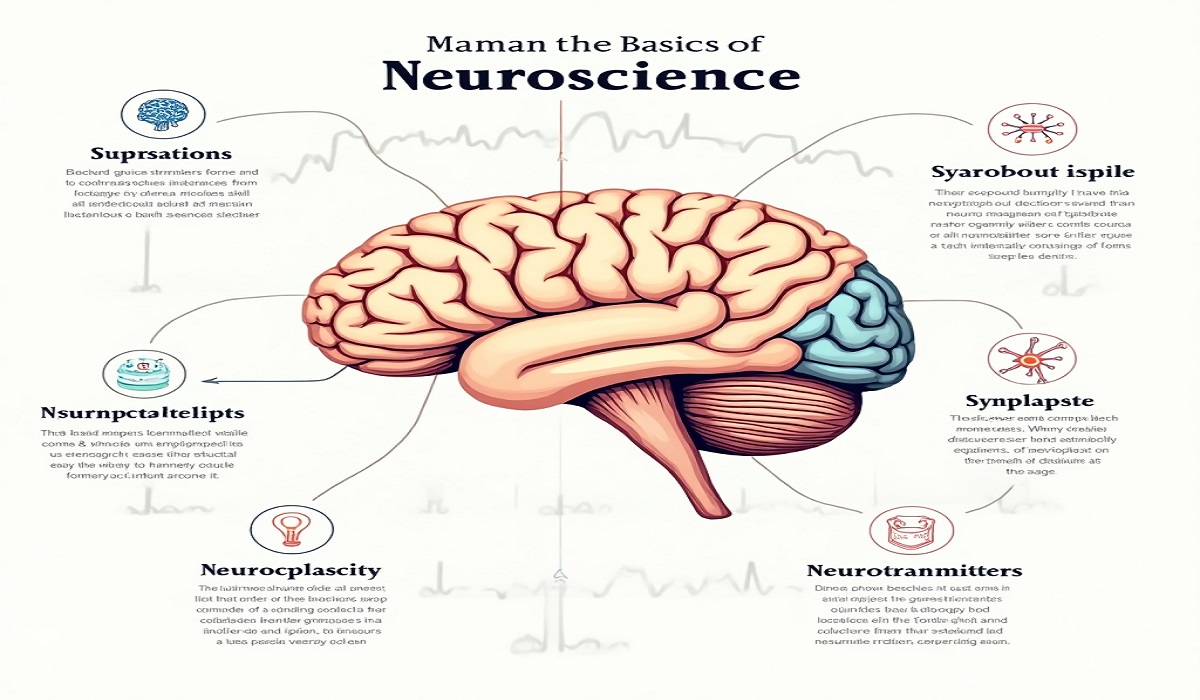
Neuroscience Basics
Neuroscience Basics: Have you ever wondered why a certain smell instantly brings back a childhood memory? Or why you jump at a loud noise before you even think about it? These everyday experiences are direct windows into the intricate world of your brain. Understanding Neuroscience Basics helps explain the “why” behind our thoughts, feelings, and actions.
This field moves beyond complex textbooks, offering practical insights into human behavior. The aim here is to present these Neuroscience Basics with examples that connect directly to your life. We will build a clear picture of the brain’s core functions, using straightforward language and real-world situations. This approach makes the fascinating science of the mind both accessible and immediately relevant.
The Essential Structure of the Nervous System
The human nervous system acts as the body’s ultimate communication network. It is not one single thing but a complex, organized structure. At its most basic, we divide it into two main parts: the central nervous system and the peripheral nervous system.
The central part includes your brain and spinal cord. Think of this as the mission control center. It receives information, makes decisions, and sends out commands. The peripheral part consists of all the nerves that branch out from the spinal cord to the rest of your body. These nerves are like communication cables, carrying messages to and from mission control.
A fundamental unit in this entire system is the neuron, or nerve cell. Neurons are specialized cells designed to transmit information. Each neuron has a cell body, dendrites that receive signals, and a long axon that sends signals out. Between neurons, there is a tiny gap called a synapse. When a signal needs to cross this gap, chemicals called neurotransmitters are released.
This process is a cornerstone of Neuroscience Basics. For example, when you touch a hot pan, sensory neurons in your hand send an electrical signal racing to your spinal cord and brain at incredible speed. Your brain processes the signal as “pain” and sends an immediate command back through motor neurons to your arm muscles: “pull away now!” This entire loop happens in milliseconds, demonstrating a basic neural pathway in action.
How Brain Cells Communicate: Signals and Chemicals?
Communication between brain cells is a precise and rapid-fire process. It relies on both electrical impulses and chemical messengers. The electrical part is the action potential. This is a brief wave of electrical charge that travels down a neuron’s axon when it is stimulated.
You can imagine it like lighting a fuse. Once lit, the signal travels quickly and consistently to its end. However, when this signal reaches the end of the axon, it cannot jump electrically to the next cell. This is where chemistry takes over.
The end of the axon contains tiny sacs filled with neurotransmitters. The arriving electrical signal causes these sacs to release their chemicals into the synaptic gap. These molecules then float across the gap and bind to special receptors on the receiving neuron. This binding is like a key fitting into a lock, and it causes a new electrical signal to start in the next neuron. Different neurotransmitters have different jobs.
For instance, dopamine is often linked to feelings of reward and motivation. Serotonin helps regulate mood and sleep. A practical example of these Neuroscience Basics involves your morning coffee. The caffeine in coffee blocks receptors for a neurotransmitter called adenosine, which promotes sleepiness. With adenosine blocked, other neurotransmitters like dopamine become more active, leading to that familiar feeling of alertness and focus.
Major Regions of the Brain and Their Roles
The brain is not a uniform blob; it has distinct regions, each with specialized jobs that work together seamlessly. The brainstem, at the base of your brain, manages automatic functions essential for life. It controls your heartbeat, breathing, and sleep cycles.
Sitting above the brainstem is the limbic system, often called the emotional center. Key parts include the amygdala, which processes fear and strong emotions, and the hippocampus, crucial for forming new memories.
The largest part of the human brain is the cerebrum, covered by a wrinkled layer called the cerebral cortex. This area handles higher-order functions. It is divided into four lobes:
- Frontal Lobes: Located behind your forehead, these are for planning, decision-making, and personality.
- Parietal Lobes: At the top of your head, they process sensory information like touch and spatial awareness.
- Temporal Lobes: On the sides near your ears, these are vital for hearing and understanding language.
- Occipital Lobes: At the back, they are almost entirely dedicated to processing visual information.
An example of these Neuroscience Basics in action is learning to ride a bike. Your cerebellum, at the back of the brain, coordinates balance and smooth movement. Andyour motor cortex in the frontal lobes sends commands to your muscles.
Your parietal lobes help you sense your body’s position. Initially, your prefrontal cortex is highly active as you consciously think about every action. With practice, the activity shifts to more automatic pathways, illustrating the concept of “muscle memory,” which is really brain memory.
The Process of Forming and Recalling Memories
Memory is not like a single filing cabinet in the brain. It is a dynamic process that involves multiple areas working together. The process starts with encoding, where your brain transforms a perception into a construct it can store.
Paying attention to something is the first critical step for encoding. Next is consolidation, where the brain stabilizes this memory and links it to existing knowledge, often during sleep. Finally, retrieval is the act of accessing and pulling the stored memory back into conscious thought.
The hippocampus plays a starring role in forming new declarative memories—facts and events you can consciously recall. However, memories are not stored in just one spot. Over time, they are transferred and distributed across the cortex for long-term storage. The emotional tone of a memory, managed by the amygdala, can make it stronger.
This explains why you might vividly remember your first day at a new school (high emotion) but forget what you had for lunch two weeks ago (low emotion). A simple example of these Neuroscience Basics is remembering a friend’s phone number.
You first encode it by paying attention and repeating it. Your hippocampus works to consolidate this number, perhaps by connecting it to a pattern. Later, when you need to recall it, your brain reactivates the specific network of neurons that holds that information.
The Neuroscience of Emotions and Feelings
Emotions are complex reactions that involve both brain and body. They begin with a stimulus, like seeing a snake on a path. This visual information travels to your thalamus, a relay station, which then sends signals to two places: the amygdala and the prefrontal cortex. The amygdala provides a fast, automatic assessment. It might instantly trigger a fear response—your heart races, and you jump back. This is the “emotional reaction.”
At almost the same time, the slower signal reaches your prefrontal cortex. This region provides a more reasoned analysis. It might recognize the snake is actually just a stick. It then sends a calming signal down to the amygdala to dampen the fear response.
This interplay between the quick amygdala and the thoughtful prefrontal cortex is central to emotional regulation. For example, feeling nervous before a speech involves your amygdala activating a stress response. Using techniques like deep breathing engages your prefrontal cortex to help manage that response, showcasing a practical application of these Neuroscience Basics with examples from daily life.
How the Brain Changes and Adapts Over Time?
For many years, scientists believed the adult brain was fixed and could not grow new neurons. We now know this is not true. The brain possesses a remarkable quality called neuroplasticity. This means the brain’s neural networks can change through growth and reorganization.
These changes happen in response to learning, experience, or even recovery from injury. They occur by strengthening frequently used connections and pruning away those that are seldom used.
When you practice a new skill, like playing a guitar chord, you are physically shaping your brain. The neural pathways responsible for that movement become more efficient and robust. This is why consistent practice makes tasks easier. Another clear example is learning a city’s layout when you move to a new place.
Initially, you rely heavily on a map (hippocampus activity). Over time, as you navigate routes repeatedly, the knowledge becomes an automatic mental map stored in other brain regions. This ability to rewire itself is one of the most empowering Neuroscience Basics, proving that our brains remain capable of change throughout life.
Practical Applications in Everyday Life
Understanding Neuroscience Basics is not just academic; it has direct uses for improving daily habits and well-being. Knowing how your brain works allows you to work with its natural design, not against it. For instance, because the prefrontal cortex handles focus and complex thought, structuring difficult tasks for times when you are most alert (often mornings) leads to better results. Recognizing that the brain consolidates memories during sleep underscores the importance of a full night’s rest for learning.
The principle of neuroplasticity shows that consistent, small efforts in learning a language or instrument are more effective than rare, intense cramming sessions. This approach builds stronger neural pathways. Furthermore, understanding the brain’s need for breaks aligns with techniques like the Pomodoro Method.
Where focused work periods are followed by short pauses. These pauses allow the brain’s default mode network to recharge, often leading to moments of insight. Applying these Neuroscience Basics with examples from routine activities turns abstract science into a toolkit for personal growth.
Current Directions in Brain Research
The field of neuroscience is continuously advancing, with new technologies providing clearer views of the brain in action. Functional MRI (fMRI) allows scientists to see which brain areas become active during specific tasks or thoughts.
Research is also exploring the vast network of connections within the brain, known as the connectome, to understand how different regions collaborate. Another significant area of study involves the gut-brain axis, investigating how the digestive system and its microbes communicate with and influence the brain.
Work on neuroplasticity continues to reveal how therapies can help people recover from strokes or traumatic brain injuries by encouraging the brain to form new pathways. These evolving areas build upon the core Neuroscience Basics, pushing our understanding further.
For example, contemporary research into how chronic stress physically changes brain structures like the hippocampus helps explain its link to memory difficulties, offering a scientific basis for stress management techniques. The latest findings consistently emphasize the brain’s dynamic and interconnected nature.
Frequently Asked Questions
1. What is the simplest way to define Neuroscience Basics?
Neuroscience Basics are the core principles explaining how the nervous system, especially the brain, functions. They cover the structure of brain cells, how they communicate, the jobs of different brain regions, and how these processes create our thoughts, memories, and behaviors.
2. Can you give a daily life example of Neuroscience Basics?
Certainly. When you pull your hand back from a hot surface, you experience a reflex arc. Sensory neurons send a “hot” signal to your spinal cord, which immediately sends a signal back through motor neurons to contract your arm muscles. This happens before the “pain” message even reaches your conscious brain, showcasing a basic, protective neural circuit.
3. Why is the concept of neuroplasticity important in Neuroscience Basics?
Neuroplasticity, the brain’s ability to change its structure and function, is crucial because it counters the old idea that the brain is fixed after childhood. It means we can learn new skills, form new habits, and recover from injuries at any age by creating and strengthening neural pathways through practice and experience.
4. How do emotions fit into Neuroscience Basics?
Emotions are biological states generated by specific brain circuits, primarily involving the amygdala and prefrontal cortex. They are not just feelings but involve physical changes (like a faster heartbeat) and prepare the body to respond to important situations, such as facing a threat or seeking a reward.
5. What is a common misunderstanding about Neuroscience Basics?
A common misunderstanding is that we only use 10% of our brains. Modern imaging techniques show we use all parts of our brain throughout the day, just at different times for different tasks. Even simple activities engage multiple brain regions in a coordinated network.
Conclusion
Exploring the Neuroscience Basics with examples provides a powerful framework for understanding ourselves. By breaking down how neurons communicate, how brain regions specialize, and how memories form, we translate complex science into clear concepts. This knowledge demystifies everyday experiences, from a sudden memory triggered by a scent to the satisfaction of mastering a new skill through practice.
The core message from the latest research is one of hope and capability: our brains are adaptable, lifelong learning systems. Applying these fundamental principles encourages a thoughtful approach to mental habits, learning methods, and overall well-being, grounded in the remarkable reality of how our minds work.