

Tax Benefits for Education
Tax Benefits for Education: Hey there! If you or someone in your family is heading to school, you probably worry about how much everything costs. Tuition, books, supplies – it adds up fast. But guess what? The government offers real help through tax benefits for education. These are special rules that let you keep more of your hard-earned money instead of giving it all to taxes.
Think of it like a helper that lowers your tax bill or gives you money back. In this big guide, we will walk through everything step by step using easy words. No fancy talk – just clear explanations like your favorite teacher would use. By the end, you will know exactly how to use these tax benefits for education to save hundreds or even thousands of dollars. Let’s get started!

What Exactly Are Tax Benefits for Education?
Tax benefits for education are like secret discounts from the IRS (that’s the tax people in the United States). They come in a few types:
- Credits – These cut your tax bill dollar for dollar. They are the best because they give you the biggest bang for your buck.
- Deductions – These lower the money the government counts as your income, so you pay less tax overall.
- Savings plans – Special accounts where your money grows without taxes, and you can pull it out tax-free for school stuff.
These tax benefits for education work for college, trade schools, and sometimes even younger kids’ schooling. They help parents, students, and even adults going back to learn new job skills. The rules change a little each year, so we are using the latest info for 2025 taxes (the ones you file in 2026). Always double-check with a tax helper because your own situation matters.
Why care? Because school can cost $10,000 or more a year. But with these benefits, many families save $2,000 to $5,000 easily. That’s real money for groceries, rent, or even a family fun day!
The Top Two Education Tax Credits You Need to Know
The best tax benefits for education are the two big credits. You can pick only one per student each year – the American Opportunity Tax Credit (AOTC) or the Lifetime Learning Credit (LLC). Let’s break them down nice and slow.

American Opportunity Tax Credit (AOTC) – Great for New College Students
This is the superstar credit for students in their first four years of college or vocational school. It can give you up to $2,500 back per student!
How it works: You get 100% of the first $2,000 you spend on school plus 25% of the next $2,000. So if you spend $4,000 on tuition and books, boom – full $2,500 credit.
Even better? Up to $1,000 of it is “refundable.” That means if your tax bill is already zero, the government still sends you cash!
Who can get it?
- The student must be in their first four years of higher education.
- Enrolled at least half-time.
- Working toward a degree or certificate.
- You (or your dependent) paid the bills.
Income limits: If you make under about $80,000 single or $160,000 married, you get the full amount. It slowly goes away if you earn more, up to $90,000 or $180,000.
Example time: Sarah is a freshman paying $5,000 for classes. Her parents’ income is low enough. They claim the AOTC and get $2,500 off their taxes. That’s like free money for books next semester!
This credit is one of the strongest tax benefits for education because it puts real cash in your pocket.
Lifetime Learning Credit (LLC) – Perfect for Any Year of School
No limit on how many years you can use this one. It works for college, grad school, or even one class to learn a new job skill.
Max amount: $2,000 per family per year (not per student). It is 20% of the first $10,000 you spend.
Who qualifies?
- Any age student.
- Just one course is enough – no half-time rule.
- Can be for you, your spouse, or dependent.
Same income limits as the AOTC roughly. And remember, pick only one credit per student.
Real story: Mike is 35 and taking night classes for a better job. He spends $8,000 on fees. With the LLC, he gets $1,600 off his taxes. Easy!
These credits are huge tax benefits for education because they work even if you use savings plans (as long as you don’t use the exact same dollars twice – no double-dipping!).

529 College Savings Plans – The Super Smart Way to Save
One of the most popular tax benefits for education is the 529 plan. It is like a special bank account just for school.
Here is why it rocks:
- Money you put in grows tax-free.
- When you take it out for school, no taxes at all!
- Anyone can open one – grandparents, parents, even friends.
What counts as school costs? Tuition, fees, books, supplies, and even room and board if the student goes half-time. In 2026, you can even use up to $20,000 a year for K-12 private school tuition in many cases.
Example: You put $5,000 in a 529 plan today. Over 10 years it grows to $8,000 with no tax on the growth. Your kid uses it for college – zero tax! Many states even let you deduct your contributions on state taxes.
Tip: Start early. Even small monthly gifts add up huge because of the magic of growing tax-free.
These plans are flexible too. If your kid gets a scholarship, you can change the beneficiary to a sibling or even roll it into a retirement account in some cases now.
Student Loan Interest Deduction – Help Paying Back What You Borrowed
Lots of students borrow money for school. Good news – you can deduct up to $2,500 of the interest you pay each year as a tax benefit for education.
This is an “above the line” deduction, so you get it even if you don’t itemize other deductions.
Who qualifies?
- You paid the interest on a loan for you, your spouse, or dependent.
- Income under about $85,000 single or $170,000 married for full deduction (it phases out higher).
Super simple example: You paid $1,800 in interest last year. You subtract that from your income before taxes are calculated. If you are in the 22% tax bracket, you save about $396 in taxes!
This deduction works year after year until the loan is gone. Many people forget it – don’t be one of them!

More Helpful Tax Benefits for Education You Should Know
There are even more ways to save:
Coverdell Education Savings Account (ESA) Like a mini 529 but with more rules. You can put in up to $2,000 a year per child. Growth is tax-free, and it can cover K-12 costs too. Income limits apply to open one.
IRA Withdrawals Without Penalty Normally you pay extra tax if you take money from retirement accounts early. But for school, you can pull out without the 10% penalty. Still pay regular tax, but it helps in a pinch.
Savings Bonds Interest Exclusion If you cash in old U.S. savings bonds for college, you might skip tax on the interest if your income is under certain limits.
Employer Education Help Some jobs pay for classes tax-free up to $5,250 a year. That is straight-up free money from your boss!
Scholarships and Grants Most are tax-free if you use them for tuition, fees, and books. Just don’t count them as income if they cover those costs.
Work-Related Education Deduction Self-employed people or certain workers can deduct classes that improve job skills as a business expense. Teachers and reservists have extra rules too.
All these together make tax benefits for education a powerful toolkit.
How to Actually Claim These Tax Benefits for Education?
It is easier than you think! Here are the steps:
- Gather your papers – Form 1098-T from the school (shows tuition paid), 1098-E for loan interest, and records of 529 withdrawals.
- Use tax software or a professional – It asks simple questions and fills everything.
- Fill out Form 8863 for the credits.
- Report 529 stuff on your main tax form if needed.
- File your return – Get ready for a bigger refund!
Pro tip: Keep receipts for at least three years. If the IRS ever asks, you are covered.
Many free tools on IRS.gov walk you through it. Publication 970 is the official guide – it is free to download and explains every detail.
Common Mistakes People Make (And How to Avoid Them)
- Double-dipping: Using the same expense for both a credit and tax-free 529 money. Pick one!
- Forgetting income limits: Check your numbers early.
- Missing the half-time rule for some benefits.
- Not telling the school about scholarships (they adjust the 1098-T).
- Waiting until April – Start planning in January.
Avoid these and you get the full power of tax benefits for education.
State Tax Benefits for Education – Extra Savings Possible
Every state is different. Some give you a state tax deduction just for putting money in a 529 plan. Others offer credits. Check your state tax website or ask your tax helper. These add hundreds more in savings on top of federal help.
Tips to Maximize Your Tax Benefits for Education This Year
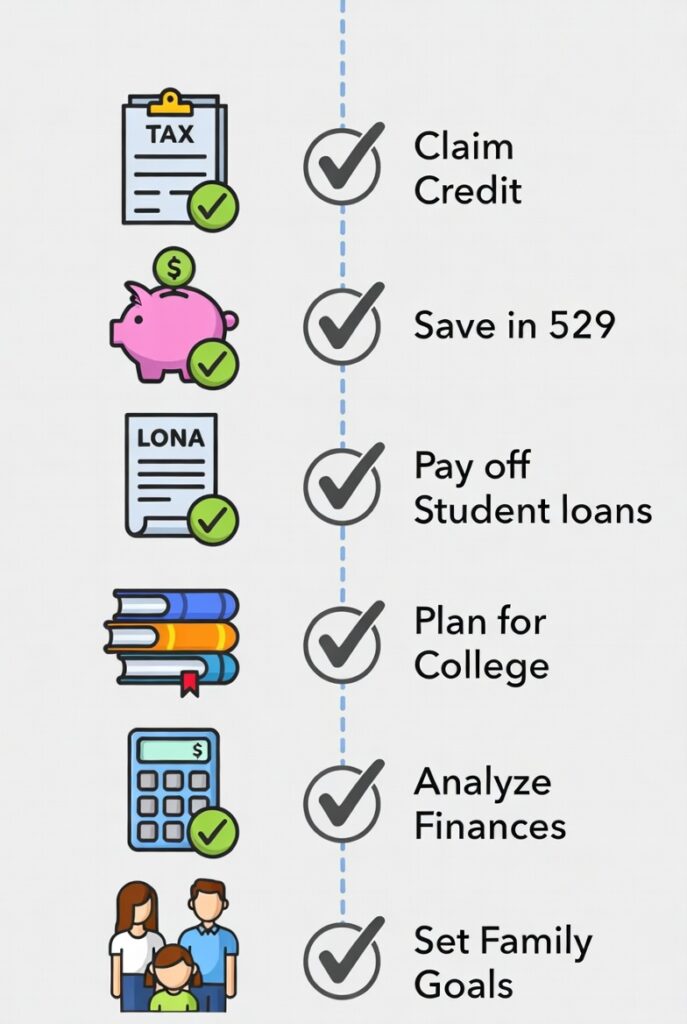
- Start a 529 plan today – even $50 a month helps.
- Compare AOTC vs LLC each year and pick the bigger one.
- Track every dollar spent on school.
- Talk to grandparents about gifting to 529 plans (big gift tax perks).
- If you owe student loans, pay a little extra interest before year-end for the deduction.
- Use free tax filing if your income is low – many options cover education forms.
Real family example: The Johnson family used AOTC, a 529 plan, and the loan deduction last year. They saved over $4,200 total. That paid for their daughter’s books and a laptop!
With these tax benefits for education, school becomes way more affordable. You do not need to be rich to use them – they are made for regular families like yours.
FAQs About Tax Benefits for Education
1. Can I claim tax benefits for education if I use a scholarship?
Yes! Scholarships that cover tuition are usually tax-free. You can still claim credits or deductions on any extra money you paid yourself.
2. What if my income is a little too high for the credits?
The benefits phase out slowly. You might still get part of the credit. Plus, 529 plans and the loan deduction have different limits – many still qualify.
3. Are there tax benefits for education for K-12 private school?
Yes! 529 plans let you pull out up to $20,000 a year tax-free for K-12 tuition in 2026. Some states offer more help too.
4. Do I need to be a full-time student?
Not always. The Lifetime Learning Credit works for one class. AOTC needs half-time for the first four years.
5. Where do I find the official rules?
Go to IRS.gov and search for Publication 970. It is free and explains everything with examples.
Summary: Start Using Tax Benefits for Education Today
Tax benefits for education are real tools that put money back in your pocket. From the powerful AOTC and Lifetime Learning Credit to amazing 529 plans and the student loan deduction, you have many ways to save.
Remember the big ones:
- Up to $2,500 credit per student with AOTC
- $2,000 with the Lifetime Learning Credit
- Tax-free growth and withdrawals in 529 plans
- $2,500 student loan interest deduction
These tax benefits for education can easily save a family thousands every year. The rules are simple once you know them, and help is everywhere – software, IRS guides, and tax pros.
Do not wait until tax time. Open that 529 plan, track your expenses, and talk to your family about using these benefits. Your future self (and your wallet) will thank you!
School should open doors, not empty bank accounts. With these tax benefits for education, you can make learning affordable and exciting again. Go file smarter, save bigger, and celebrate your success!