
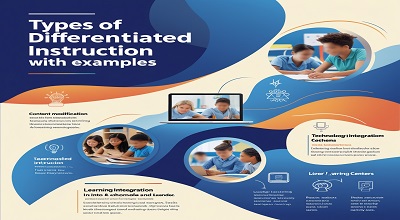
Types of Differentiated Instruction
Types of Differentiated Instruction: Differentiated instruction (DI) is a teaching approach that tailors instruction to meet the diverse needs of students in the classroom. By recognizing that learners have varying abilities, interests, and learning styles, educators can design lessons that maximize engagement and academic success. This article explores the latest types of differentiated instruction with practical examples to help teachers implement these strategies effectively.
Differentiated Instruction: An Overview
Differentiated instruction is rooted in the belief that students learn best when their unique needs are addressed. Carol Ann Tomlinson, a leading expert in DI, identifies three key areas where differentiation can occur:
- Content (what students learn)
- Process (how students learn)
- Product (how students demonstrate learning)
Additionally, differentiation can be based on:
- Readiness (skill level)
- Interest (student passions)
- Learning Profile (preferred learning style)
Now, let’s explore the different types of differentiated instruction with examples.
Types of Differentiated Instruction with Examples
Differentiation by Content
This involves modifying the material students learn based on their readiness, interests, or learning profiles.
Examples:
- Tiered Assignments:
- Advanced Students: Analyze a primary source document.
- Intermediate Students: Summarize key points from a textbook.
- Beginner Students: Use guided notes with fill-in-the-blank sections.
- Learning Stations:
- Station 1: Video lesson for visual learners.
- Station 2: Podcast for auditory learners.
- Station 3: Hands-on activity for kinesthetic learners.
- Adapted Texts:
- Provide simplified readings for struggling readers.
- Offer advanced articles for gifted students.
Differentiation by Process
This refers to varying the instructional methods used to help students grasp the content.
Examples:
- Flexible Grouping:
- Small groups work on problem-solving tasks based on skill level.
- Peer tutoring pairs advanced students with those needing support.
- Scaffolding Techniques:
- Step-by-step guided practice for struggling learners.
- Open-ended questions for advanced students.
- Choice Boards:
- Students select from activities like creating a poster, writing an essay, or recording a podcast.
Differentiation by Product
This allows students to demonstrate learning in various ways.
Examples:
- Project-Based Learning (PBL):
- Students choose between creating a model, writing a report, or presenting a slideshow.
- Rubric-Based Assessments:
- Different expectations based on student readiness (e.g., basic vs. advanced criteria).
- Multimedia Presentations:
- Some students create videos, others design infographics, and some write blogs.
Differentiation by Learning Environment
Adjusting the classroom setup to support different learning needs.
Examples:
- Quiet Zones: For students who need minimal distractions.
- Collaborative Spaces: For group work and discussions.
- Movement-Friendly Areas: For kinesthetic learners.
Technology-Enhanced Differentiation
Using digital tools to personalize learning.
Examples:
- Adaptive Learning Software (e.g., DreamBox, Khan Academy): Adjusts difficulty based on performance.
- Interactive Whiteboards: Allows visual and hands-on learning.
- Flipped Classroom: Students watch lectures at home and engage in activities in class.
Benefits of Differentiated Instruction
- Increases student engagement.
- Supports diverse learning needs.
- Encourages higher-order thinking.
- Builds a positive classroom culture.
Challenges and Solutions in Implementing DI
| Challenge | Solution |
|---|---|
| Time constraints | Use pre-designed templates and digital tools. |
| Large class sizes | Implement station rotations and peer learning. |
| Assessment difficulties | Use rubrics and portfolio assessments. |
Latest Trends in Differentiated Instruction (2025)
- AI-Powered Personalization: Tools like ChatGPT for customized learning.
- Gamification: Using game elements to motivate students.
- Universal Design for Learning (UDL): Combining DI with accessibility principles.
Conclusion
Differentiated instruction is essential for meeting the needs of all learners. By incorporating content, process, product, and environmental differentiation, teachers can create inclusive and effective classrooms.
FAQs
1. What are the four main types of differentiated instruction?
The four main types are:
- Differentiation by Content
- Differentiation by Process
- Differentiation by Product
- Differentiation by Learning Environment
2. How can technology support differentiated instruction?
Technology enables adaptive learning, interactive lessons, and personalized pacing through tools like AI tutors, educational apps, and online assessments.
3. What is an example of differentiation by interest?
Allowing students to choose research topics based on their passions (e.g., space, animals, history) while meeting the same learning objectives.
4. How do teachers assess differentiated instruction?
Through varied assessments like rubrics, portfolios, presentations, and self-reflections tailored to student readiness and learning styles.
5. Can differentiated instruction work in large classrooms?
Yes, strategies like learning stations, flexible grouping, and digital tools help manage differentiation even in large classes.
Download Link: L777 APK