
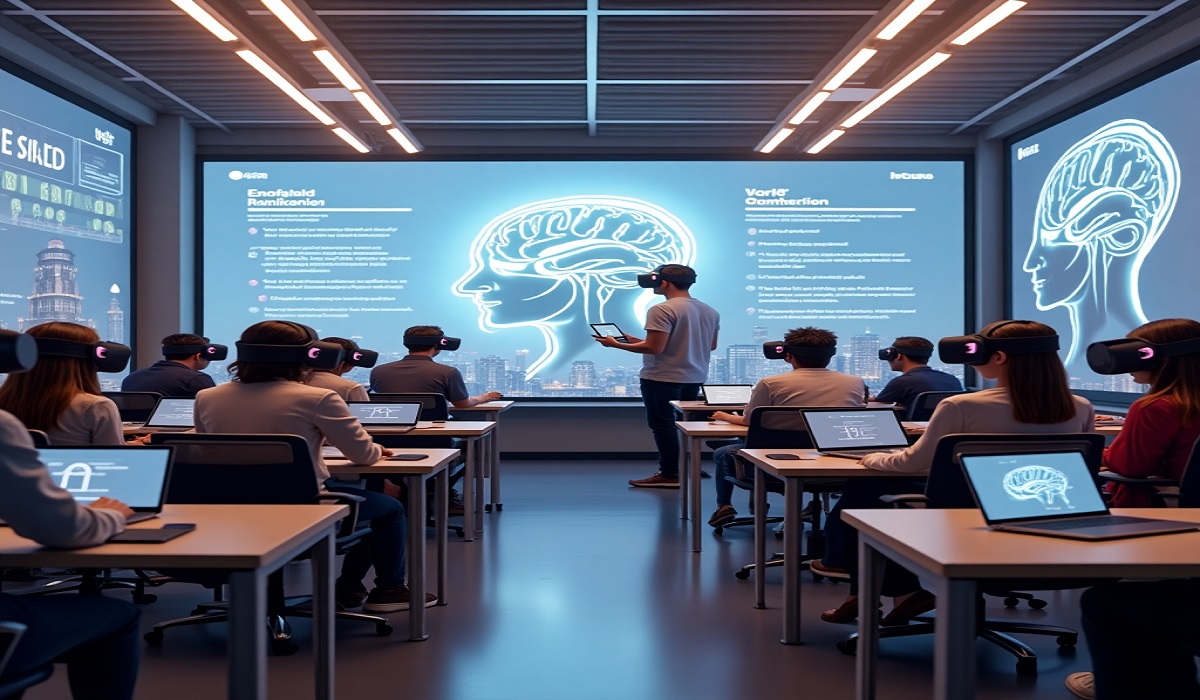
XR (Extended Reality) Learning
XR (Extended Reality) Learning: Imagine a history lesson where you can walk through ancient Rome, or a science class where you can hold and turn a human heart in your hands. This is not a scene from a future movie. It is happening now in classrooms and training rooms around the world. This shift is powered by Extended Reality learning. XR stands for Extended Reality.
It is a term that includes different technologies that blend the real world with digital creations. These technologies are Virtual Reality (VR), Augmented Reality (AR), and Mixed Reality (MR). This article will explain Extended Reality learning with examples that show its use today. We will see how these tools help people understand complex subjects by doing and seeing, not just reading.
The main idea behind XR (Extended Reality) learning is simple:
People learn better by experiencing. Reading about how a machine works is one thing. Putting on a headset and practicing with a virtual version of that machine is different. It is more powerful. This hands-on method makes hard ideas easier to grasp. It also helps students remember information longer.
Schools and companies are now using XR (Extended Reality) learning to move past old-fashioned textbooks. They create active, memorable lessons. We will look at specific cases of Extended Reality learning with examples from medicine, engineering, and basic education. These stories show the practical benefits of this technology.
What Does XR (Extended Reality) Mean for Education?
To understand XR (Extended Reality) learning, you must first know what the “X” stands for. Extended Reality is like a big umbrella. Under this umbrella, you find three main types of digital experience tools. Each one changes our view of the world in a unique way.
Virtual Reality (VR) is a complete digital world. When you put on a VR headset, you cannot see your physical room. You are transported somewhere else. You could be on the surface of Mars or inside a human body. This total immersion is useful for Extended Reality learning. It removes distractions and lets learners focus entirely on the subject.
Augmented Reality (AR) adds digital things to the real world. You use a phone, tablet, or special glasses to see these additions. For instance, you might point your phone at a textbook picture of a dinosaur. A 3D model of that dinosaur then appears on your screen, standing on your desk. This mix of real and digital supports Extended Reality learning by bringing information into your own space.
Mixed Reality (MR) is a more advanced blend. Here, digital objects do not just appear in your room. They can interact with it. A virtual ball could bounce off your real table. A digital engine part could be placed on your actual workbench. This interaction makes XR (Extended Reality) learning with examples in job training very effective. Learners can practice with virtual tools as if they were real.
- VR creates a new world.
- AR adds to your current world.
- MR lets digital and real objects work together.
These tools form the foundation of modern Extended Reality learning. They turn abstract ideas into things you can see and touch.
How XR Changes the Way Students Understand Information?
Why is XR (Extended Reality) learning so good for teaching? The answer lies in how our brains work. We are built to learn from our surroundings and from doing tasks. Traditional learning often uses words and flat pictures. Extended Reality learning uses experience. This method leads to several strong benefits.
First, complex ideas become simple. Think about learning the solar system. A diagram in a book shows circles around the sun. An Extended Reality learning experience lets you stand in the middle of the planets. You see their sizes compared to each other.
You watch their paths around the sun. The scale and movement make sense in a way a picture cannot match. This is a prime example of XR (Extended Reality) learning with examples that build understanding.
Second, it is safe to make mistakes. Would you want a student pilot to practice an emergency landing with a real plane full of people? Of course not. With Extended Reality learning, they can try the procedure hundreds of times in a virtual cockpit. No one gets hurt.
The same applies for surgeons, chemists, or electricians. They can practice risky tasks without any real-world danger.
Finally, this style of learning is engaging. It feels more like an adventure than a lecture. This engagement keeps students interested. They want to explore more. They ask more questions. This active participation is a core goal of XR (Extended Reality) learning.
Real Uses of XR (Extended Reality) Learning in Medical Training
The field of medicine has warmly welcomed XR (Extended Reality) learning. It offers a perfect solution for training that needs both knowledge and careful skill. Medical schools and hospitals now use Extended Reality learning with examples that prepare doctors and nurses for real situations.
One common use is for anatomy lessons. Instead of only studying charts, students can put on a headset. They explore a detailed, life-size virtual human body. They can take organs apart and put them back together. And they can see how muscles move from angles a textbook cannot show. This direct exploration is a powerful form of XR (Extended Reality) learning.
Surgery practice is another major area. Surgeons can practice new operations on virtual patients. They use tools that feel real in their hands. The system gives feedback on their accuracy and speed. This repeated practice builds confidence and skill before a surgeon ever touches a real person. These examples of Extended Reality learning save lives by creating better-prepared medical teams.
Nurses also use this technology. They might use AR glasses that show a patient’s vital signs right next to the person in the bed. Or they can practice setting up difficult equipment on a virtual model. This XR (Extended Reality) learning makes their training thorough and modern.
XR (Extended Reality) Learning for Building and Engineering Skills
Building skyscrapers, designing engines, and wiring buildings are complex jobs. A small mistake can cost a lot of money or be unsafe. XR (Extended Reality) learning is becoming a key tool for teaching these trades and engineering fields. It lets people learn by doing, without wasting materials or facing hazards.
Aspiring architects and engineers use VR to walk through their building designs before construction starts. They can check if spaces feel right, if light comes in correctly, or if a beam might be in the way. This early review, a result of XR (Extended Reality) learning, prevents expensive changes later.
For technicians, AR is very helpful. Imagine a mechanic fixing a new model of car. They can wear AR glasses that show animated instructions over the real engine. The glasses can highlight which bolt to remove next. This guided Extended Reality learning helps workers do complex repairs correctly the first time. It acts as a personal expert looking over their shoulder.
In factory training, employees can learn to operate heavy machinery in VR. They get the feel of the controls and learn safety steps in a risk-free place. This method of Extended Reality learning ensures they are competent and safe when they use the real, expensive machine.
Bringing XR (Extended Reality) Learning into School Classrooms
You do not need a medical school or factory to use XR. These tools are finding their way into elementary, middle, and high schools. Teachers are using Extended Reality learning with examples that bring standard subjects to life. This makes school more exciting and effective for students of all ages.
A geography lesson can transform with VR. Students can take a virtual field trip to the Amazon rainforest or the Great Barrier Reef. They hear the sounds and see the sights. This experience creates a lasting memory. It builds a connection to the place that a photo cannot. This is the strength of XR (Extended Reality) learning for general education.
For chemistry, AR apps let students mix virtual chemicals. They can see the reactions happen on their desk. They learn what combinations are safe and which are explosive, without any smell or danger. It turns abstract formulas into visible events.
History is another subject that gains from XR. Students can witness historical events, like a famous speech or a moment in a civil rights movement, from a virtual front-row seat. This perspective builds empathy and a deeper understanding of the past. These classroom applications show how XR (Extended Reality) learning is not just for experts. It is for every learner.
What You Need to Start Using XR for Education?
Starting with XR (Extended Reality) learning might seem difficult, but it is becoming easier. The technology is more available now than ever before. You do not always need the most expensive gear to begin.
For VR, you need a headset. Some headsets, like Meta Quest, work alone without a computer. They are good for schools and homes. More powerful headsets connect to a strong computer for very detailed graphics, often used in universities.
For AR, you often just need a smartphone or tablet. Many educational AR apps use the device’s camera to place 3D models in your room. Some advanced AR systems, like Microsoft HoloLens, are glasses that let you use your hands freely.
The most important part is the software: the lessons and experiences. Companies and educators are creating more content every day. You can find Extended Reality learning programs for science, art, history, and job skills. When choosing, look for programs that fit your learning goals, not just the cool technology.
Thoughts on the Future Path of XR in Education
The journey for XR (Extended Reality) learning is just beginning. As the technology gets better and cheaper, we will see it in more places. The future will likely bring lighter glasses, more realistic touch feedback, and lessons that adapt to each student.
We can expect XR (Extended Reality) learning to connect people across the globe. A student in one country could join a virtual science lab with a teacher on another continent. This can make high-quality education available to more people.
Artificial Intelligence (AI) will also work with XR. An AI could watch a student practice a skill in VR. It could then give personal tips and adjust the lesson to focus on weak points. This personalized XR (Extended Reality) learning could help every student succeed at their own speed.
The goal remains clear: to use technology to help people learn, not replace teachers. The best XR (Extended Reality) learning with examples will always be those that put the student’s experience first. They use immersion and interaction to unlock human curiosity and understanding.
Frequently Asked Questions About XR (Extended Reality) Learning
1. Is XR (Extended Reality) learning only for high-tech subjects like science?
No, it is not. While XR is great for science, its use is much broader. You can use it for history, art, language learning, and even soft skills like public speaking. For instance, a student could practice giving a speech in a virtual auditorium. XR (Extended Reality) learning applies to any subject that benefits from seeing and doing.
2. Are XR tools too expensive for a normal school to use?
Costs are coming down. A basic VR headset is similar in price to a computer or tablet, which many schools already own. Many strong AR experiences work on smartphones students may have. Schools can start small with one headset for a classroom or use shared tablet carts. The value XR (Extended Reality) learning adds often justifies the investment.
3. Can using XR headsets make students feel sick?
Some people can feel discomfort, like motion sickness, especially in VR. This is sometimes called “cybersickness.” Good software developers design experiences to minimize this. They use steady movement and clean graphics. It is also wise to start with short sessions, about 10-15 minutes, and let students take breaks. Most people adjust over time.
4. How do I know if an XR learning program is good quality?
Look for programs made with real teachers or subject experts. Read reviews from other educators. A good XR (Extended Reality) learning experience should have clear educational goals. It should do more than just look impressive; it should truly help explain a topic or build a skill. Try it yourself if possible.
5. Does XR learning mean students will be isolated with a headset all day?
Not at all. XR is a tool, not the whole lesson. Teachers might use a 10-minute VR experience to introduce a topic. Then, the class discusses what they saw. XR can also be social. Multi-user VR programs let students work on a virtual project as a team. The best classroom use mixes XR (Extended Reality) learning with group work, discussion, and other traditional methods.
Final Thoughts on XR Learning Tools
XR (Extended Reality) learning is a powerful shift in education. It changes learning from a passive activity to an active exploration. By providing XR (Extended Reality) learning with examples, we see its real impact. It helps medical students practice safely, lets mechanics learn new engines, and brings history to life for children.
The technology succeeds when it serves the learner. The goal is not to use the flashiest headset. The goal is to explain a tough concept, to build a needed skill, or to spark curiosity. As these tools become more common, they will shape a future where anyone can learn anything by stepping into an experience. This future of hands-on, immersive education is being built today, one virtual lesson at a time.