
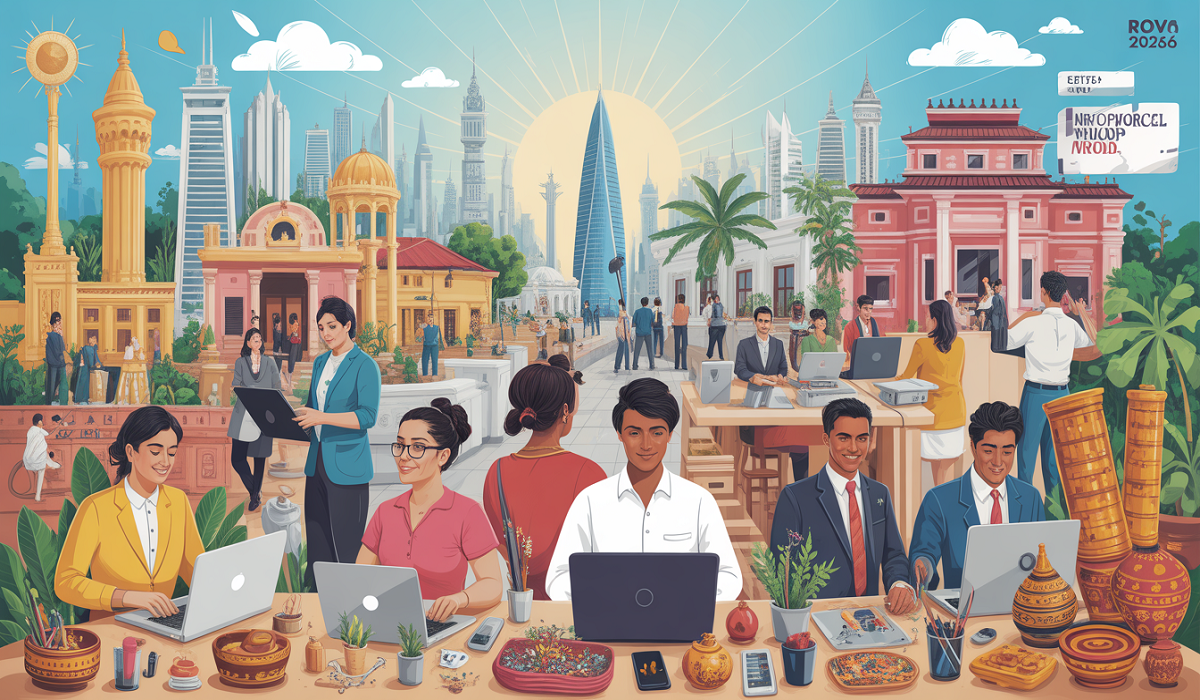
South Asia’s Workforce in 2026
South Asia’s Workforce in 2026: Rajesh lives in a small town in Bihar, India. He can repair a water pump in 15 minutes, he speaks three languages. He also knows how to manage a small cash counter. But when he goes for a job interview in Patna, the manager asks, “Do you have a high school diploma?” Rajesh does not. He left school to help his father. So he walks away without a job.
Across South Asia, this same story happens a million times every month. In Pakistan, a woman who learned digital sewing from YouTube cannot prove her skill. In Bangladesh, a young man who built two apps for local shops has no certificate, in Nepal, a porter who speaks fluent English to tourists has no grade on paper.
The problem is not talent. The problem is trust. How can an employer trust a worker who has no degree? How can a worker prove real ability without a classroom?
The answer is coming in 2026. It is called a Portable skills passports South Asia’s Workforce in 2026.
This is not a physical book. It is not a government file. It is a digital record of everything you can actually do, it lives on your phone. You can show it to any employer from Karachi to Kolkata. And the best part? You do not need a university to start one.
What Exactly Is a Portable Skills Passport?
Let us break this into very simple pieces.
Remember your old school report card? It had rows like “Math: B+” and “Science: A-”. Now imagine that report card is not from a school but from real life. Imagine it includes:
- “Can fix a laptop screen” (verified by a local repair shop owner)
- “Can translate English to Urdu” (verified by a community center)
- “Can operate a cash register” (verified by a grocery store manager)
- “Can create a Facebook ad campaign” (verified by a digital marketing course online)
Now imagine that this report card uses blockchain. Do not be scared of that word. Blockchain is just a fancy digital notebook that nobody can erase or fake. Once a skill is added, it stays there forever. You own it. Not the government. Not a company. You.
A portable skills passport is like a digital backpack of your abilities. You can take it anywhere. You can show only what you want. For example, if you are applying for a driving job, you show your driving badge. You do not need to show that you also know cooking.
By 2026, countries like India, Sri Lanka, and Bhutan are testing these systems together. The goal is simple: let a worker from rural Bangladesh prove his welding skill to a factory in Dhaka or even Dubai.
The keyword Portable skills passports South Asia’s Workforce in 2026 will be on every job portal, every training center, and every government policy paper. It is not a trend. It is a necessity.
Why South Asia Needs This Right Now?
Let us look at some numbers. Do not worry—we will keep it easy.
South Asia has about 700 million working-age people. That is more than the population of Europe. But most of these workers are in what experts call “informal jobs.” What does that mean?
It means they sell vegetables on a cart. They drive rickshaws, they stitch clothes at home. They work as house helpers, they collect plastic for recycling. These jobs are real. They pay money. But there is no contract, no salary slip, no proof.
Now imagine you are one of these workers. You have done a job for ten years. You are very good at it. But one day, you want to join a formal company. They ask for proof. You have zero certificates. Your ten years of hard work look like nothing on paper.
This is where the Portable skills passports South Asia’s Workforce in 2026 becomes a game-changer.
Here are four big reasons South Asia cannot wait any longer:
Reason 1: Millions of Young People Join the Job Market Every Month
Every month, 2 million young people in South Asia turn 18. Many are not in school. They need work. But employers do not trust them because there is no way to verify their skills quickly. A skills passport fixes that.
Reason 2: Companies Waste Money on Bad Hires
A factory in Lahore once hired 50 people based on fake diplomas. Two months later, 30 could not do basic machine work. The factory lost money, time, and production. With a verified skills passport, that factory can check real abilities in 30 seconds.
Reason 3: Women Workers Are Invisible
In rural Pakistan and India, millions of women sew, embroider, make pickles, and run small home-based businesses. They have no certificates. A portable passport lets them list these skills. Then they can work from home for companies in big cities.
Reason 4: Migrant Workers Get Cheated
Every day, thousands of workers from Nepal and Bangladesh go to the Middle East for jobs. Many are cheated because they cannot prove what they know. A skills passport stored on a cheap phone stops fraud. The employer sees the truth before the worker even buys a plane ticket.
How Does a Portable Skills Passport Actually Work?
You might be thinking: “This sounds nice, but how does it work in real life? Do I have to go to a government office? Do I need a computer?”
No, no, and no.
Let me walk you through a simple example. Meet Aisha. She is 22 years old, she lives in a village outside of Multan, Pakistan. She learned beauty salon skills from her older sister, she also learned basic English from a mobile app. And she learned how to use Excel for inventory from a free YouTube course.
Here is how Aisha gets her Portable skills passports South Asia’s Workforce in 2026 in five steps:
Step 1: Create a free account
Aisha goes to a government-approved skills wallet app on her smartphone. She signs up with her phone number. No email needed. No computer. Just her thumbprint or a simple PIN.
Step 2: Add her skills
She types: “Hair cutting,” “Facial treatments,” “Basic English speaking,” “Microsoft Excel (entry level).” She also adds videos of herself cutting hair and speaking English.
Step 3: Get verification
The app asks Aisha to go to a local verified assessor. In her village, the assessor is the owner of a small salon. He watches Aisha give a haircut. He gives her a “Verified” badge. For English, she does a 5-minute voice call with an online tester. For Excel, she takes a 10-question quiz on her phone.
Step 4: Receive digital badges
Within two days, Aisha’s passport shows three verified badges. Each badge has a QR code. When scanned, it shows the date, the assessor’s name, and a unique code that cannot be copied.
Step 5: Share with employers
Aisha applies for a job at a salon in Lahore. The owner asks for her passport. She sends a link. The owner sees her verified skills, watches her video, and calls her for an interview. No fake papers. No confusion.
This entire process costs Aisha less than 100 rupees (about one US dollar). Some government programs make it completely free.
By 2026, systems like this will cover not just beauty and English but hundreds of skills: plumbing, coding, driving, teaching, sewing, accounting, customer service, and more.
Who Is Building These Passports in South Asia?
No single company or government is building this alone. In fact, the most exciting part of Portable skills passports South Asia’s Workforce in 2026 is that many countries are working together.
Let us look at who is doing what:
India: The Skill India Digital Platform
India already has a massive program called Skill India. By 2026, they plan to issue digital skill passports to 100 million people. The passport connects to Aadhaar (India’s digital ID) and stores badges from training centers, employers, and online courses. A welder in Uttar Pradesh can show his passport to a company in Mumbai immediately.
Pakistan: PSDP (Pakistan Skills Development Program)
Pakistan is building a national skills wallet in partnership with mobile companies like Jazz and Telenor. They focus on youth in rural Punjab and Sindh. By late 2025, early trials of the portable passport will cover 5 million workers. The goal is 20 million by 2026.
Bangladesh: BIMTECH Digital Badges
Bangladesh’s technical training authority has started issuing digital badges for garment workers. A seamstress who learns quality control gets a badge. By 2026, these badges will merge into a full passport that can be recognized in India, Nepal, and Bhutan.
Nepal: The Migrant Worker Wallet
Nepal depends on money sent home from workers abroad. Their skills passport focuses on construction, caregiving, and hospitality. A Nepali worker going to Qatar can show his passport at the airport. No more fake agency certificates.
Sri Lanka & Bhutan: Small but Smart
Sri Lanka is building a tourism skills passport for guides, drivers, and hotel staff. Bhutan is focusing on organic farming and handicrafts. Even though these countries are smaller, their systems will connect with India’s by 2026.
All of these systems are built to talk to each other. That means a passport from Bangladesh will work in India. A passport from Pakistan will work in Nepal. This is called “interoperability.” A fancy word that simply means “they work together.”
How This Helps Different Kinds of Workers?
Let us make this very real. Imagine three different workers. See how the portable passport changes their lives.
The Factory Worker (Ramesh, age 40, Tamil Nadu, India)
Ramesh has worked in a textile factory for 18 years. He can fix 12 different types of sewing machines. He has no certificate. The factory closes in 2025. Ramesh is scared. He thinks he will end up jobless. Then a local NGO helps him get a skills passport. He takes three practical tests. His passport now shows “Industrial Sewing Machine Repair – Expert Level.” Three factories call him. He chooses the one closest to his home. His salary goes up 40%.
The Village Tailor (Farah, age 28, near Faisalabad, Pakistan)
Farah sews clothes for neighbors. She is very good but earns little, she wants to take orders from city boutiques, she gets a portable passport. She records herself making a complicated dress, she uploads the video. A boutique owner in Islamabad sees it. He sends her an order for 50 dresses. Farah hires two friends to help. Her monthly income goes from 8,000 rupees to 35,000 rupees.
The College Student (Anjali, age 19, Kathmandu, Nepal)
Anjali is studying but needs part-time work. She knows graphic design from YouTube, she also speaks Hindi, Nepali, and basic Korean. She gets a skills passport and adds her language and design badges. A travel agency hires her to make social media posts for Korean tourists. She works from her dorm room. She pays her own tuition fees.
Do you see the pattern? The passport does not give skills. It unlocks opportunities that were hidden before.
Chapter 6: Will This Replace School Degrees?
A very important question. Many people ask: “If I have a skills passport, do I still need school?”
The honest answer is: It depends.
For a doctor, a lawyer, or an engineer—yes, you need proper degrees. Those jobs require deep, long, formal education. A skills passport cannot replace medical school.
But for 80% of jobs in South Asia, a degree is not really needed. Let me give you an example.
A company wants to hire a customer service person. The person needs to speak politely, type fast, and solve basic problems. Does that require a four-year degree? No. A 30-year-old mother who worked at a shop and handled angry customers every day probably has better skills than a fresh graduate.
The problem is that the mother has no paper to prove it. The fresh graduate has a degree. The company hires the graduate. And then they find out the graduate cannot handle angry customers.
With a skills passport, the company can see: “This mother has a verified badge in ‘Customer Conflict Resolution’ from her shop owner.” That badge is worth more than a degree.
So no, the passport will not replace degrees for every field. But for millions of workers, it will matter more than a degree. And that is a huge shift.
By 2026, recruiters across South Asia will ask: “Show me your Portable skills passports South Asia’s Workforce in 2026” before they ask for your degree certificate.
What About Cheating and Fake Passports?
You might worry: “If everything is digital, can’t people cheat? Can’t they buy fake badges?”
This is a very smart concern. And the people building these passports have thought about it deeply.
Here is how they stop cheating:
1. Real-time verification
Each badge has a unique code. The employer scans it. The system shows: “Issued on March 12, 2026. Verified by: Aligarh Welding Center (Govt approved).” If someone tries to copy the badge, the system will say “Duplicate detected.”
2. Video and photo proof
For many badges, the worker must upload a short video doing the skill. A plumber films himself fixing a leak. A chef films himself chopping vegetables. A video is harder to fake than a paper.
3. Live tests
For important skills, the system schedules a live video call with a tester. The tester watches the worker perform the task in real time.
4. Peer and employer ratings
After a worker finishes a job, the employer can rate them. Bad ratings lower the passport’s trust score. This stops people from getting a badge and then doing bad work.
5. Blockchain storage
Remember blockchain? Once a badge is stored, the date and time are locked. Nobody—not even the government—can change it secretly.
These systems are not perfect. But they are much harder to cheat than paper certificates. You can buy a fake degree on a street in Delhi for 500 rupees. You cannot buy a fake blockchain badge.
The Role of Mobile Phones and Internet
South Asia has a secret weapon: cheap smartphones and cheap internet.
Let us look at some easy numbers:
- India has over 800 million smartphone users.
- Pakistan has about 190 million mobile connections (many people have two SIMs).
- Bangladesh has 180 million mobile subscribers.
- Nepal has 40 million mobile subscriptions (more than its population because of dual SIMs).
Even in villages, most families have at least one smartphone. Data is very cheap. In India, 1 GB of data costs less than a cup of tea. In Pakistan, you can get daily internet for 20 rupees.
This means the Portable skills passports South Asia’s Workforce in 2026 does not need special computers or expensive devices. It runs on the phone that a rickshaw driver already carries. It uses WhatsApp-like data, it works on 4G and even on 3G in remote areas.
If a worker has no smartphone, they can go to a local “skills kiosk”—a small shop or a government center that helps people create and print their passport QR code. You can show a printed code, and an employer can scan it with their own phone.
No worker is left behind.
How to Start Your Own Portable Skills Passport Today?
“This sounds great,” you say, “but 2026 is still two years away. Can I start now?”
The answer is yes. You can start building your portable skills passport today, even if the full system is not yet ready. Here is a simple action plan for any worker, student, or job seeker in South Asia:
Step 1: List your skills on paper
Take a notebook. Write down everything you can do. Do not be shy. Examples: “Cook biryani,” “Drive a motorcycle,” “Teach kids the alphabet,” “Use Google Sheets,” “Take wedding photos,” “Fix a door lock.” Write at least 20 things.
Step 2: Record proof
For each skill, take a short video on your phone. Show yourself doing it. Keep these videos safe.
Step 3: Get free online badges
Many websites give free certificates and digital badges. Here are a few:
- Google Digital Garage (free digital marketing and career badges)
- Microsoft Learn (free Excel, Word, and basic coding badges)
- Coursera for Campus (free courses if your school is registered)
- Skill India free courses (if you are in India)
- DigiSkills Pakistan (free online courses with certificates)
Collect these badges. Save them as PDFs or images on your phone.
Step 4: Ask for offline verification
Talk to your current employer, your teacher, a local shop owner, or anyone who has seen you work. Ask them to write a short letter saying: “I have seen [your name] do [skill name] well.” Take a photo of that letter.
Step 5: Store everything in one digital folder
Create a folder on your phone or Google Drive called “My Skills Passport.” Put all your videos, certificates, photos, and letters inside. This is your unofficial passport.
Step 6: Wait for government wallets
By late 2025, each country will launch its official skills wallet app. When that happens, you will upload everything from your folder into the app. The app will ask you to do live tests for some skills. Complete them. Then you will have an official Portable skills passports South Asia’s Workforce in 2026.
You are now ahead of 90% of other workers.
Challenges and Problems (Real Talk)
We have talked a lot about how great this will be. But as a fair writer, I must also tell you about the real problems. No system is perfect.
Problem 1: Not every village has a good assessor
If you live far from a town, there might not be a qualified person to verify your welding or nursing skills. The government needs to train thousands of local assessors quickly.
Problem 2: Electricity and phone charging
Some remote areas still have irregular electricity. If your phone is dead, you cannot show your passport. Solar chargers and power banks are getting cheaper, but this is still a barrier.
Problem 3: Older workers fear technology
A 55-year-old construction worker may have amazing skills but no comfort with smartphones. We need simple voice-based and offline systems for them. Maybe a printed QR code card with a photo.
Problem 4: Employer reluctance
Some old-fashioned companies will still ask for a university degree. Changing their mindset will take time. The young generation of employers, however, loves the skills passport. They see its value.
Problem 5: Data privacy fears
Workers worry: “If the government has all my skills, will they use it against me?” This is a valid concern. Strong privacy laws are needed. The worker must control who sees what. No one should see your passport without your permission.
These problems are real but not impossible. Countries like Estonia and Singapore have already solved similar issues. South Asia can learn from them.
The Big Dream for 2030
Let us look five years beyond 2026. What is the big dream?
The dream is that a worker anywhere in South Asia—from a mountain village in Nepal to a beach town in Sri Lanka—can wake up. Open their phone, and see a dashboard of job opportunities matched to their exact skills.
The dream is that a company can say: “I need 500 tailors who can do zipper work and button stitching” and find them in three days, not three months.
The dream is that no young person has to beg for a job because their school grades were bad. Their real skills will speak louder than any exam.
The dream is that a grandmother who is amazing at knitting can sell her patterns to a city store and get paid online.
The dream is that employers stop asking “Where did you study?” and start asking “What can you build, fix, create, or teach?”
That world is closer than you think. The South Asia’s Workforce in 2026 is the first big step. By 2030, these passports will be as common as a national ID card.
Summary of Key Points about South Asia’s Workforce in 2026
Let us recap everything in 10 bullet points so you remember the most important ideas:
- A portable skills passport is a digital record of your real abilities, stored on your phone.
- It uses blockchain and verification so nobody can fake it.
- South Asia has 700 million workers, most with no formal proof of their skills.
- By 2026, India, Pakistan, Bangladesh, Nepal, Sri Lanka, and Bhutan will have connected systems.
- This passport helps factory workers, home-based women, students, and migrant workers the most.
- It does not replace degrees for doctors or lawyers, but for 80% of jobs, it matters more.
- Cheating is stopped by video proof, live tests, and blockchain storage.
- Cheap smartphones and internet make this possible even in villages.
- You can start building your own passport today with videos and free online badges.
- Challenges exist (assessors, electricity, older workers), but solutions are coming.
FAQs: South Asia’s Workforce in 2026
Q1: Is a portable skills passport free for workers?
Yes, basic registration and storage of up to 20 skills is free in all government-backed systems. Some optional premium services (like extra storage or express verification) may charge a small fee of 100-200 rupees. But no worker will be forced to pay to get started.
Q2: What happens if I lose my phone? Can I get my passport back?
Absolutely. Your passport is stored in the cloud, not just on your phone. You can log in from any new phone using your phone number and a one-time password. Your badges are never lost.
Q3: Can I use my passport to get a job outside South Asia?
Yes, but it depends on the country. In 2026, the Gulf countries (UAE, Saudi Arabia, Qatar) and Southeast Asia (Malaysia, Thailand) are starting to recognize South Asian skills passports. For Europe or North America, you may still need formal degrees. But expect wider acceptance by 2028.
Q4: What if an employer does not believe my video proof?
That is why government-backed passports have a “verified” stamp. The employer can scan the QR code and see that a registered assessor approved your skill. If they still doubt, they can ask you to repeat the skill live during the interview.
Q5: Can a student with no work experience get a passport?
Yes! Students can add skills from school projects, online courses, sports achievements, and volunteer work. For example: “Organized school event” is a skill. “Completed Google classroom course” is a skill. “Helped younger students with math” is a skill. The passport is not just for paid work. It is for every ability you have.
Final Words: Your Skills Are Real. Now Show Them.
South Asia’s Workforce in 2026: South Asian workers have been judged by what they do not have—a framed degree, a stamp from a college, a piece of paper from a big city school. Meanwhile, their real abilities have been invisible.
A farmer in Punjab who can fix a water pump with tape and a screwdriver. A mother in Dhaka who can sew a school uniform in 30 minutes. A teenager in Kathmandu who can edit a video on his phone. A rickshaw driver in Chennai who knows every shortcut in the city. These are real skills. They feed families. They build economies, they deserve to be seen.
The Portable skills passports south asia workforce 2026 is not just a technology project. It is a fairness project. It says: “Show me what you can do, not where you sat in a classroom.”
So whether you are 15 or 55, start today. Write down your skills. Record your videos. Collect your badges. When the official passport comes, you will be ready. And when an employer asks you “What can you do?” you will not need a long story. You will just hand them your phone and smile.