
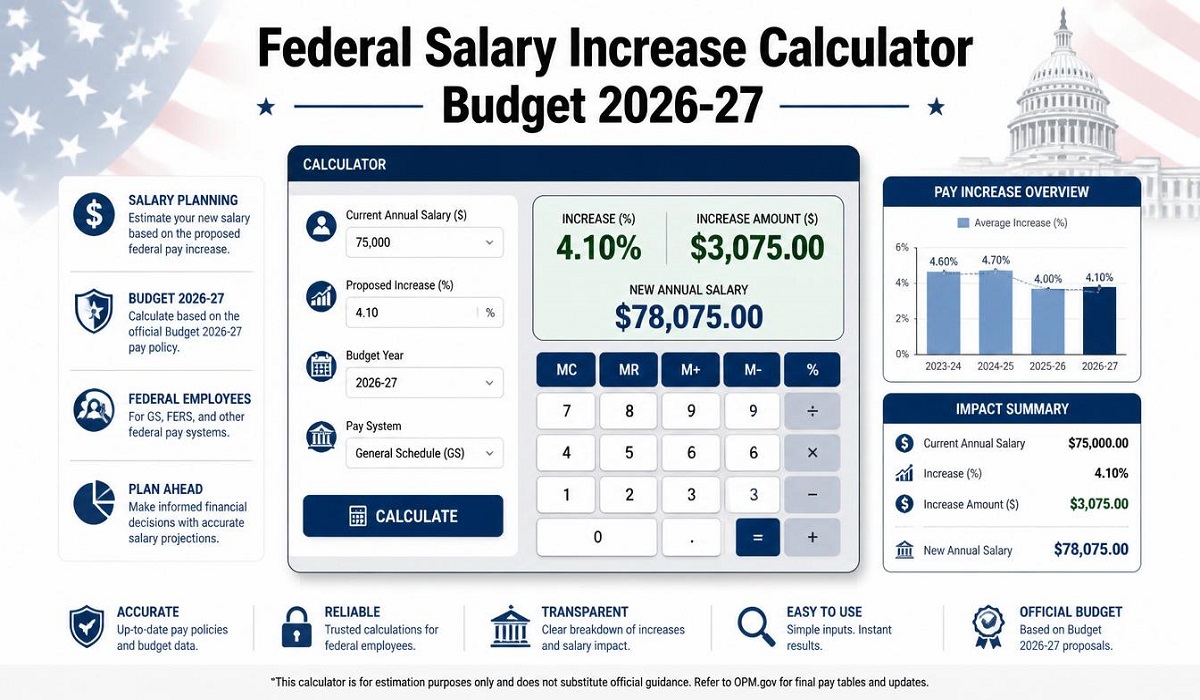
Federal Salary Increase Calculator
Federal Salary Increase Calculator: Every year, government employees in Pakistan wait for one big announcement: the federal budget. This is when the government decides if salaries will go up or down. For the year 2026-27, the budget has a special section called Annexure-VII. This section explains exactly how much more money government workers will get.
But reading official budget documents can be hard. The words are long, the tables are confusing, and many people just want a simple answer: “How much extra will I take home?”
That is where the Federal Salary Increase Calculator comes in. This tool (which you can use online or with a simple formula) helps you find your new salary in seconds. You do not need to be a finance expert. You just need your current basic pay and a few easy steps.
In this article, we will break down Budget 2026-27 • Annexure-VII like a friendly teacher. We will use easy examples, avoid fancy words, and show you exactly how to calculate your raise. By the end, you will know your new monthly pay, and you can even explain it to your coworkers.
Understanding Budget 2026-27 • Annexure-VII (The Simple Version)
What Is Annexure-VII?
Think of Annexure-VII as a “cheat sheet” inside the big budget book. Every year, the Ministry of Finance releases many pages of data. Annexure-VII is the one page (or sometimes two pages) that shows the new pay scales for federal government employees.
For 2026-27, Annexure-VII has three main pieces of information:
- The old basic pay scales (what you were getting before July 2026).
- The new basic pay scales (what you will get starting July 2026).
- The percentage increase (usually between 15% to 25%, depending on your grade).
Who Gets This Salary Increase?
The federal salary increase applies to:
- All civil federal government employees (working in ministries, departments, and attached offices).
- Employees of autonomous bodies (like certain authorities and corporations) if the government declares them under the federal pay raise.
- Military and defense employees (often have a separate but similar raise).
- Contract employees (if their contract says “subject to government budget revisions”).
Does It Apply to Pensioners?
Yes, in most cases. Budget 2026-27 • Annexure-VII usually includes a separate column for pensioners. They get a smaller raise (often 5% to 10%) because they no longer work full time. But always check the official notification—this article is based on typical patterns.
A Real Example from Annexure-VII (Made Easy)
Let us say in the old budget (2025-26), a clerk in BPS-14 had a basic pay of Rs. 30,000 per month. According to Budget 2026-27 • Annexure-VII, the new basic pay for BPS-14 might be Rs. 36,000 per month. That is a Rs. 6,000 increase—which is a 20% raise.
But wait. Your total salary is not just basic pay. You also get allowances. So the real change in your pocket will be bigger. We will cover allowances in Chapter 3.
Why You Need a Federal Salary Increase Calculator?
The Problem with Manual Math
Many people try to calculate their new salary by hand. They take their current basic pay, multiply by the percentage raise, and add allowances. This works… but only if you are perfect at math and if you remember all the rules.
Here is where mistakes happen:
- Forgetting that allowances are also increased (some allowances get the same percentage, some get a fixed amount).
- Using the wrong percentage for your grade (BPS-1 to BPS-16 often get a different raise than BPS-17 to BPS-22).
- Not adding the “ad hoc relief” or “special allowance” that sometimes comes separately.
How the Calculator Solves This?
A Federal Salary Increase Calculator does all the work for you. You enter:
- Your current basic pay (from your latest payslip).
- Your BPS grade (e.g., BPS-14, BPS-17, etc.).
- Your city (to add the correct house rent allowance).
- Your marital status and number of children (for medical and conveyance allowances).
Then the calculator instantly shows:
- Your new basic pay.
- Your new total gross salary.
- Your estimated new net salary (after taxes, if applicable).
- The difference in your annual income.
Some advanced calculators even tell you how much extra you will get in your pension if you retire next year.
Where to Find a Reliable Calculator
You can find free calculators on government financial websites, salary analysis blogs, and even mobile apps. But be careful: only use calculators updated after the budget announcement. A calculator from 2025 will give you wrong numbers for 2026-27.
If you cannot find one, do not worry. In the next chapter, I will teach you a simple 5-step method that works like a manual calculator. You can do it on a piece of paper.
How to Calculate Your Federal Salary Increase? (Step-by-Step for 8th Grade Level)
Let us pretend you are a government employee named Ali. Ali works in Islamabad, he is in BPS-15, and his current basic pay is Rs. 38,000 per month. He wants to know his new salary after Budget 2026-27.
Step 1: Find the Percentage Increase for Your BPS
Budget 2026-27 • Annexure-VII usually gives two different percentages:
- Lower grades (BPS-1 to BPS-16): 20% to 25% increase in basic pay.
- Higher grades (BPS-17 to BPS-22): 15% to 20% increase in basic pay.
For our example, let us assume the government announced a 22% increase for BPS-15. So Ali’s raise = 22%.
Step 2: Calculate New Basic Pay
Formula:New Basic Pay = Old Basic Pay + (Old Basic Pay × Percentage ÷ 100)
Ali’s calculation:
38,000 + (38,000 × 22 ÷ 100)
= 38,000 + (38,000 × 0.22)
= 38,000 + 8,360
= Rs. 46,360 new basic pay
Step 3: Add Allowances (This Is Important)
Allowances are extra money you get for things like rent, travel, and utility bills. Common allowances:
| Allowance Name | How It Changes After Budget |
|---|---|
| House Rent Allowance (HRA) | Usually increases by the same percentage as basic pay. |
| Conveyance Allowance | Often fixed amount or small increase. |
| Medical Allowance | Often fixed amount (may not increase). |
| Ad hoc Relief Allowance | Sometimes given as a separate % of basic pay. |
| Special Allowance (2019 etc.) | Often linked to basic pay percentage. |
For Ali (living in Islamabad, which is an “A” category city), his HRA is 45% of basic pay.
- Old HRA = 45% of 38,000 = 17,100
- New HRA = 45% of 46,360 = 20,862
His Conveyance allowance (fixed) = Old Rs. 2,500 → New Rs. 2,800 (assuming 12% increase).
Step 4: Add Other Fixed Allowances
Let us say Ali gets:
- Medical allowance: old Rs. 1,500 → new Rs. 1,500 (no change)
- Utility allowance: old Rs. 2,000 → new Rs. 2,400 (20% increase)
Step 5: Total Gross Salary
Old total gross:
Basic 38,000 + HRA 17,100 + Conveyance 2,500 + Medical 1,500 + Utility 2,000 = Rs. 61,100
New total gross:
Basic 46,360 + HRA 20,862 + Conveyance 2,800 + Medical 1,500 + Utility 2,400 = Rs. 73,922
Monthly increase: 73,922 – 61,100 = Rs. 12,822 extra per month
Annual increase: 12,822 × 12 = Rs. 153,864 extra per year
That is real money. Enough for school fees, home repairs, or saving for Eid.
Common Mistakes People Make (And How to Avoid Them)
Even smart people mess up their salary calculations. Here are the top 5 mistakes and how to avoid them.
Mistake 1: Using Last Year’s Percentage
Some employees assume the raise is the same every year. Wrong. In 2025-26, the raise was around 18-20%. For 2026-27, it might be 22-25% due to inflation. Always check the new Annexure-VII document.
Fix: Wait for the official budget release (usually first week of June). Do not calculate in May.
Mistake 2: Forgetting the “Ad Hoc Relief” Is Not a Permanent Raise
Sometimes the government gives an “ad hoc relief” of 5% or 10% that is not merged into basic pay. This means next year, your next raise is calculated on the old basic pay—not the ad hoc amount.
Fix: Read the budget notification carefully. If it says “ad hoc,” treat it as temporary extra money.
Mistake 3: Not Updating Your Pension Calculation
If you are a pensioner, do not use the same percentage as active employees. Pensioners usually get half the raise. For example, if active employees get 20%, pensioners might get 10%.
Fix: Use a separate Federal Salary Increase Calculator with a “pensioner mode.”
Mistake 4: Ignoring Tax Changes
A higher salary means higher income tax. If your gross salary goes up by Rs. 15,000, your net (in-hand) might go up by only Rs. 11,000 after tax.
Fix: Calculate your net salary. Subtract 5% to 15% for tax depending on your total income.
Mistake 5: Thinking All Allowances Rise Equally
Only allowances “linked to basic pay” (like HRA) rise automatically. Fixed allowances like medical may stay the same for years.
Fix: List your allowances in two columns: “linked to basic” and “fixed.” Increase only the first column.
How to Read the Official Annexure-VII Document Like a Pro
You do not need to be a budget officer to understand Annexure-VII. Here is a simple walkthrough.
Where to Find Annexure-VII
After the federal budget is passed by the National Assembly (usually late June), the Finance Division uploads all annexures on their official website: finance.gov.pk. Look for a PDF called “Budget 2026-27 – Annexures” or “Salary and Pension Revision 2026-27.”
What the Table Looks Like
Annexure-VII is a big grid. The rows are BPS grades (1 to 22). The columns are:
| BPS | Old Min Basic | New Min Basic | Old Max Basic | New Max Basic | Old Pension | New Pension |
|---|
But there is a trick. The “Min Basic” is for someone who just joined that grade. The “Max Basic” is for someone who has been in that grade for many years (usually 10+ years). Most employees are somewhere in between.
How to Find Your Exact New Basic Pay?
Your basic pay is not just “minimum” or “maximum.” It is based on your “annual increment” (the yearly step increase). For example, in BPS-14, there might be 20 steps. Step 1 is minimum. Step 20 is maximum.
In Annexure-VII, you will see a formula like:New Basic = Old Basic × (1 + Raise %)
But they show only the minimum and maximum as examples.
Federal Salary Increase Calculator Budjet 2026-27
Real Scenarios – See Your Own Situation
Let us look at three different government employees. Each uses the Federal Salary Increase Calculator in a different way.
Scenario 1: Lower Grade (BPS-7) in a Small City
Employee: Fatima, BPS-7, basic pay Rs. 18,500. City: Multan (Category B). Raise: 25%.
- New basic = 18,500 × 1.25 = 23,125
- HRA (30% of basic for Cat B): old 5,550 → new 6,937.5
- Other allowances (small): old total 4,000 → new total 4,500 (assume 12.5% increase)
- Old gross = 18,500 + 5,550 + 4,000 = 28,050
- New gross = 23,125 + 6,937.5 + 4,500 = 34,562.5
- Monthly increase = Rs. 6,512.5
Scenario 2: Middle Grade (BPS-16) with Children
Employee: Bilal, BPS-16, basic pay Rs. 55,000. City: Lahore (Category A). Raise: 22%. He has 2 children (gets children education allowance).
- New basic = 55,000 × 1.22 = 67,100
- HRA (45%) = old 24,750 → new 30,195
- Conveyance = old 3,000 → new 3,500
- Medical = old 2,000 → new 2,000
- Children education allowance (Rs. 1,000 per child) = old 2,000 → new 2,500 (25% increase)
- Old gross = 55,000 + 24,750 + 3,000 + 2,000 + 2,000 = 86,750
- New gross = 67,100 + 30,195 + 3,500 + 2,000 + 2,500 = 105,295
- Monthly increase = Rs. 18,545
Scenario 3: Higher Grade (BPS-19) Officer
Employee: Dr. Sana, BPS-19, basic pay Rs. 120,000. City: Islamabad (Category A). Raise: 17% (higher grades get less % but more absolute rupees).
- New basic = 120,000 × 1.17 = 140,400
- HRA (45%) = old 54,000 → new 63,180
- Conveyance (special) = old 10,000 → new 12,000
- Utilities + medical = old 8,000 → new 9,000
- Old gross = 120,000 + 54,000 + 10,000 + 8,000 = 192,000
- New gross = 140,400 + 63,180 + 12,000 + 9,000 = 224,580
- Monthly increase = Rs. 32,580
But after tax (approx 12% for this bracket), net increase = around Rs. 28,670.
What If the Budget Changes Before Final Approval?
Budgets are not final until the President signs them. Sometimes parliament asks for more raise, sometimes the government reduces it due to economic pressure.
Possible Changes in 2026-27
- Inflation-based increase – If inflation stays above 12%, the raise could go up to 25-30% for lower grades.
- Tiered increase – Lower grades get more % than higher grades (common in Pakistan).
- Merger of allowances – Sometimes 2-3 small allowances are merged into basic pay. That is actually good because future raises will be bigger.
How to Stay Updated?
- Bookmark the Finance Division’s website.
- Follow one or two reliable salary blogs (avoid rumor pages on Facebook).
- Check after July 1st every year – that is when new salaries are implemented.
If you calculate early using the Federal Salary Increase Calculator, do it again after the final approval.
Frequently Asked Questions (FAQ)
1. When will the new salary from Budget 2026-27 • Annexure-VII start?
The new salary usually starts from July 1st, 2026. You will see the increased amount in your July salary (which is paid in August). Sometimes there is a delay of 1-2 months, but the government pays arrears (backdated money) later.
2. Can I use the Federal Salary Increase Calculator for my pension?
Yes, but you must select “pensioner mode.” Pensioners get a smaller raise (often half of the active employee’s percentage). For example, if active employees get 20%, pensioners might get 10% on their gross pension.
3. What if my department is not listed in the budget notification?
Most federal departments are covered. But if you work for a corporation that is “self-financing” (like some banks or factories), their board decides the raise. However, they often match the federal government’s percentage as a courtesy.
4. Is the raise the same for all cities?
No. The house rent allowance (HRA) depends on your city category:
- Category A (Islamabad, Rawalpindi, Lahore, Karachi, etc.) – 45%
- Category B (Multan, Peshawar, Quetta, etc.) – 30%
- Category C (smaller towns) – 15%
Basic pay raise is the same for all cities.
5. Will my tax rate increase automatically?
Yes. When your gross salary goes up, you move to a higher tax slab. But the government sometimes increases the tax-free threshold in the same budget. For 2026-27, expect the tax-free limit to be around Rs. 800,000 to Rs. 900,000 per year.
Summary (The Short Version)
- Budget 2026-27 • Annexure-VII is the official document that shows new federal government salaries and pensions.
- A Federal Salary Increase Calculator helps you find your exact new monthly pay without doing messy math.
- Lower grades (BPS-1 to BPS-16) usually get a higher percentage raise (20-25%) compared to higher grades (15-20%).
- Your total salary increase includes basic pay plus allowances. House rent allowance rises the most.
- Avoid common mistakes: use the correct percentage for your grade, don’t forget taxes, and remember that some allowances stay fixed.
- You can calculate manually with five simple steps: find your raise %, calculate new basic, add allowances, include fixed amounts, then subtract tax.
- The new salary starts July 1, 2026. Always re-check after final budget approval.
Whether you are a BPS-7 clerk or a BPS-20 officer, knowing your exact raise helps you plan your family’s budget, save for big expenses, and avoid surprises. Use the calculator, check Annexure-VII yourself, and share this guide with a coworker who struggles with numbers.