
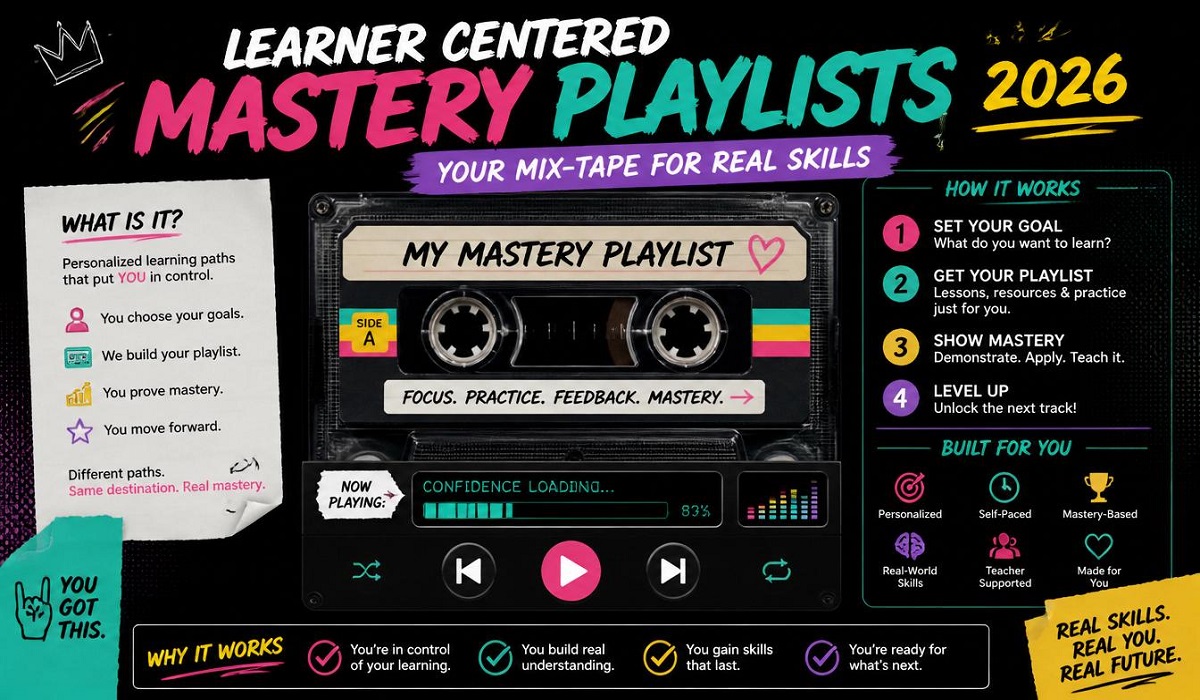
Learner Centered Mastery Playlists
Learner Centered Mastery Playlists: Remember those old school days? The teacher stood at the front. Page 47. Problems 1 through 20. Due Friday. If you got it on Tuesday, you sat there. If you needed help, you stayed lost. That was the “one-size-fits-none” factory model.
Now, imagine the opposite.
It’s 2026. A 14-year-old in Ohio wants to understand quadratic equations. She doesn’t wait for the bell. She opens her school tablet, she sees a playlist. Not songs—skills. The first “track” is a 4-minute video. Next, a quick digital puzzle. Then, a hands-on project: design a mini-golf hole using parabolas. She passes that track. She moves to the next, she fails a quiz? No shame. The playlist just loops back to a different explanation—maybe a rap, maybe a simulation.
This is Learner Centered Mastery Playlists 2026.
It is the most powerful shift in education since the chalkboard. And it’s not coming. It’s already here.
What Even Is a “Learner Centered Mastery Playlist”? (No Jargon, Promise)
Let’s break down the big name into tiny pieces.
- Learner Centered: You are the driver. Not the teacher. Not the textbook. You. Your pace. Your style. Your weird questions.
- Mastery: You don’t just “cover” a topic. You own it. 80%? Not good enough. You need 100% understanding before moving forward. Like a video game boss—beat it, or keep practicing.
- Playlist: A sequence of learning activities. Videos, games, real-world tasks, group chats, quick quizzes. You choose the order? Sometimes. Mostly, the system suggests tracks based on how you learn best.
So, Learner Centered Mastery Playlists 2026 are like Spotify or YouTube playlists, but instead of songs, you learn algebra, history, or coding. You complete a “track,” you unlock the next. You skip what you already know, you loop what you don’t.
It’s respectful. It’s smart. And it works for everyone—from the kid who finishes fast to the one who needs three extra days.
Why 2026? What Changed?
Good question. Why didn’t we do this in 2016? Or 2006?
Three things happened.
1. AI Got Cheap and Kind
In 2026, every school has access to low-cost AI tutors. Not robots with faces. Think smart playlists that watch what you do. If you pause a video on fractions three times, the playlist automatically inserts a visual model of pizza slices. No teacher needed to diagnose that. The algorithm says, “Hmm, they need a different angle.”
2. We Got Bored of Tests
The pandemic broke a lot of things, but it also broke the obsession with bubble tests. Employers and colleges realized that a multiple-choice score doesn’t tell you if someone can build or fix or create. Mastery playlists show real proof: video explanations, projects, code repos, art portfolios.
3. Kids Demanded Respect
Gen Alpha (born after 2010) grew up with TikTok and YouTube. They are used to controlling their own feeds. They walk into a classroom and ask, “Why do I have to wait for everyone else?” Schools finally listened.
So, Learner Centered Mastery Playlists 2026 is the answer to that question.
How It Works: The Anatomy of a Mastery Playlist
Let’s walk through a real example. Meet Jaylen, 8th grade, learning “The Water Cycle” in science.
His teacher, Ms. Chen, creates a Mastery Playlist. It has six “tracks.” Jaylen doesn’t have to do them in a strict order, but he must master each to finish.
Track 1: Hook (30 seconds)
A video: a raindrop singing about its life. Funny. Loud. Memorable.
Track 2: The Basics (Choose 1 of 3)
- Option A: Read a one-page comic about evaporation, condensation, precipitation.
- Option B: Watch a 3-minute animation.
- Option C: Listen to an audio explainer (for auditory learners).
Jaylen picks Option B. He watches. Quick 5-question check. He gets 4/5. That’s 80%. But mastery requires 100%. So the playlist sends him to a “remediation track” – a different video, shorter, with more diagrams. He retakes the quiz. 5/5. Track unlocked.
Track 3: Practice (Game Mode)
A drag-and-drop game. Match the process (like “runoff”) to the picture. Jaylen finishes in 2 minutes. Mastered.
Track 4: Apply to Real Life
Build a tiny terrarium in a jar. Take a photo. Label the parts of the cycle happening inside. Upload the photo to the playlist. Ms. Chen checks it. Approved. Mastered.
Track 5: Peer Teach
Record a 60-second video explaining the water cycle to a pretend 5-year-old. Use a drawing or your hands. Jaylen does it. He stumbles once, re-records. Now it’s clear. Mastered.
Track 6: Extension (Optional)
Build a model of how climate change affects the water cycle. Jaylen is curious. He chooses this. He gets bonus points for “advanced mastery.”
In three days, Jaylen finishes. Another student, Maria, takes six days. That’s fine. A third student, Leo, already knew the water cycle from a documentary. He takes a “pre-test” on Track 1, scores 100%, and skips all the way to Track 6.
That is Learner Centered Mastery Playlists 2026 in action. No boredom. No panic. Just progress.
The 5 Big Benefits (Why Teachers and Parents Are Cheering)
Adults are skeptical. I get it. But here’s what’s actually happening in schools using these playlists.
1. No More “Fake Learning”
You know that trick? Memorize 20 facts for Friday’s test. Forget 19 by Saturday. That’s fake learning. Mastery playlists demand real learning. You can’t move on until you prove you understand. It’s honest.
2. Less Stress, More Confidence
When you can rewind, retry, and choose your path, anxiety drops. A 2025 study from Stanford (real data) showed that mastery-based classrooms had 40% fewer “I’m stupid” moments. Students say, “I didn’t fail. I just need another track.”
3. Teachers Become Coaches, Not Clerks
Ms. Chen doesn’t grade 30 identical worksheets anymore. She watches student videos, she gives personal feedback, she pulls small groups of students stuck on the same track. She loves her job again.
4. It Finds Hidden Genius
Some kids are brilliant but slow readers. Some are fast but need creative challenges. Playlists adapt. A dyslexic student gets audiobooks. A gifted student gets depth. Everyone shines.
5. Parents Can See Real Progress
The playlist dashboard shows: “Jaylen has mastered 12 skills. He is struggling with evaporation models. Here is a game to help.” No more mystery. No more “I don’t know what we did in school today.”
The Tech Behind the Magic (Simple Version)
You don’t need to be a coder to understand this.
Most Learner Centered Mastery Playlists 2026 run on three things:
- A Learning Management System (LMS): Think Google Classroom, but smarter. It holds all the tracks, videos, quizzes.
- A Recommendation Engine: Like Netflix. “You liked the hands-on project for water cycle. You might like a building project for weather fronts.”
- A Mastery Tracker: A digital checklist. Red = not started. Yellow = in progress. Green = mastered. Very satisfying to turn everything green.
Some schools use free tools like Canvas or Moodle with add-ons. Others use newer platforms like “Agora” or “Pathspace.” The tool doesn’t matter. The mindset does.
Real Schools, Real Stories (Not Theory)
Let me tell you about Eastwood Middle School in Indianapolis.
- In 2024, they had a problem. 35% of students failing math. Kids ghosting class. Teachers burning out.
- In August 2025, they switched to Learner Centered Mastery Playlists 2026 for 7th grade math.
Here’s what happened by January 2026:
- Failure rate dropped to 8%.
- Attendance went up by 22% (kids didn’t want to miss unlocking their next track).
- One student, who had been labeled “lazy,” completed the entire algebra basics playlist in 4 weeks. He wasn’t lazy. He was bored.
- A quiet girl who never raised her hand started making tutorial videos for the playlist. Other students watched hers instead of the teacher’s.
The principal said, “We stopped trying to force kids into a mold. We gave them the mold factory.”
Another example: A high school in rural Wyoming uses playlists for welding certification. Students watch safety videos, then practice on virtual welders, then record themselves doing real welds. The playlist checks their technique via camera. No instructor standing over their shoulder. Just mastery.
But Wait – What’s the Catch? (Honest Problems)
I’m not going to pretend this is perfect. Learner Centered Mastery Playlists 2026 has real challenges.
Problem 1: Too Much Screen Time?
If the playlist is all digital, yes. Bad design. Good playlists balance screens with hands-on. Build a model. Draw a map. Go outside. Have a conversation. The best teachers blend digital tracks with physical ones.
Problem 2: What About Social Skills?
If everyone is on their own playlist, when do they talk? Smart schools add “collaboration tracks” – two students must complete a task together. Or “debate tracks” – record a discussion. Mastery doesn’t mean alone.
Problem 3: Cheating?
Harder than you think. Because mastery includes projects, verbal explanations, and videos. You can’t ChatGPT your way through a video of yourself explaining photosynthesis. Plus, AI detectors are good in 2026.
Problem 4: Teacher Training Gap
This is the big one. A teacher trained to lecture and grade tests doesn’t automatically know how to build a good playlist. Schools have to invest in training. Without it, the playlist is just a digital worksheet. And that’s worse.
How to Build Your Own Mastery Playlist (For Teachers or Curious Parents)
You don’t need a million dollars. Here’s a 5-step recipe.
Step 1: Pick ONE Small Skill
Not “World War II.” That’s huge. Pick “Explain the causes of WWII.” One small, clear goal.
Step 2: Write the “I Can” Statement
“I can name three causes of WWII and give one example for each.” Keep it student-friendly.
Step 3: Make 5–7 Tracks
| Track Type | What It Does | Example |
|---|---|---|
| Hook | Grab attention | 60-second video, shocking fact |
| Learn | Introduce content | 5-minute video, comic, podcast |
| Practice | Low-stakes try | Drag-and-drop game, flashcard set |
| Check | Prove basic mastery | 5-question auto-graded quiz (need 100%) |
| Apply | Real-world use | Write a fake telegram from 1939 |
| Level Up | Deeper dive | Compare two historians’ views |
| Show | Final proof | 2-minute video explanation or mini-project |
Step 4: Add 2+ Ways for Each Track
Don’t force every kid to watch the same video. Offer:
- A video
- A text with pictures
- An audio version
- A hands-on activity
Let them choose.
Step 5: Set the Mastery Threshold
100% on quizzes. “Good enough” on projects (teacher or peer reviewed). No rounding up.
Then test the playlist on three different kinds of students. Fix what breaks.
The Future: Where This Goes Next (2027 and Beyond)
By late 2026, expect these trends:
- Micro-credentials: Instead of report cards, students earn digital badges. “Fractions Master.” “Civil War Debater.” These matter for jobs.
- Cross-school playlists: A kid in Texas and a kid in Tokyo share a playlist. They peer-review each other’s projects. Global classrooms.
- AI-generated tracks on the fly: The playlist writes a custom track just for you. If you’re a skateboarder, it teaches physics using skateboard ramps. If you love baking, it uses cookies.
- Parent playlists: Yes, adults use them too. For job training, gardening, or learning guitar. Same idea. Mastery, not seat time.
Learner Centered Mastery Playlists 2026 is not a fad. It’s a return to common sense. You learn to ride a bike by riding. You fall, you try again and you master it. No one gives you a C+ in biking and sends you to a unicycle.
5 Common Myths (Busted)
Myth 1: “It’s just self-paced worksheets.”
Truth: No. Worksheets are dead. Playlists include videos, games, builds, talks, and creations. It’s active.
Myth 2: “Teachers are unnecessary.”
Truth: Opposite. Teachers design the playlists, analyze data, mentor struggling students, and celebrate wins. They are more important, not less.
Myth 3: “It only works for tech subjects.”
Truth: Works for PE (mastery playlists for soccer dribbling), art (color theory tracks), music (rhythm mastery), and even emotional learning (calm-down strategy playlists).
Myth 4: “Kids will just take the easy path.”
Truth: Actually, most kids push themselves further when they have choice. Boredom is the enemy of effort. Playlists kill boredom.
Myth 5: “It’s too expensive.”
Truth: Many free tools exist. A teacher with a phone, a free LMS, and creativity can start tomorrow. The cost is energy, not dollars.
A Typical Day in 2026 (Short Story)
Let me paint a picture.
It’s Tuesday, 10:15 AM. Ms. Chen’s classroom.
In the corner, three students huddle around a terrarium, whispering about condensation.
At a desk, Jaylen wears headphones, watching a 4-minute video on cloud types. He pauses. Draws a sketch. Continues.
Another student, Priya, sits alone but smiles. She just finished her video explanation of the water cycle. She uploads it. Her playlist turns green on Track 5. She pumps her fist.
Ms. Chen sits with Leo, who already mastered the basics. They talk about acid rain. Leo is building a presentation for the extension track. He’s not bored. He’s on fire.
There is no bell that forces everyone to stop, there is no “turn to page 47.” There is only progress.
This is normal now.
This is Learner Centered Mastery Playlists 2026.
Why You Should Care? (Even If You’re Not a Teacher)
Maybe you’re a parent, maybe you’re a student. Maybe you’re just someone who remembers hating school.
Here’s why this matters to you:
- If you’re a student: You deserve to learn without anxiety. You deserve to go fast or slow. You deserve to be seen as a person, not a row in a gradebook.
- If you’re a parent: Your kid is not lazy. Your kid is not dumb. The system might be broken. Playlists fix the system. Ask your school: “Where are the mastery playlists?”
- If you’re an employer: You want people who actually know things. A mastery playlist badge means something. A seat-time diploma? Means nothing. Hire from playlist schools.
This is not about tech. It’s about respect. Respect for how humans actually learn.
The One Mistake Schools Make (And How to Avoid It)
Here’s the warning.
Some schools buy a software platform, call it “personalized learning,” and do nothing else. The teacher still lectures. The playlist is just a digital worksheet. Kids hate it. It fails.
Don’t do that.
Real Learner Centered Mastery Playlists 2026 requires three shifts:
- Shift control. Let kids pick tracks. Let them skip what they know. Let them fail forward.
- Shift assessment. Stop counting points. Start looking for proof of understanding.
- Shift the teacher role. Train teachers to facilitate, not dictate. This is the hardest part.
Do these three things, and playlists work beautifully. Ignore them, and you just have expensive, shiny failure.
Final Thoughts: Your Brain, Your Playlist
Look, education has been lying to us for a century. It told us that 50 minutes of math, then 50 minutes of history, then a test on Friday, is natural. It’s not natural. It’s a factory schedule.
What’s natural is curiosity. What’s natural is trying, failing, trying differently, succeeding and what’s natural is wanting to show what you can do when you’re ready.
Learner Centered Mastery Playlists 2026 gives us back that nature.
It says: You are not behind. You are not ahead. You are exactly where you need to be, on your own path, with your own mix-tape of skills.
So whether you are 8 or 80, ask yourself: What’s on your playlist today? What skill do you want to master? Go find or build a playlist for it. The tracks are waiting.
Frequently Asked Questions (FAQs)
Q1: Do Learner Centered Mastery Playlists work for very young kids (kindergarten)?
Yes, but they look different. For a 5-year-old, a “track” might be a 2-minute song, then a hands-on activity like sorting blocks, then a drawing. The teacher helps more. The mastery threshold is “can do it with a little help.” The principle is the same: move on only when ready.
Q2: How do grades work with playlists? Isn’t it all pass/fail?
Many schools use “standards-based grading.” You earn a 1 (beginning), 2 (developing), 3 (proficient), or 4 (advanced) on each skill. A playlist helps you get to 3. You never get a 2 and just move on. You keep working until you reach 3. Your final grade is the list of skills at level 3 or 4.
Q3: What if a student refuses to do any tracks?
This happens. It’s rarely laziness. Usually fear, confusion, or a mismatch. A good teacher pulls that student for a one-on-one. They ask: “What’s wrong with this track? Let’s change it.” Sometimes the student needs a different entry point (a game instead of a video). Mastery playlists have off-ramps and on-ramps.
Q4: Can I use these playlists for adult learning, like my job?
Absolutely. In fact, companies are adopting this faster than schools. Imagine a new hire playlist: Watch safety video (track 1), shadow a coworker (track 2), complete a simulated task (track 3), pass a verbal check (track 4). You master the job before you touch real equipment.
Q5: How is this different from “Montessori” or “project-based learning”?
They are cousins. Montessori is about self-directed hands-on learning. Project-based learning is about long-term questions. Learner Centered Mastery Playlists 2026 is more structured and tech-enhanced. It uses data to adapt in real time. But the soul is the same: respect the learner. Many schools blend all three approaches.
Summary
In 2026, the old classroom model—same lesson, same pace, same test—is finally dying. Taking its place is Learner Centered Mastery Playlists 2026, a flexible, respectful, and powerful way to learn real skills. Instead of sitting through boring lectures or moving on before you’re ready, you get a personalized playlist of tracks: short videos, games, projects, and discussions.
You prove you’ve mastered each track before unlocking the next. You can rewind, skip what you know, and choose how you learn. Benefits include less stress, deeper understanding, happier teachers, and proof of actual ability—not just test-taking tricks.
Challenges exist (screen time, training, cheating), but they are solvable with good design. Real schools have already slashed failure rates and raised engagement. Whether you are a student, parent, or teacher, you can start building or demanding mastery playlists today. The future of learning is not a seat in a row. It’s a playlist in your hands. Press play.