
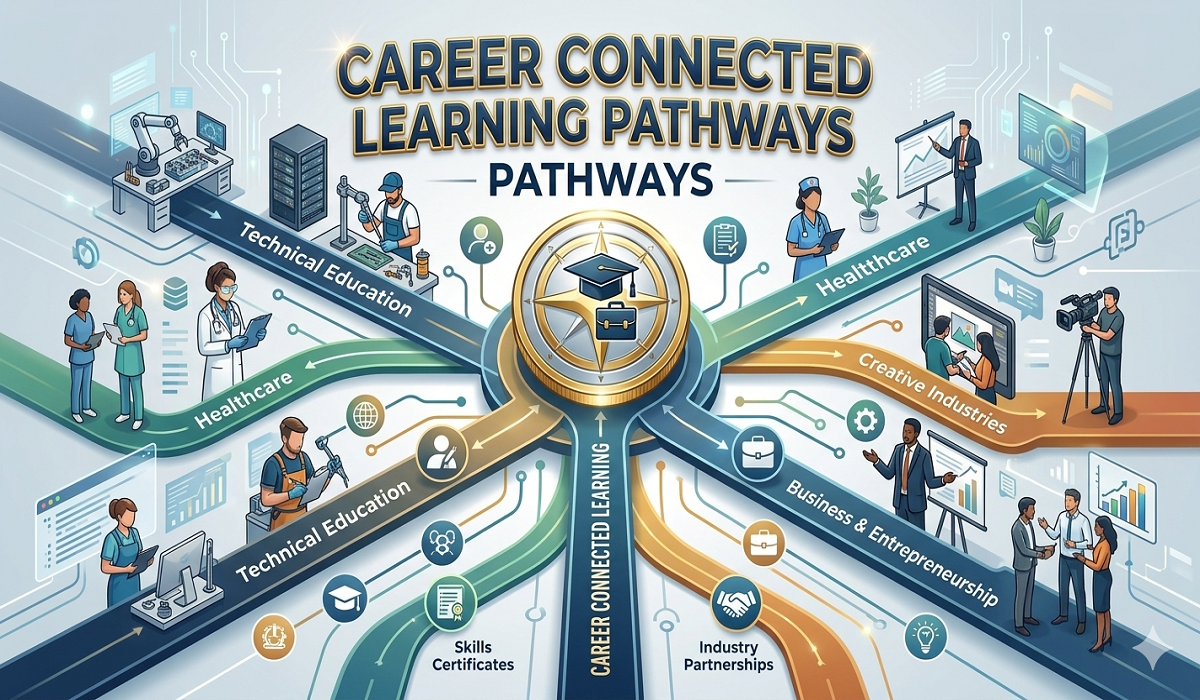
Career Connected Learning Pathways
Career Connected Learning Pathways: Imagine waking up on a Monday morning. Are you excited to go to school? Or do you feel like pulling the covers over your head?
For most of history, school meant sitting in a chair, listening to a teacher talk, memorizing facts for a test, and then forgetting half of it by Friday. Then, after twelve or sixteen long years, you graduated. And guess what? You had no idea how to actually do a real job.
That world is ending.
Welcome to Career connected learning pathways 2026. This isn’t a fancy phrase from a politician. It’s a real movement happening in classrooms, community colleges, and online platforms right now. By 2026, this way of learning will be the new normal.
So, grab a snack, get comfortable, and let me explain why your future just got a whole lot more interesting.
What Does “Career Connected Learning” Even Mean?
Let’s break it down like a Lego set.
- Career = A job you do because you love it and it pays the bills.
- Connected = Tied together. Linked. Not separate things.
- Learning = Gaining skills, knowledge, and wisdom.
- Pathways = A road map. Step one, step two, step three.
So, Career connected learning pathways 2026 means: A clear, step-by-step road map that starts in school and leads directly to a real job you actually want.
Think of it like learning to cook. Old school: You read a 500-page book about knives, ovens, and recipes. You take a test on page 450. You get an A. Then you go into a kitchen and burn water.
New school (career connected): On day one, you walk into a real kitchen. A chef shows you how to chop an onion. You practice, you chop a hundred onions. You mess up, you try again. By week three, you’re cooking for real customers. You learn while you do. That is career connected learning.
In 2026, this idea will be everywhere—from high schools to online bootcamps to community colleges.
Why 2026? Why Not Now?
Great question. You might be thinking, “This sounds nice, but why are you putting a date on it?”
Here’s the truth: elements of career connected learning exist today. Some schools have internship programs. Some trade schools teach hands-on skills. But by 2026, three big things will push this idea into overdrive.
1. Employers Are Begging for Change
Have you ever heard a business owner say, “Kids graduate and don’t know how to work”? I’ve heard it a hundred times.
Employers are tired of teaching new hires basic stuff like showing up on time, sending a professional email, or using common software. In 2026, companies won’t wait for colleges to fix this. They will partner directly with high schools and training programs to shape the curriculum.
2. College Debt Is a Monster
Right now, students in the U.S. owe over 1.7trillioninstudentloans.That’strillionwitha“T.”Familiesarewakingup.Theyareasking,“Whyborrow100,000 for a four-year degree when my kid could learn a skill in six months and start earning?”
Career connected learning pathways 2026 offers a middle path. You don’t skip education. You just make it useful from day one.
3. Technology Made It Possible
Online learning exploded during the pandemic. Zoom, Slack, Google Classroom, virtual reality training—all of these tools matured. By 2026, a student in a small town can take a robotics class from a teacher in Tokyo, complete a virtual internship with a company in London, and earn a certificate recognized worldwide. The walls of the classroom have crumbled.
The Old Way vs. The 2026 Way: A Side-by-Side Look
Let me paint two pictures.
The Old Way (before 2026):
- 9th grade: General math, English, history, science.
- 10th grade: Same thing, slightly harder.
- 11th grade: Maybe one elective like woodshop or art.
- 12th grade: College prep essays, SATs, panic.
- After graduation: “What do I want to do with my life?” No idea. Work at a restaurant or go to college because you don’t know what else to do.
The New Way (Career connected learning pathways 2026):
- 9th grade: Core subjects but with a twist. Math includes budgeting for a small business. English includes writing press releases. Science includes environmental fieldwork.
- 10th grade: Students choose a “pathway cluster”—healthcare, technology, skilled trades, creative arts, business, or green energy.
- 11th grade: Two days a week at a local workplace. Shadowing a nurse, coding at a software company, or helping a plumber.
- 12th grade: Earn industry certificates (like CompTIA for IT or CPR for healthcare). Graduate with a portfolio of real work and a job offer waiting.
- After graduation: Start earning 45,000–70,000 per year. No debt. Or go to college with a clear major and three years of real experience.
Which path sounds better to you?
The Core Pieces of a Career Connected Pathway
Every good pathway has building blocks. You wouldn’t build a house without a foundation, walls, and a roof. Same here.
Piece 1: Exploration (9th–10th Grade)
You can’t choose a career you’ve never seen. In early high school, students take short “taste tests” of different fields.
Example: A six-week module on coding. A six-week module on carpentry. A six-week module on nursing. You don’t become an expert. You just learn what you like and don’t like.
This saves years of confusion.
Piece 2: Deep Dive (10th–11th Grade)
Once you pick a pathway—say, “Renewable Energy Technician”—you go deep. You take specialized classes, you meet mentors who work in solar or wind power. You visit job sites.
By the end of this stage, you know the difference between a photovoltaic cell and a thermal collector. You can talk like a pro.
Piece 3: Real-World Application (11th–12th Grade)
This is the magic. You leave the school building and go to work. Not a fake “career day.” Real work.
- You build a website for a local bakery.
- You assist a dental hygienist for three hours every Tuesday.
- You help maintain the school’s greenhouse and sell plants to the community.
You get feedback from a real boss. You learn soft skills—showing up, listening, solving problems, you make mistakes in a safe environment.
Piece 4: Credentialing (12th Grade)
A credential is proof that you know your stuff. It could be a certificate from Google, a license from the state, or a badge from a professional group.
By graduation, you don’t just have a diploma. You have actual proof that an employer wants to see.
Piece 5: Launch (Post-Graduation)
The final piece. You either:
- Start working full-time in your field.
- Enroll in a two-year community college program (and skip the intro classes because you already know that stuff).
- Go to a four-year college with a clear major and a scholarship (because real-world experience looks amazing on applications).
There is no “lost” year. No “finding yourself” at a dead-end job. You have a map.
Real Examples: What This Looks Like in 2026
Let me give you three stories. These are based on real programs that are growing right now.
Example 1: The High School That Runs a Vet Clinic
In a medium-sized town in the Midwest, a high school has a working veterinary clinic inside the building. Real pet owners bring their dogs and cats. Students in the “Animal Sciences Pathway” do everything from answering phones to assisting with vaccinations under a licensed vet’s supervision.
By graduation, these students have 800 hours of hands-on experience. Some go straight to work as vet techs. Others apply to veterinary college with a huge advantage.
Example 2: The Coding Pathway That Pays Students
A school district in California partnered with a software company. Every Tuesday and Thursday, juniors and seniors in the “Software Development Pathway” log into the company’s real project management system. They fix minor bugs, write documentation, and test new features.
The company pays them $18 an hour. The students earn money, learn skills, and often get a full-time job offer before graduation day.
Example 3: The Green Energy Roadmap
In Texas, a community college and a solar panel installation company created a six-month career pathway. Students meet twice a week for classroom safety and theory. Three days a week, they ride along with installation crews.
After six months, students take a certification exam. The company hires 90% of them starting at $55,000 per year. No student debt. A clear path to becoming a crew leader within three years.
These are not dreams. These are happening right now. And by 2026, they will be everywhere.
But What About Math, English, and Science? Won’t Kids Miss Out?
I hear this worry from parents all the time. They say, “I don’t want my child to just learn a trade. I want them to be educated.”
Fair point. Here’s the secret: Career connected learning pathways 2026 does NOT throw away academic subjects. It teaches them through the career lens.
- Math: Instead of abstract algebra problems about trains leaving stations, students calculate material costs for a construction project or analyze data from a school garden’s harvest. Same math skills. Real context.
- English: Instead of writing an essay about a book they didn’t read, students write a business proposal, a professional email chain, or a safety manual. They learn grammar, persuasion, and clarity—skills every job requires.
- Science: Instead of memorizing the periodic table in isolation, students test water quality for a local stream or learn the biology of animal wounds in a vet clinic.
Students actually remember more this way. Research proves it. When you know why you’re learning something, you pay attention.
Who Benefits Most? (Spoiler: Everyone)
You might think career pathways are only for kids who don’t like school. Or only for future electricians and plumbers. Not true.
Benefit #1: The “Bored Genius”
Some kids are smart but hate sitting still. They get labeled as troublemakers or underachievers. But put them in a real workshop or a coding lab? They come alive. Career pathways save these students from dropping out.
Benefit #2: The Anxious Overachiever
There are kids who get straight A’s but are terrified of the real world. They’ve never made a decision without a teacher’s approval. Real-world experience teaches them to fail, adapt, and grow. It builds confidence.
Benefit #3: The First-Generation Student
If your parents didn’t go to college, you have no map. You don’t know about internships, networking, or industry certificates. Career pathways provide a clear, step-by-step guide. It levels the playing field.
Benefit #4: Employers
Companies spend billions each year training new hires. If students graduate with basic job skills, companies save money. They also get workers who stay longer because they chose a field they actually like.
Benefit #5: The Economy
When young people earn good wages right away, they spend money. They buy cars, rent apartments, start small businesses. A nation with career connected pathways is a richer, more stable nation.
Challenges and Real Talk (It’s Not All Perfect)
I want to be honest. This isn’t a fairy tale. Rolling out Career connected learning pathways 2026 has real obstacles.
Challenge 1: Not Enough Employers Participating
In some towns, there simply aren’t enough businesses to host hundreds of students. A small rural area might have one hardware store and a diner. What then?
Solution: Virtual pathways. Students can do remote internships with companies across the country. Also, schools can create simulated workplaces—school-based enterprises like a credit union or a print shop.
Challenge 2: Teacher Training
Most teachers became teachers because they love their subject, not because they know how to run a workplace simulation. Schools need to train teachers differently. They also need to hire “pathway coaches”—people from industry who come into the classroom.
Challenge 3: Equity
Wealthy school districts already have amazing career programs. Poor districts often have nothing. This is unfair. Governments and nonprofits need to fund pathways in every community, not just the rich ones.
Challenge 4: Parent Skepticism
Some parents still believe a four-year degree is the only respectable path. They see career pathways as “dumbing down” education. It takes time and success stories to change minds.
Despite these challenges, the momentum is unstoppable. Too many young people are drowning in debt or stuck in jobs they hate. Something has to change.
How to Build Your Own Career Pathway? (Starting Tomorrow)
You don’t have to wait for 2026. Whether you’re a student, a parent, or a teacher, here are five concrete steps.
Step 1: Identify Your Interests
Ask yourself three questions:
- What do I do when I lose track of time?
- What problems do I enjoy solving?
- Who do I admire, and what do they do for work?
Write down five possible careers. Don’t judge yourself. Just write.
Step 2: Find the Local Pathway
Search online for “career pathway [your city]” or “work-based learning [your state].” Call your school counselor. Ask: “What programs exist where I can learn and work at the same time?”
If nothing exists, ask your school to partner with a local business. One conversation can start a movement.
Step 3: Earn a Low-Cost Certificate
While you’re still in high school or after graduation, look for certificates that cost under $500. Google has career certificates in IT, data analytics, and project management. Community colleges offer CNA (nursing assistant) or welding certificates. These open doors immediately.
Step 4: Find a Mentor
A mentor is someone who is five to ten years ahead of you in your chosen field. They don’t have to be famous. They just have to answer your questions once a month. Ask them: “What should I learn? Who should I meet? What mistakes should I avoid?”
You can find mentors on LinkedIn or through local professional groups.
Step 5: Build a Portfolio
A portfolio is a collection of your real work. Not test scores. Real stuff.
- A video of you fixing a computer.
- Photos of a bookshelf you built.
- A link to a website you designed.
- A log of hours you volunteered at a dental office.
When you apply for a job, show them the portfolio. It’s worth more than any GPA.
What the Research Says? (Short and Simple)
I know you don’t want a bunch of boring studies. But here are three facts worth remembering:
- Students who participate in career connected learning are 25% more likely to graduate high school on time.
- Within five years of graduation, students who followed a career pathway earn $12,000 more per year on average than those who only took general academic classes.
- 89% of employers say they would hire a candidate with a certificate and a portfolio over a candidate with a four-year degree but no real experience.
The numbers don’t lie. This works.
A Typical Week for a Student in 2026
Let me walk you through a real schedule. Meet Jordan, 17 years old, junior in high school.
Monday:
8:00 AM – English class. Writing a safety manual for a construction site.
10:00 AM – Math. Calculating load weights for a crane lift.
12:00 PM – Lunch.
1:00 PM – Pathway class: Intro to Construction Management.
3:00 PM – School ends. Jordan meets with his mentor (a project manager) on Zoom for 30 minutes.
Tuesday:
8:00 AM – History class. Studying labor laws and the history of worker safety.
10:00 AM – Science. Physics of leverage and pulleys.
12:00 PM – Lunch.
1:00 PM – Jordan drives to a real construction site. He shadows a site supervisor, takes notes, helps move materials.
5:00 PM – Done for the day.
Wednesday:
Same as Monday, plus an afternoon study group.
Thursday:
Same as Tuesday. Jordan gets paid $15 an hour for his site work.
Friday:
8:00 AM – Guest speaker from the local union.
10:00 AM – Pathway class. Practice interviewing and resume writing.
12:00 PM – Lunch.
1:00 PM – Work on portfolio. Add photos from Tuesday’s site visit.
2:00 PM – Done. Weekend starts.
Jordan graduates in one year with 600 hours of site experience, two safety certificates, and a job offer from the construction company. He will start at $52,000. No college debt. He might go to community college part-time later for a project management degree. Or he might not. Either way, he has choices.
Frequently Asked Questions (FAQs)
1. Is career connected learning only for students who aren’t “college material”?
No. That’s an old myth. Career pathways help everyone—from future doctors to future electricians. Even if you plan to get a PhD, real-world experience makes you a better researcher and a more employable graduate. Many medical schools now prefer applicants who worked as EMTs or medical assistants first.
2. What if I choose a pathway and then change my mind?
Changing your mind is normal and even encouraged. The first year of exploration is designed for you to try different things. If you switch pathways in 11th grade, you might need an extra semester or summer catch-up. But that’s still faster and cheaper than switching your college major after two years and $40,000 in debt.
3. Do I still need a college degree?
It depends on your goal. Some careers—like doctor, lawyer, or research scientist—require a degree. Others—like web developer, plumber, or graphic designer—value skills over degrees. With a career pathway, you can get a good job right away, then decide later if you want college. Many employers will even pay for your degree while you work.
4. How do I convince my parents this is a good idea?
Show them this article. Then ask them to call a local employer that participates in career pathways. Let them hear from a business owner that real experience matters. Also, show them the salary data. When parents see that a certified welder earns $70,000 with no debt, many change their minds.
5. What if my school doesn’t have any career pathways yet?
Be the squeaky wheel. Talk to your principal. Start a petition. Find a local business that wants to partner and bring them to the school. If nothing changes, look for online pathways. Platforms like Coursera, Udemy, and even YouTube have free or low-cost courses. Build your own pathway. You don’t need permission to learn.
Summary: Your Future Is a Pathway, Not a Wall
For too long, school has felt like a wall. You push against it, memorize what’s on the other side, and hope you land somewhere soft.
Career connected learning pathways 2026 tears down that wall. It replaces it with a series of doors. Each door leads to real skills, real mentors, real work, and real paychecks.
You don’t have to wait until you’re 22 to start your life. You don’t have to borrow money for a degree that might not help you, you don’t have to guess what you want to do.
Here is the truth: The world is changing faster than ever. Jobs that existed ten years ago are gone. Jobs that will exist ten years from now haven’t been invented yet. The only way to stay ahead is to learn by doing. To get your hands dirty. To build, create, fix, and serve—starting now.
So whether you’re 14 or 40, ask yourself: What pathway will I choose? Where will I put my time and energy? Who will I learn from?
The pathway is waiting. Take the first step today.