
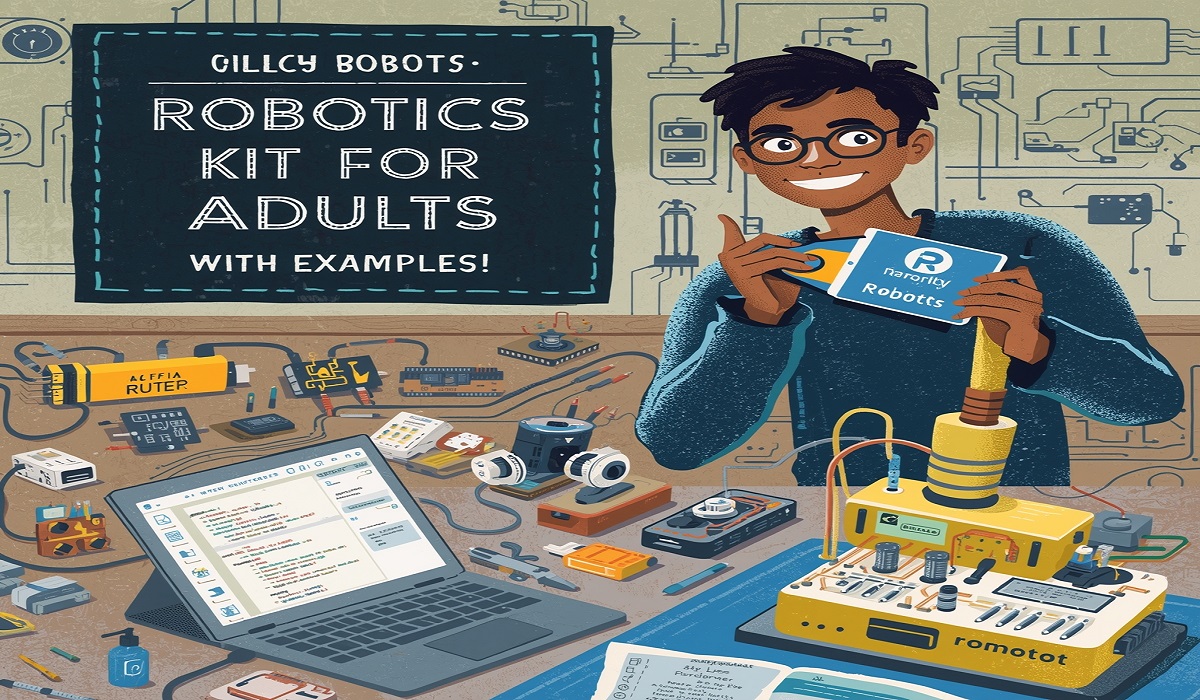
Robotics for Beginners Adults
Robotics for Beginners Adults: The world around us fills with machines that move, sense, and act. From the automatic doors at a supermarket to the assembly lines building cars, simple robotics principles are already part of our daily lives. Perhaps you have watched a robotic vacuum clean a room or seen a video of a factory robot arm and felt a spark of curiosity. That curiosity is your starting point.
This guide exists for Robotics for Beginners Adults who are ready to move from interest to action. We will bypass complex jargon and focus on clear, tangible ideas. This is a practical look at robotics for beginners adults with examples you can see and understand today, using approaches and kits designed for adult learners. Our goal is to provide a straightforward path into building and programming your first machines.
Understanding Robotics: Core Parts and Their Functions
A robot, in its simplest form, is a machine that can follow instructions to perform a task. It typically involves three key parts working together. First, there are sensors, which act like the robot’s ears, eyes, and fingers. These components gather information from the world. A sensor could be a simple button that detects touch or a distance sensor that measures how far an object is.
The second part is the controller, or the robot’s brain. This is usually a small computer, like an Arduino or Raspberry Pi board. The brain receives information from the sensors and makes decisions based on the code, or instructions, you provide it. It follows your programmed logic to determine what action comes next.
Finally, the third part is the actuator, which allows the robot to cause a change in its environment. This is the “muscle” of the operation. Common actuators include electric motors that spin wheels or move arms, lights that turn on, and speakers that make sounds.
For robotics for beginners adults, a basic example is a line-following car. Its sensors detect a dark line on a light surface, its brain processes this data, and its actuators—the motors—steer to follow the path.
Selecting Your First Robotics Kit: A Focus on Adult Learners
Choosing the right starting point is important for success. A good kit for robotics for beginners adults provides all necessary physical parts and prioritizes clear, project-based learning. Many adult beginners find success with Arduino-based starter kits. These kits often include the brain (board), a collection of sensors and motors, wires, and instructions for several projects.
Another excellent option is a Raspberry Pi kit, which uses a more powerful small computer capable of running an entire operating system. This might suit you if your interest leans toward robots that can process video or connect easily to the internet. When selecting, look for kits labeled “starter”
or “beginner” that specifically mention hands-on projects. The key is to find a kit that matches your interest—whether that’s a rolling vehicle, a robotic arm, or a smart home device—and has a supportive user community online where other adults share their projects and solutions.
Core Programming Concepts for Robot Control
Programming tells your robot how to behave. You do not need to be an expert coder to start. Most platforms for robotics for beginners adults use simplified languages or visual block-coding tools. The fundamental ideas are accessible. One core concept is the “loop.” A loop is a set of instructions the brain repeats over and over, like constantly checking a sensor.
Another vital idea is the “conditional statement,” often called an “if-then” rule. This is how your robot makes choices. You might program: “IF the distance sensor detects an object closer than 10 centimeters, THEN stop the motors.” This simple logic allows robots to react to their surroundings.
Variables are another concept; they are like labeled containers that hold information, such as the current speed of a motor. As you work through robotics for beginners adults with examples, you will see these concepts in action, turning abstract code into physical movement you can observe and adjust.
Building a Simple Obstacle-Avoidance Robot: A Step-by-Step Example
Let’s apply these ideas to a common first project: a small wheeled robot that avoids obstacles. This project perfectly illustrates robotics for beginners adults with examples of sensors, code, and actuators working together. You will need a chassis with wheels and motors, a brain like an Arduino, a ultrasonic distance sensor, and a motor driver board.
First, you build the physical robot, mounting the sensor on the front and connecting the motors and brain. Next, you write the program. The core logic uses a loop and conditionals. The loop constantly asks the distance sensor for a measurement. Your conditional rules govern the response: “IF the measured distance is greater than 20 cm, THEN drive forward.”
“IF the distance is 20 cm or less (an obstacle is near), THEN turn the motors to rotate the robot to the right for half a second.” After the turn, the loop starts again, checking for a clear path. This creates a robot that navigates a room independently, providing a deeply satisfying and educational experience.
From Kit to Custom Creation: Planning Your Own Project
After completing a few kit projects, you may want to design something unique. This shift is a natural step in learning robotics for beginners adults. Start by clearly defining a simple task. Maybe you want a device that waters a plant when the soil gets dry, or a small rover that can carry a light object from one room to another.
With a task in mind, break it down into the three core parts. What sensor will you need? A soil moisture sensor for the plant, or perhaps a button to tell the rover to start? Which brain can handle these inputs? What actuator will perform the job? A small water pump or a servo motor to release the object? Sketch your design and research each component.
Online communities are invaluable here, filled with other hobbyists who have tackled similar challenges. This process of designing, sourcing parts, and solving problems is where theoretical knowledge becomes practical skill.
Integrating Sensors for More Complex Behaviors
Sensors allow your robot to interact intelligently with the world. Moving beyond a single distance sensor opens many possibilities for robotics for beginners adults with examples of increased complexity. A light sensor can let a robot follow a flashlight beam or stop at a line. A sound sensor could be programmed to start a task when you clap your hands.
Combining multiple sensors creates even smarter machines. Consider a package-delivery robot project for a tabletop. It could use a line sensor to follow a track on the floor to a delivery zone, an ultrasonic sensor to stop at the correct distance from a wall, and a color sensor to identify the correct package to drop off.
Each sensor adds a layer of information for the brain to process, resulting in behavior that appears thoughtful and deliberate. Learning to manage data from multiple sources is a key skill in advancing your robotics understanding.
Troubleshooting Common Issues in Beginner Robotics
Every new builder encounters challenges. Knowing how to solve them is part of the journey. A very common issue is electrical connections. A loose wire or a component plugged into the wrong pin on the brain can stop a project entirely. Always double-check your connections against your wiring diagram.
Software problems, or bugs in your code, are equally common. When a robot does not act as expected, use a methodical approach. Isolate the problem. Test the motors alone with a simple program. Read the sensor values and display them on a screen to see if they make sense. This process of testing each part separately often reveals the issue.
For robotics for beginners adults, patience and systematic checking are your most important tools. Remember, searching online with a specific description of your problem will often lead you to forum posts where others have found the solution.
Resources and Communities for Continuing Your Robotics Journey
Your learning does not end with your first project. A wealth of resources exists to support adults in robotics. Websites like the official Arduino Project Hub or the Raspberry Pi Foundation’s projects site offer thousands of free, community-shared guides for all skill levels. These are excellent places to find new robotics for beginners adults with examples to build.
Joining online communities, such as specific subreddits or Discord servers dedicated to robotics, is highly recommended. You can ask questions, share your successes, and see what others are building. Local makerspaces.
Or community college workshops sometimes offer in-person classes, which provide access to more advanced tools and direct mentorship. Engaging with these groups transforms a solitary hobby into a shared passion, accelerating your learning and keeping your motivation high.
Frequently Asked Questions
1. What is the best programming language for a beginner in robotics?
For absolute beginners, starting with visual block-based programming like the language used in Arduino’s beginner mode or Scratch for Raspberry Pi is very effective. It teaches logic without syntax errors. You can then smoothly transition to text-based languages like Python or C++, which are widely used in robotics for beginners adults kits and have vast support communities.
2. How much math do I need to know to start learning robotics?
You can begin with very little formal math. Basic arithmetic is sufficient for many initial projects, like setting speed values or distance thresholds. As you advance, concepts from algebra (for variables) and geometry (for understanding movement and angles) become helpful, but you can learn them as needed through practical application.
3. Is soldering required for beginner robotics kits?
Many modern starter kits are designed to be “breadboard friendly” or use screw terminals and connectors that require no soldering. This allows robotics for beginners adults to start building immediately. Soldering is a useful skill for more permanent or custom projects, but it is not a requirement to take your first steps.
4. Can I learn robotics without an engineering background?
Yes, absolutely. The field of hobbyist robotics is built for enthusiasts from all backgrounds. Kits and online tutorials are designed to teach the necessary electronics, programming, and mechanical concepts from the ground up. Curiosity and a willingness to learn are the only prerequisites.
5. What is a realistic budget for starting a robotics hobby?
A comprehensive starter kit with a brain, sensors, motors, and instructions typically costs between $70 and $150. This investment provides all you need for several substantial projects. After that, you can expand by purchasing individual sensors or components for specific ideas, often for just a few dollars each.
Conclusion
Beginning robotics as an adult is an accessible and rewarding pursuit. It combines logical thinking with hands-on creation, resulting in machines you can see and touch. By starting with core concepts, selecting an appropriate kit, and progressing through projects, you build both knowledge and confidence.
The examples provided, from obstacle-avoidance to multi-sensor integration, show a clear path from simple to more involved creations. Remember, every expert builder started with a single circuit and a line of code. Use the available resources and communities, embrace the problem-solving process, and allow your curiosity to guide you. The world of robotics for beginners adults is ready for you to explore and contribute to, one project at a time.